Bottle Warmer vs. Microwave: What We Use and Why
This post contains affiliate links. If you buy through them, we may earn a small commission at no extra cost to you.Learn more.
The short version of bottle warmer vs microwave: use a warmer, or a warm-water bath, and don’t microwave the milk. That isn’t our opinion so much as the CDC’s, and it’s the rare baby-gear question where the official guidance is blunt and unambiguous. Below is what the CDC actually says, the honest middle ground most people miss, and what we reach for at home.
We should be plain about our lane here. Anything to do with feeding safety, temperatures or milk storage is a question for the CDC and your pediatrician, not a review site. So on the safety part we quote them and link them, and we stick to the thing we can actually speak to: which method is less annoying at 3 a.m.
What the CDC actually says
The CDC’s guidance on warming a bottle is direct:
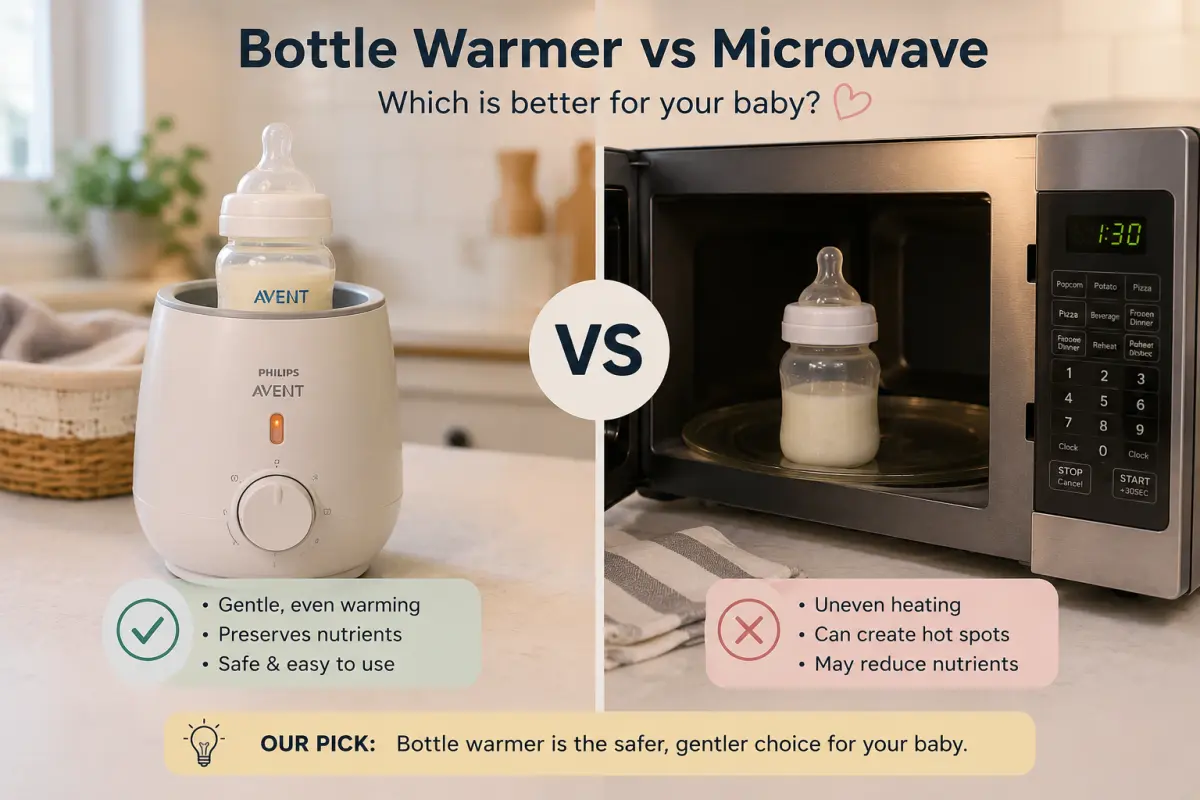
“If you do decide to warm the bottle, never use a microwave. Microwaves heat milk and food unevenly, resulting in ‘hot spots’ that can burn your baby’s mouth and throat.”
You can read that in full on the CDC’s breastfeeding FAQ. The CDC lists two methods it considers fine instead: a bottle warmer, or a warm-water bath, which is just standing the sealed bottle in warm water. That’s the whole safety picture, from the people whose job it is to have one. We’re not going to add to it or water it down.
So why do people still reach for the microwave
Because it’s right there, it’s free, and it’s fast. When you’re holding a hungry baby at 2 a.m., the microwave is the appliance you can operate without thinking, and heating a bottle in it takes thirty seconds instead of a few minutes. We understand the pull completely. It’s the same reason people ask whether they really need a warmer at all, which we get into in our bottle warmer guide.
The problem is that the microwave’s one advantage, raw speed, comes with the exact trade the CDC describes: uneven heating. And that turns into a practical hassle on top of the safety issue, which is the part we can talk about honestly.
The gear problem, not just the safety one
Set the safety question aside for a second, since the CDC has already settled it, and the microwave still loses on pure convenience.
A hot spot means the milk reads lukewarm on the outside of the bottle while a pocket inside is much hotter. So even if you were only thinking about comfort, you’d have to swirl the bottle and test a few drops every single time, and you’d still be guessing. A warmer, or a mug of warm water, heats the whole bottle gradually and evenly, so once you know your routine you get the same result every time without the guesswork.
There are two smaller gear points worth knowing. A microwave can heat unevenly enough that it’s simply inconsistent from one bottle to the next, so you never build a reliable habit. And warming milk in a microwave is often discouraged for breast milk specifically, on the grounds that it can affect the milk itself, which is another reason we send you to the CDC rather than improvise a position on it.
The honest middle ground: microwave the water, not the milk
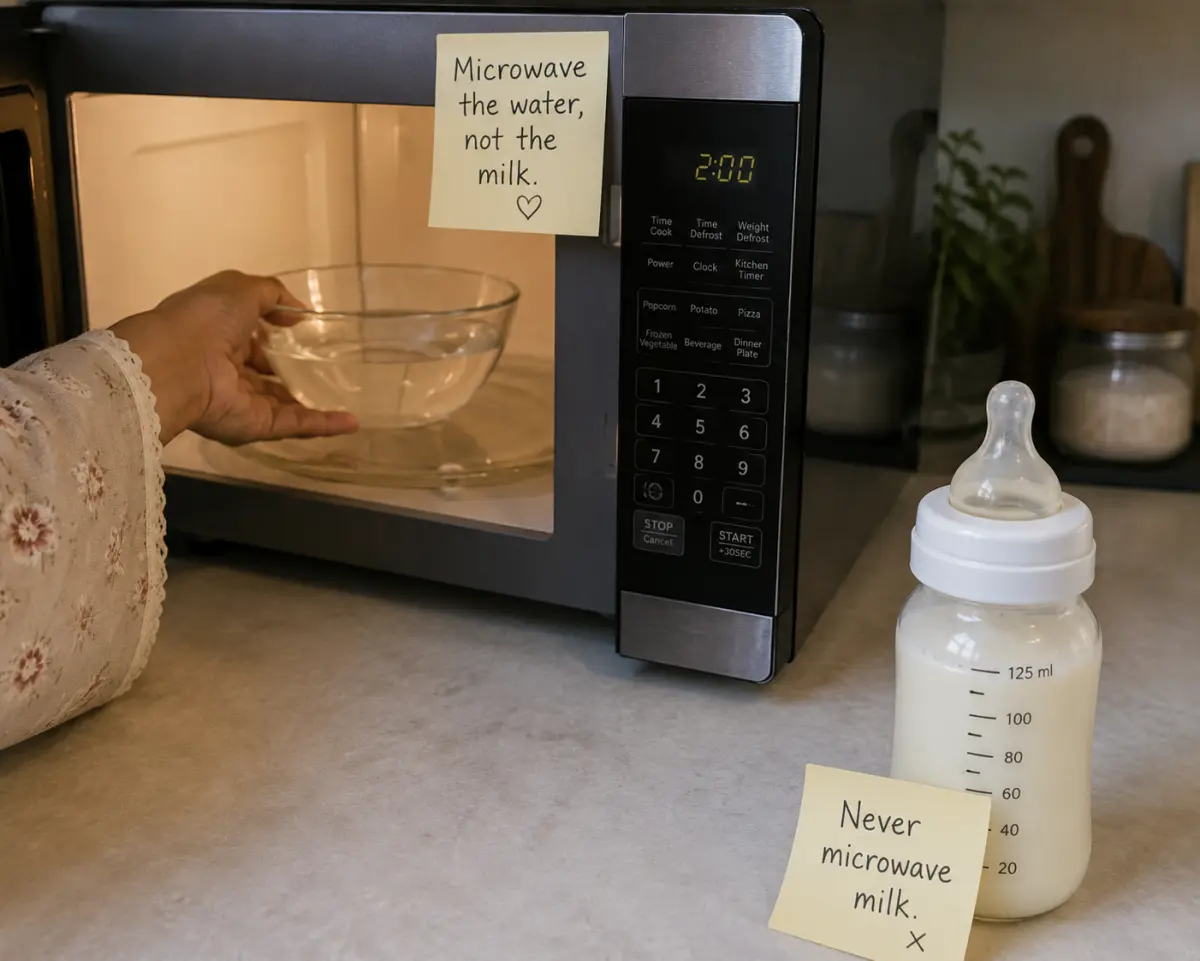
Here’s the part most “warmer vs microwave” articles skip. You don’t have to choose between a bought warmer and microwaving the milk. You can microwave a mug of water, take it out, and stand the sealed bottle in it for a few minutes, which is roughly what a gentle warmer takes anyway, as our bottle warming times show. That’s the warm-water bath the CDC lists as acceptable, and the microwave only ever touches the water.
The full method, including the water level most people get wrong, is in how to warm breast milk without a bottle warmer.
It costs nothing, it needs no special gear, and it sidesteps the hot-spot problem entirely because the milk is warmed gently by the water around it, not by the microwave. It’s slower and more hands-on than a countertop warmer, and you still test the temperature before feeding. But if you’re deciding whether to buy a warmer at all, this is the free method to try first.
What we actually do
When a warmer is worth buying over both
If you’re warming a bottle once in a while, the mug-of-water method is genuinely enough, and we’d tell you to save your money. A warmer earns its counter space when you’re warming bottles daily, feeding in the dark half-asleep, and want one-handed operation that gives the same result every time without a mug, a kettle, or a wait.
That’s a convenience call, not a safety one, and it’s exactly the decision our bottle warmer picks are meant to help with, including the honest case for not buying one. If you’re still building out the feeding corner, the registry checklist has the short list of what actually gets used every day.
Frequently asked questions
Can you microwave breast milk or formula?
No. The CDC says never to warm a baby's milk in a microwave, because microwaves heat unevenly and create hot spots that can burn a baby's mouth and throat even when the bottle feels lukewarm. We follow that, and we link the CDC's own guidance below rather than give you feeding-safety advice ourselves.
Is it OK to microwave water and then stand the bottle in it?
That's a different thing, and yes, it's just a warm-water bath. You're heating the water, not the milk, and then standing the sealed bottle in it to warm gently. The bottle never goes in the microwave. You still test the temperature before feeding, as the CDC advises.
Is a bottle warmer actually safer than a microwave?
The CDC lists a bottle warmer or a warm-water bath as acceptable ways to warm a bottle, and a microwave as one to avoid. Beyond safety, which isn't our lane, a warmer's practical advantage is that it heats gently and evenly by design, so you're not chasing hot spots. Follow the CDC and your pediatrician on the safety question, not a blog, including this one.