How long does a breast pump battery last? Our three wearables, per charge
This post contains affiliate links. If you buy through them, we may earn a small commission at no extra cost to you.Learn more.
How long does a breast pump battery last? With the three wearable pumps I use, between about 30 minutes and about an hour on one charge. That works out to one or two pumping sessions before the pump has to go back on charge. Sessions per charge is the number that matters, more than minutes, because it tells you whether you can pump twice before you get back to a charger.
These are our numbers from our own pumps. They aren’t averages for the whole market, and a pump you own may do better or worse. What they will give you is a realistic sense of what a wearable, battery-powered pump gets through in a normal day.
Battery life across our three wearable pumps
| Pump | Our rating | How long a charge lasts | Sessions per charge |
|---|---|---|---|
| Momcozy M5 | 4.5 / 5 | About 1 hour | 2, easily |
| Mammanuwa S32 | 3.5 / 5 | 40 to 50 minutes | 1 easily, sometimes 2 |
| Elvie Pump | 4 / 5 | About 30 minutes | 1, then recharge |
The ratings are for the pump as a whole, not just the battery. The Elvie outranks the Mammanuwa even though its battery is shorter, because it’s quieter, it runs from an app and it switches modes by itself.
Momcozy M5: about an hour
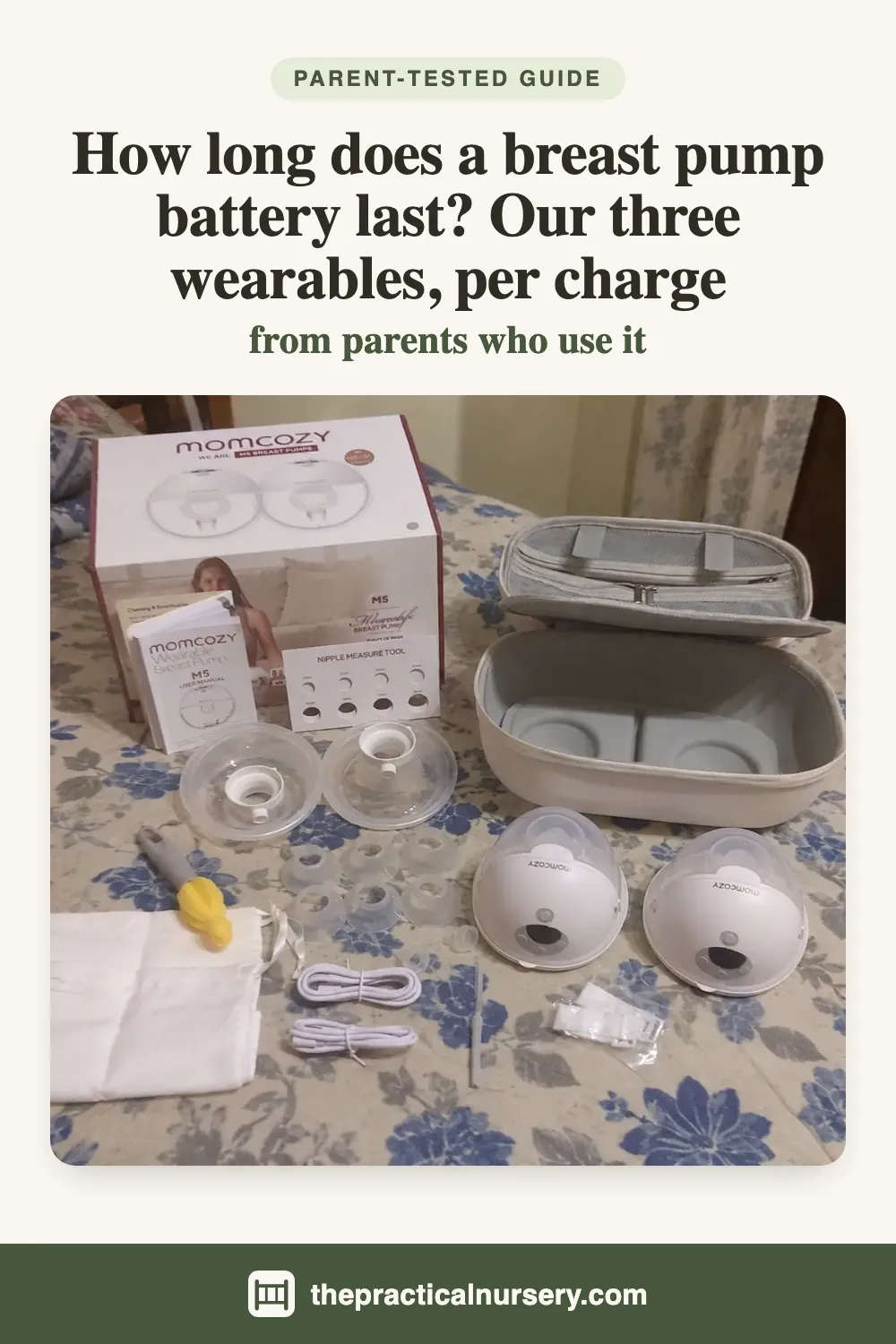
The M5 has the longest battery of our three. A charge lasts about an hour, which gets me through two sessions without thinking about it. Each cup has its own battery and charges over USB-C, with a cable for each in the box. If you pump at work, or once in the morning and again before you’re home, this is the one that doesn’t need a charger in between. Its full review is here.
Mammanuwa S32: 40 to 50 minutes
The S32 lasts 40 to 50 minutes. That covers one full session easily, and sometimes a second, so I treat it as a one-session pump that occasionally surprises me. For a budget pump, the battery is one of its better points. It beats the Elvie’s.
There’s a separate thing to know about the S32 that isn’t the battery but gets mixed up with it: it gets hot after about 15 minutes of wear. That isn’t about how long the battery lasts, but it’s one of the reasons it sits third in our ranking.
Elvie Pump: about 30 minutes
The Elvie has the shortest battery of our three. About 30 minutes covers one full session, and then it needs charging. If you pump once and can charge before the next session, you won’t notice. If you pump twice in a working day, you will. The full story, including its volume sensor, is in our Elvie Pump review.
Why sessions per charge matters more than minutes
A battery figure in minutes on its own doesn’t tell you much, because what you care about is whether the pump will finish the session you’re about to start, and whether it’ll manage the one after that.
Think about it this way. If your pump covers one session per charge, you need to charge between every pump. That’s fine at home with a cable by the bed. It’s a problem at work if the cable is at home, or on a day out where the next socket is hours away.
If your pump covers two sessions per charge, you can pump, forget about it, and pump again. That small difference changes how you plan a day, and it’s a big part of why the Momcozy M5 is our top pick.
A pumping day, charge by charge
Here’s how the numbers play out on an ordinary day with three sessions: one at home in the morning, one at work or out in the middle of the day, and one in the evening.
With the Momcozy M5, a full charge covers the morning and the midday session. You charge it when you get home, and it’s ready for the evening. One charge a day, and no cable in your work bag.
With the Mammanuwa S32, the morning session is covered easily, and sometimes the midday one too. On the days it isn’t, you need to charge it at work, so the cable comes with you.
With the Elvie, every session needs a fresh charge. Morning session, charge, midday session, charge, evening session. That’s manageable at home and at a desk with a socket. It’s harder on a day where you’re out and about with nowhere to plug in.
If your day has only one session away from home, any of the three will do it. The more sessions you fit in between charges, the more the battery decides which pump suits you.
Why wearable pumps don’t last longer
A wearable pump carries its motor, battery and controls inside a cup that has to fit in your bra. There’s only so much room in there, and the battery shares it with everything else. That’s the trade you make for having no tubes, no bottles hanging off you and no plug in the wall.
A wearable pump’s battery is about getting you through your sessions until you can charge again, not lasting all day. Once you think of it like that, the numbers above make more sense.
How to plan your charging
None of this is complicated, but it’s easy to get caught out in the first few weeks.
- Charge after every session, not when it runs flat. Then every session starts on a full battery.
- If your pump gets one session per charge, charge between every pump without exception.
- Keep a charging cable where you pump. If you pump at work, keep one there too.
- Check the battery before you leave the house, not when you’re about to pump.
- If your pump charges over USB-C, like the M5, it can charge from the same kind of cable you use for other things, which makes a spare easy to keep in a bag.
Charging times differ between pumps, so check your own manual for how long a full charge takes, and follow its advice on looking after the battery over time.
Pumping on the go
Portable pumping is the whole reason to buy a battery-powered, wearable pump, and the battery is what decides how portable it really is.
For a short trip out, any of our three will do one session. For a full day out or a working day with two sessions, the M5 is the safe choice, or you’ll need to charge in between. If you’re travelling, pack the cable in your carry-on with the pump. Breast pumps are allowed on planes, and we cover what goes in your carry-on in does a diaper bag count as a carry-on.
Pumped milk away from home needs its own planning. For anything about storing it, follow the CDC’s guidance on handling breast milk rather than a gear blog.
What to look for when you buy
If battery matters to you, these are the questions I’d ask about any pump.
How many sessions do you need between charges? If the answer is two, rule out any pump that only gets one in real use.
Where will you charge it? At home, at work or in a car? A pump that charges over a common cable is easier to keep topped up.
Does each side have its own battery? On a double wearable pump like the M5, each cup charges separately, so check that both are full before you leave, not just one. A pump where one side runs out first still ends your session.
Will you pump with the baby nearby or around other people? That isn’t a battery question, but it often decides between a pump with a longer battery and a quieter one. The Elvie is our quietest and has our shortest battery, so it’s a real trade.
Is the battery figure for a full session at the strength you’ll actually use? Stronger suction and longer sessions use more battery, so a figure on a box may not match your day.
And battery isn’t everything. The Elvie has our shortest battery and still ranks above the Mammanuwa, because it’s quieter and does more for you. We rank all three on everything, not just battery, in the best electric breast pump, and we put the top two head to head in Momcozy M5 vs Elvie.
The bottom line
A wearable breast pump battery lasts between about 30 minutes and about an hour in our use, which is one or two sessions. The Momcozy M5 lasts about an hour and gets two sessions. The Mammanuwa S32 lasts 40 to 50 minutes and gets one, sometimes two. The Elvie lasts about 30 minutes and gets one. Count the sessions you need between charges, and buy the pump that covers them.
Frequently asked questions
How long does a breast pump battery last?
Across the three wearable pumps we use, from about 30 minutes to about an hour per charge. The Momcozy M5 lasts about an hour, enough for two sessions. The Mammanuwa S32 lasts 40 to 50 minutes, one session easily and sometimes two. The Elvie lasts about 30 minutes, one full session before it needs charging.
How many pumping sessions do you get on one charge?
With our pumps, one or two. The Momcozy M5 gets two easily, the Mammanuwa S32 one and sometimes two, and the Elvie one. Sessions per charge is a more useful number than minutes, because it tells you whether you need to recharge before the next pump.
Do wearable breast pumps have shorter battery life?
Wearable pumps carry their battery inside a cup that has to fit in a bra, so there is only so much room. That is the trade for having no tubes and no wall socket. Our three last between about 30 minutes and about an hour per charge.
Which wearable breast pump has the longest battery?
Of the three we use, the Momcozy M5, at about an hour per charge. It is also our top-rated pump overall, at 4.5 out of 5.
How do you make a breast pump battery last longer?
Charge it after every session rather than waiting for it to run flat, so each session starts full. Keep the charging cable with the pump, especially if you pump at work. For anything about the battery's care and lifespan, follow the manual for your own pump.