Best Baby Closet Organizers & Closet Dividers for a Nursery That Actually Works
This post contains affiliate links. If you buy through them, we may earn a small commission at no extra cost to you.Learn more.
A good baby closet organizer, or closet divider, solves one problem at a time, not the whole closet at once. Clothes need sorting by size, folded things need a container, and small stuff like socks and hair bows needs its own compartment before it sinks to the bottom of a drawer. Below are four ways to solve those separate problems: a rod divider, an over-door organizer, stackable shelf bins, and a drawer organizer. Pick the one that matches the mess you actually have, not all four at once.
The four, side by side
| Organizer | Type | Best for | Key spec | Fits |
|---|---|---|---|---|
| Baby Size Dividers (7-piece wood) | Rod divider | Sorting clothes by age on the rod | 7 tabs, newborn to 18-24mo, ~17.7 x 7.6cm each | Any standard closet rod |
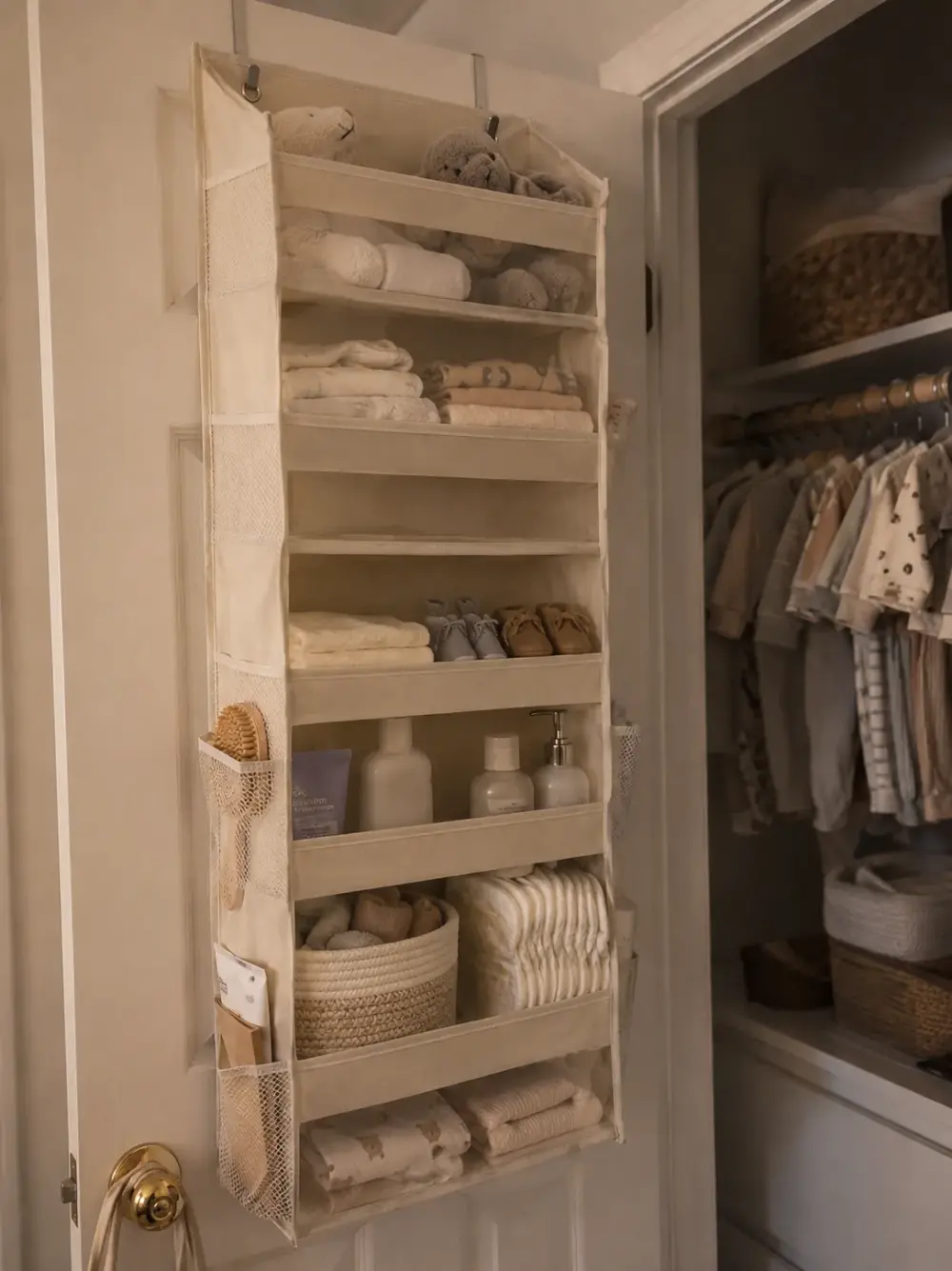
| Homelux Theory Over-Door Organizer | Over-door organizer | No spare closet or shelf space | 18 pockets total (6 front, 12 mesh side), holds up to 50 lbs | Standard hinged door, 2-pack |
| QianglyTai Storage Baskets (4-pack) | Shelf / cupboard bins | General folded-item and loose-item storage | 26L each, steel frame + MDF base, foldable | Open shelving |
| MSHOMELY Drawer Organizer | Drawer divider | Small items: socks, accessories, tiny clothes | 16 stackable cells, adjustable dividers, dust cover | Dresser drawer |
Before you buy: two things to skip
Dividers with tiny printed size labels in a decorative font. They photograph well and are useless at 2 a.m. when you can’t read them. Look for large, high-contrast labels or icon-based tabs you can identify at a glance.
“Complete closet system” bundles that lock you into a dozen matching pieces. Start with one divider set and one bin type, then add only what you actually run out of space for. Nursery closets are small; you don’t need six kinds of storage before you know which one you’ll use daily. Same logic we use for the rest of the registry in baby items you don’t need.
1. Baby Wardrobe Size Dividers (7-piece wood set)
Seven wooden dividers, one for each of newborn, 0-3 months, 3-6 months, 6-9 months, 9-12 months, 12-18 months and 18-24 months. Instead of printed text, each tab is carved with its own icon, sun, mountains, stars, moon, so it reads at a glance and works for any nursery color scheme. Each tab measures about 17.7 x 7.6cm, and the full seven-piece set weighs around 70g, light enough that it won’t strain a standard closet rod.
What we like
- One set covers newborn to 24 months, no repurchasing as sizes change
- Solid wood construction, built for repeated handling on a rod
- Icon tabs (sun, moon, stars) suit any nursery style or gender
What we don't
- No stated finish or sealant, worth checking for warping if your closet runs humid
- Coverage stops at 18-24 months, plan for a second system after that
This is the one to start with if your closet rod is currently one undivided wall of clothes. It’s the cheapest, fastest fix for the single biggest closet complaint: not being able to find the right size fast.
2. Homelux Theory Over the Door Organizer
A 2-pack of fabric organizers, each measuring 55 x 14 x 6.7 inches, made from non-woven, moisture-resistant fabric. Each unit has 6 front pockets across 3 different depths (the top two are shallower, for things you want to grab quickly) plus 12 additional mesh side pockets, 18 pockets per unit in total. Homelux Theory rates each organizer to hold up to 50 lbs, with reinforced stitching between the side pockets specifically to stop the whole thing from tilting once loaded.
What we like
- No drilling or hardware, just hooks over a standard door
- 18 pockets per unit across 3 depths, fits both bulky and small items
- Two units in the pack cover two doors, not just one
What we don't
- Requires a standard hinged door, won't fit sliding or bifold closet doors
- Rated to 50 lbs, worth checking your door hinges can take that long-term
This is the pick if your nursery genuinely has no spare shelf or closet space left. It adds storage to a door you’re not otherwise using, at the cost of needing the right kind of door to hang it on.
3. QianglyTai Stackable Storage Baskets (4-pack)
Four fabric storage baskets, 26 liters each, built with a double-layer fabric shell over a 3.5mm galvanized steel frame and a thickened density-board (MDF) base. Each basket has leather-style carry handles and folds flat when empty. They come in gray.
What we like
- Steel frame and MDF base resist sagging that plain fabric bins develop once loaded
- Folds flat when empty, does not waste shelf space unused
- Carry handles make it easy to pull a full basket down rather than digging on the shelf
What we don't
- 26L x4 is a lot of volume, measure your shelf before ordering
- Heavier empty than plain fabric bins, due to the steel frame
This is the general-purpose pick for open shelving: folded clothes, towels, burp cloths, toys, anything that doesn’t hang and doesn’t need small compartments.
4. MSHOMELY Stackable Drawer Organizer
A 16-cell organizer made from food-grade PET plastic, with removable, adjustable dividers and a dust- and moisture-proof cover. It’s built to stack, so multiple units multiply storage without using more drawer footprint. It weighs about 3.5 lbs and is marketed for socks, underwear, small baby clothes, ties and belts.
What we like
- Stacks to add capacity without using more drawer footprint
- Dividers are removable and adjustable, not fixed at one cell size
- Dust- and moisture-proof cover, useful for between-size storage
What we don't
- Rigid PET plastic, not padded, best for socks and folded items rather than delicates
- Built for small items only, not a fit for bulkier baby gear
This is the one for the drawer, not the closet: the small stuff that otherwise sinks to the bottom and never gets found again.
A small nursery closet, laid out
Most nursery closets are small, so here’s how these four actually work together in one, rather than as four separate purchases competing for the same space.
- Top shelf: the storage baskets. This is the space you reach into least often, so it’s where out-of-season sizes, spare blankets and toy overflow belong, not the clothes your baby is currently wearing.
- The rod itself: the size dividers, at a glance height. One tab per age range, so the current size is always the first thing your hand lands on.
- Back of the closet door: the over-door organizer, loaded with grab-and-go items, a spare outfit, a diaper pack, wipes, so you’re not walking back and forth mid-change.
- A dresser drawer, not the closet itself: the stackable organizer, for the small stuff, socks, mittens, hair bows, that has no business taking up rod or shelf space.
Four products, four different zones, no overlap. If your closet only fits one of these right now, start with whichever zone is currently the worst offender.
Which one to start with
- One messy rod of mixed sizes: the wood size dividers. Cheapest, fastest fix.
- No spare shelf or closet space at all: the over-door organizer, provided you have a standard hinged door to hang it on.
- Open shelving with nothing containing it: the storage baskets.
- A drawer of socks, accessories and tiny items: the stackable drawer organizer.
Most nursery closets end up needing two of these, not all four. Start with whichever one solves the mess you’re actually looking at today.
Closet sorted, the rest of the room usually needs the same treatment: our diaper caddy picks cover the changing station, and Ubbi vs Diaper Genie settles the other recurring nursery-organization question.
Frequently asked questions
Do I need closet dividers and a bin/basket system, or just one?
They solve different problems. Dividers section a hanging rod so clothes don't get mixed by age or size. Bins and organizers contain everything that isn't hung up: folded items, accessories, anything loose. Most nursery closets end up using both, dividers on the rod, bins on the shelf above or below it.
What's the easiest way to sort baby clothes by size?
Age-based ranges (newborn, 0-3 months, 3-6 months, and so on) are the easiest to maintain, because for the first two years, size roughly tracks age. Sorting by the exact size printed on the tag is more accurate later on, but it's harder to keep up with in the newborn haze.
Will an over-the-door organizer damage the door?
Most, including the one below, are designed to hook over the top of a standard hinged door with no drilling. The thing actually worth checking is your door's hinges and how much weight the manufacturer rates the organizer to carry once it's loaded, not whether it needs hardware.
Fabric bins or dividers, which should I buy first?
If you're staring at one disorganized pile of mixed-size clothes, start with dividers, they're the cheaper, faster fix. Bins solve a separate problem, loose items with no folded structure like burp cloths, hats or toys, so add those once the rod itself is already sorted.