Ubbi vs Diaper Genie: Which Diaper Pail Is Worth It?
This post contains affiliate links. If you buy through them, we may earn a small commission at no extra cost to you.Learn more.
Short version: buy the Ubbi. It costs more today and less over time, and for most families that’s the whole decision. The Diaper Genie seals smell better in the moment it drops in, but you’re renting refills for as long as you’re in diapers.
I’m the engineer half of this site. Materials, mechanisms, long-run cost. Not vibes.
A diaper pail has one job: hold soiled diapers long enough between trash days without the room finding out. Ubbi and Diaper Genie are the two pails people actually ask about, and this page is about those two. We have since added a third, and all of them are compared in best diaper pail. These two solve that job in opposite ways. Ubbi is steel, plus whatever kitchen bags you already buy. Diaper Genie is plastic, plus a subscription to its own refill cartridges. Here’s the breakdown.
Head to head
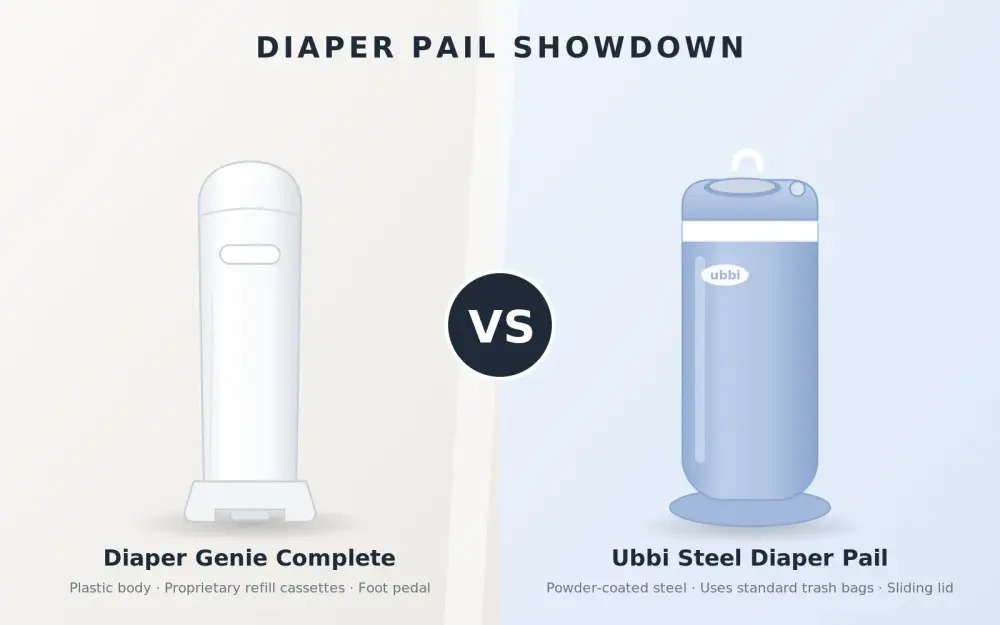
| Feature | Ubbi | Diaper Genie Complete |
|---|---|---|
| Body material | Powder-coated steel | Plastic |
| Bags | Any 13-gal kitchen bag | Proprietary ring refills |
| Ongoing cost | Whatever your bags cost | Refills, forever |
| Drop-in mechanism | Sliding lid | Clamshell + foot pedal |
| Odor absorbed by body over time | No (steel) | Yes (plastic) |
| Ongoing plastic waste | None beyond your bags | Cartridges + packaging, forever |
| Footprint | Smaller, fits the nursery | Bigger, needs more floor |
| Upfront price | Premium | Mid-range |
Build quality: why steel beats plastic here
Plastic holds onto odor. Months of use, and no amount of cleaning gets it fully out. Steel doesn’t have that problem. That’s most of what the extra Ubbi cost is buying. If you already own either one, how to clean a diaper pail walks through the wipe-out routine and the deep clean that keep both as fresh as they can get.
The reason is in the material, and it is the part worth understanding before you spend. Plastic is porous at a microscopic level, and every open and close scuffs the surface a little more, so odor molecules and greasy residue work their way in and stay. You can scrub a plastic pail until it looks clean and it still carries a background smell within a few months, because by then the smell is in the plastic, not on it. Powder-coated steel is non-porous and sealed, so nothing soaks in. Wipe it and it is genuinely clean, not just clean-looking. For an object that spends two or three years holding dirty diapers, that one property is what decides whether the pail itself becomes a smell you have to manage.
Odor control: how each one actually seals
There are two different moments to judge a pail on, and the two win different ones.
At the instant a diaper drops in, the Diaper Genie is better. Its clamshell closes over the diaper and a carbon filter sits in the lid, so the puff of smell you get is smaller than the Ubbi’s. The foot pedal helps here too, since the lid is only open for the second it takes to drop and let go. If your pail sits right next to where you sleep, that moment-of-drop-in performance is the thing you will notice first.
Over weeks and months, the Ubbi wins, for the material reason above. Its sliding lid and rubber gasket seal the stored smell in well between changes, and the steel body never turns into a smell of its own. The Genie seals each diaper beautifully on day one and slowly becomes a faintly smelly object by month four. So the honest read is simple: the Genie for the single best drop-in, the Ubbi for the pail that still smells like nothing half a year in.
The refill economics
Diaper Genie is razor-and-blades pricing: decent pail up front, then refills for as long as you’re in diapers. Run the math on your actual diaper years and the “cheaper” pail usually loses. Ubbi just uses the bags already under your sink.
The part that is easy to miss is how long that runway is. One child is roughly two to three years of diapers, and a second child restarts the clock, so the refill stream is not a few months of buying cartridges, it is years of it. Because the cartridges are proprietary, you cannot shop around or drop to a cheaper generic the way you can with kitchen bags, which is exactly the point of the design from the maker’s side. The Ubbi front-loads its cost into one purchase and then asks for nothing you were not already buying. Over a full diaper stretch, and especially across two kids, the pail that looked cheaper on the shelf is usually the more expensive one to live with. And when you are done, a steel pail holds its value and resells or carries on as a small trash can, where a used plastic pail is mostly landfill.
The waste angle
There is an environmental side to the same split, and it is genuine rather than bolted on. The Genie’s refill system means a steady stream of proprietary plastic cartridges and their packaging, bought and binned for the whole time you are in diapers, on top of the diapers themselves. The Ubbi uses standard bags, so it adds no product stream of its own, and the pail is powder-coated steel, which is recyclable at the end of its life and, far more likely, simply gets reused as a bin. If cutting down on single-use plastic is something you weigh, this is a real point in the Ubbi’s favor, and it sits alongside the cost case instead of fighting it. Here the greener choice is also the cheaper one over time, which is not always how that works out.
Size, and where each one ends up living
One practical thing the spec sheets undersell is footprint. The Genie holds more, but it is physically bigger, and in a small nursery that matters more than raw capacity. In our house the Ubbi is small enough to stand in the corner of the nursery itself, while the Genie lives just outside the room because it takes up more floor than we wanted next to the crib. If your nursery is tight, the smaller pail you can actually keep in the room may beat the bigger one you have to exile to the hallway, because capacity only helps if the pail is somewhere you will use it. The caddy that pairs with the changing station is covered in the best diaper caddies we’ve used.
Ubbi Steel Diaper Pail
It’s a fully powder-coated steel body, inside and out, not just a steel shell around a plastic liner. It has a sliding lid and a rubber gasket seal for odor lock. It fits any standard 13-gallon kitchen trash bag with no proprietary refills, and ours is the blue one, though it’s listed in a few other colors too. In practice, ours holds about 45 to 50 diapers before we take the bag out. That stretches across roughly five to six days, since the daily count varies, and it comes up to about knee height standing in the corner of the nursery.
A smell check from across the room the next morning consistently comes back faint to nothing.
What we like
- Uses any standard kitchen bag, no proprietary refills, ever
- Steel body does not absorb odor long-term
- Simple sliding mechanism with little to break
- Lots of colors, and it does not look like baby equipment
What we don't
- Premium upfront price
- Sliding lid releases a brief puff of smell at drop-in
- Slide gets a little sticky if the rim gets dirty, but a quick wipe-down sorts it out
Diaper Genie Complete
It holds up to 270 newborn-size diapers per refill, and ships with 1 refill cartridge and 1 built-in carbon filter included. It opens hands-free with a foot pedal and a clamshell seal at drop-in. Ours is the standard white unit. Replacement refill cartridges and carbon filters are sold separately on an ongoing basis.
What we like
- Best-in-class smell containment at the moment of drop-in
- Foot pedal means true one-handed, no-touch disposal
- Genuinely large capacity, can go weeks between emptying in practice
- Lower upfront price
What we don't
- Proprietary refills are a permanent subscription
- Plastic body holds onto odor as it ages
- Bigger footprint than the Ubbi, which is why ours lives outside the nursery, not in it
- More moving parts (pedal, clamshell, cutter), so more to break
So which one?
- Most families: Ubbi. You pay once, keep using the trash bags already under your sink, and the pail itself never turns into the thing that smells up the room.
- Small apartment, pail next to the bed: Diaper Genie wins that first second after drop-in. Budget for refills and don’t pretend otherwise.
- Cutting down on plastic: Ubbi, easily. Standard bags and a recyclable steel body beat a permanent stream of proprietary cartridges.
- Minimalists: skip both. A lidded can and actually taking the trash out covers it. More of that thinking in baby items you don’t need.
Whichever pail you land on, it has to live somewhere: our closet organizer and divider picks cover the rest of that space. Ubbi makes a caddy as well, and it is plastic rather than steel for a good reason, since a caddy has to be wiped clean rather than sealed against odor. We use it daily and reviewed it in our Ubbi diaper caddy review.
Frequently asked questions
Does the Ubbi really work with regular trash bags?
Yes, that's its defining feature. Any standard 13-gallon kitchen bag fits. The Diaper Genie requires proprietary ring refills, which is where its long-term cost hides.
Which diaper pail controls odor better?
Sealed-in odor is close between them, and the difference is the opening. The Genie's clamshell releases less smell at drop-in, while the Ubbi's sliding lid releases a brief puff. Over months, the Ubbi's steel body wins, since plastic pails absorb odor permanently and steel doesn't.
Do you even need a diaper pail?
Genuine answer: it's a convenience product, not a necessity. A lidded trash can with frequent emptying works. A pail earns its cost in stink-containment between takeout-the-trash days, so decide how often you realistically empty.