Diaper caddy vs changing table: which do you need?
This post contains affiliate links. If you buy through them, we may earn a small commission at no extra cost to you.Learn more.
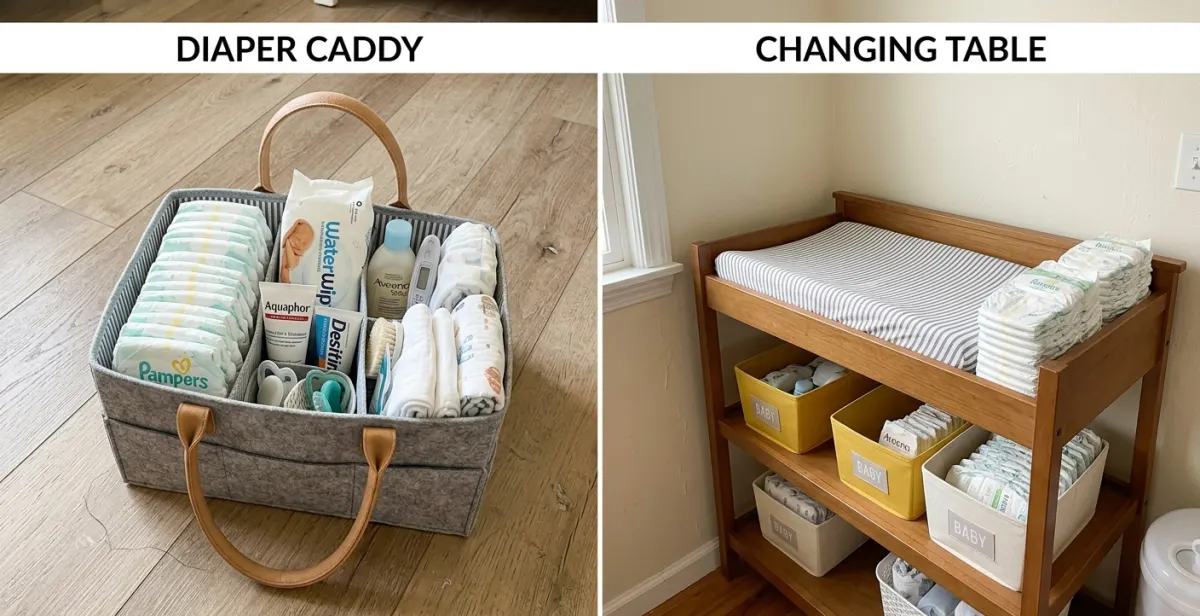
The short answer to diaper caddy vs changing table is that they are not the same kind of thing. A changing table is a place. A diaper caddy is a kit. One decides where your main changing spot is, the other decides what happens in every room that is not that spot, and most families end up with both because those are two different problems.
The question worth asking is not which of the two to buy. It is whether you need a dedicated changing table at all, because that is the expensive, room-filling half of the pair, and the answer is genuinely no for a lot of homes.
What each one actually is
A changing table is a waist-height piece of furniture with a padded mat on top and open shelves or drawers below. Everything lives on it: the full pack of diapers, the bulk wipes, the creams, the spare clothes. It does not move, and its whole value is that it is always set up and always at the right height.
A diaper caddy is a structured basket with a divider and a couple of pockets that holds about a day of changes. It sits on the table, or beside the sofa, and gets carried to wherever the baby is. Its whole value is that it moves.
| Changing table | Diaper caddy | |
|---|---|---|
| What it is | A fixed station | A mobile kit |
| Gives you | A surface at working height | Supplies wherever you are |
| Holds | The whole stock | About a day of changes |
| Rooms covered | One | All of them |
| Floor space | A large piece of furniture | A basket on a shelf |
| Cost | Highest item in this comparison | Low |
| Life after diapers | Limited, unless it converts | Carries on as storage |
The case for the table is your back
The argument for a changing table is not storage, because shelves are easy to find elsewhere. It is height.
You will change a baby thousands of times, and doing it at waist height rather than bent over a bed or kneeling on a floor is a genuinely different physical experience by month four. That is the thing people who love their changing table are actually talking about. Everything else the table does, holding diapers and wipes and clothes in one visible place, a dresser and a few baskets do as well.
The second, quieter argument is that a permanent station is always ready. Nothing to set up, nothing to clear away, no deciding where to do this at 3 a.m. For a first baby, that reduction in decisions is worth something.
The case against it is space and lifespan
A changing table is a large object with exactly one job and a life measured in two or three years, after which it is a piece of furniture you have to find a use or a buyer for. Some convert into a small dresser or a shelf unit, which is worth checking before you buy, and plenty do not.
In a small nursery it is also the piece that determines the layout of the whole room. If the table means the cot has to go somewhere awkward, that is a high price for a surface.
The alternative most families land on is a dresser you were going to own anyway with a changing mat on top, plus a caddy holding the day’s supply. That gets you the height, the storage and the permanence, and leaves you with a dresser afterwards instead of a changing table.
The caddy is the cheap half, and it covers the other rooms
Whatever you decide about the table, you will change diapers in rooms that do not have it. The living room in the evening. The bedroom at night if the cot is in there. Someone else’s house.
That is the gap a caddy fills, and it is why it rarely competes with a table in practice. The table holds the stock, the caddy carries the day, and the caddy restocks from the table in about ten seconds because they sit next to each other. If you skip the table, the caddy does the same job next to whatever furniture replaced it.
What goes in it is a short list, and keeping it short is what makes it grab-and-go, which we cover in what to put in a diaper caddy.
In a small home, the caddy wins on space
A caddy takes the footprint of a basket. A changing table takes a wall.
If you are in a flat, a shared room, or a nursery that also has to be a spare room, this is usually the whole decision. A changing mat on a dresser plus a caddy gives you a changing setup that costs little and occupies furniture you already have. It is also the version that moves with you if the baby’s room changes, which in the first two years it often does.
The early months complicate the table
Worth thinking about before you buy: in the first months a lot of babies sleep in their parents’ room, which means a good share of night changes happen nowhere near the nursery. A changing table set up in a room nobody is sleeping in yet is a piece of furniture waiting for its job to start.
A caddy covers that period without any planning at all, because it goes to whichever room you are in. If you are buying before the baby arrives and you are not sure how the first few months will be arranged, that difference is a fair argument for getting the cheap half first and deciding on the table once you know where the changes are actually happening.
Safety sits with the manual, not with us
A changing table is the one item in this comparison with a safety dimension, since it involves a baby on a raised surface. We are not going to write that guidance here. Follow the manual that comes with your table, including anything it says about straps, weight limits and anchoring, and the guidance from the CPSC and the AAP rather than a gear blog, this one included. The same goes for whatever surface you use if you skip the table.
Do you need both?
Most families do, and the useful way to think about it is in order of what each solves.
Buy the caddy first if money or space is tight. It is inexpensive, it makes every room workable, and it does not commit you to a layout. Add a table if your back wants one and the room can take it.
Buy the table first only if you are certain you want a permanent station and you have a spot for it, because it is the item that decides the rest of the room. And if you are already unsure, that uncertainty is usually the answer: the dresser-plus-mat setup costs almost nothing to try, and you can add a proper table later if you find you want it.
Whether the changing table earns its place is also one of the questions we take on in baby items you don’t need, where the answer depends more on your room than on the product.
What happens to each afterwards
The caddy has the easier retirement. A structured basket becomes storage for books, bath things or craft supplies, and a rigid plastic one becomes almost anything. Neither looks out of place once the diapers stop.
A changing table is either a convertible piece or a large object with no remaining job. If you are buying one, that is the specification worth checking, because it is the difference between a piece of furniture you keep and one you are selling in two years.
The bottom line
A changing table buys you height and permanence in one room. A diaper caddy buys you supplies in every room, for a fraction of the price and the space. They are not alternatives so much as the fixed and mobile halves of the same setup, and the caddy is the one that is hard to regret.
If you are picking a caddy, the ones we own are in the best diaper caddies we’ve used and what to look for is in how to choose a diaper caddy. For the other comparison people ask about, the one between what stays home and what leaves it, that is diaper caddy vs diaper bag.
Frequently asked questions
What is the difference between a diaper caddy and a changing table?
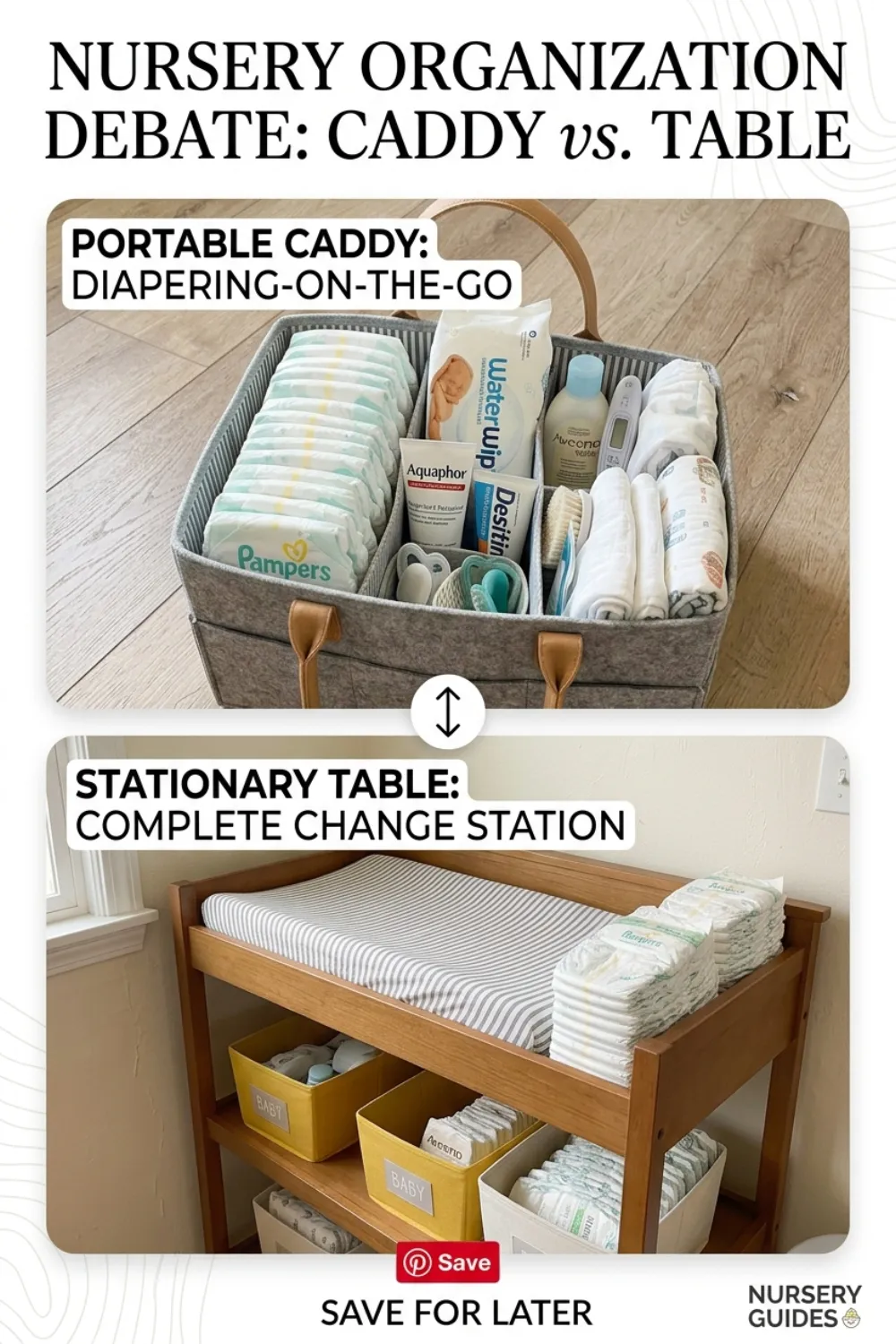
A changing table is a place and a diaper caddy is a kit. The table is a fixed station at a working height with storage underneath, and it never moves. The caddy is a basket holding about a day of changes that goes wherever you are. That is why the comparison is not really either or: the table decides where the main changing spot is, and the caddy decides what happens everywhere else in the house.
Do you need a changing table if you have a diaper caddy?
Not necessarily. Plenty of families skip the dedicated table and use a changing mat on a dresser or a bed, with a caddy holding everything that would have lived on the table's shelves. What you give up is the fixed height, which is the thing your back notices after a few months of bending over a low surface. What you gain is floor space and money, which in a small room can matter more.
Can a diaper caddy replace a changing table?
It can replace the storage a table gives you, not the surface or the height. You still need somewhere safe to lay the baby down, so the honest version is a caddy plus a changing mat on furniture you already own. That combination works and costs a fraction of a table, which is why it is the setup we would suggest to anyone short on space.
Is a changing table worth it?
It depends on your back and your square footage more than your budget. A table at the right height genuinely is easier over hundreds of changes, and the shelves keep everything visible in one place. It is also a large piece of furniture with one purpose and a two or three year life, so if the room is tight the money often goes further on a dresser with a changing mat on top.
Do you need a diaper caddy if you have a changing table?
Most families do, and it is the cheaper half of the pair. The table covers the nursery. The caddy covers every other room you end up changing a baby in, which is more of them than you expect in the first year. Without one you are either walking to the nursery for every change or carrying loose diapers and wipes around in your arms.
What should go on a changing table versus in a caddy?
Put the bulk on the table: the full pack of diapers, the box of wipes, spare outfits, the things you restock from. Keep the caddy to roughly a day of changes so it stays light enough to carry with one hand. The table is the store cupboard and the caddy is the day's supply, which is also why they sit next to each other.