How to Choose the Right Diaper Caddy
This post contains affiliate links. If you buy through them, we may earn a small commission at no extra cost to you.Learn more.
Choosing the right diaper caddy is mostly one decision made well: the material. Get that right and the rest, the size, the divider, the handles, falls into place. We tested three caddies in our own nursery for months, in felt, in a fabric basket, and in woven rope, so this is what we’d check before buying, in the order it matters. Whether your shop calls it a diaper caddy or a nappy caddy, it’s the same thing and the same checklist.
A diaper caddy is really just a portable version of your changing station: diapers, wipes, cream and a change of clothes in one grab-and-go basket, so a change doesn’t tie you to one room. That is the whole job, and the best caddy is the one that does it without slumping, overloading, or looking like clutter on your shelf. It is a different job from the one a bag does, which is why the two get chosen on different criteria: a caddy only has to survive your house, so if you’re kitting out for leaving it, that’s our diaper bag buying guide instead.
Start with the material
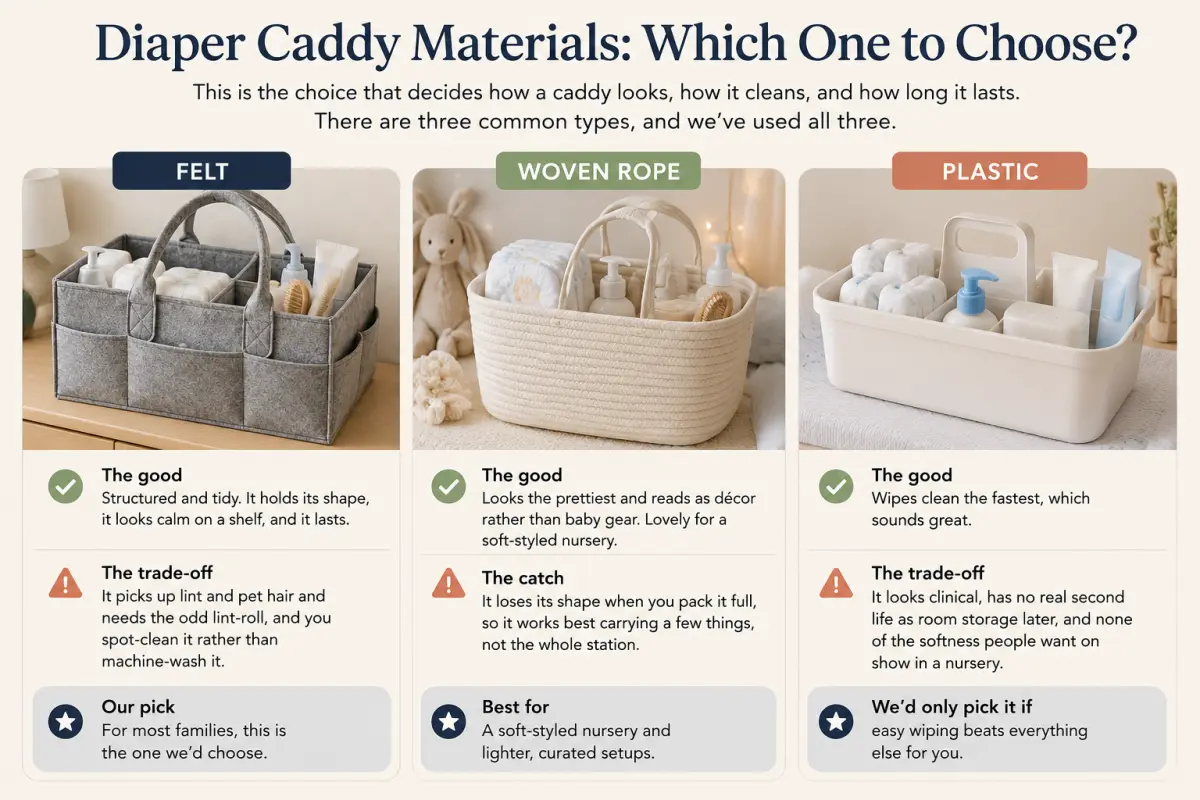
This is the choice that decides how a caddy looks, how it cleans, and how long it lasts. There are three common soft types, and we’ve used all three. Hard plastic is a fourth option that sits apart from the rest, and we cover it in our Ubbi diaper caddy review rather than here.
Felt is structured and tidy. It holds its shape, it looks calm on a shelf, and it lasts. The trade-off is that it picks up lint and pet hair and needs the odd lint-roll, and you spot-clean it rather than machine-wash it. For most families, this is the one we’d choose. The felt caddy we use daily is covered in full in our Parker Baby diaper caddy review, including how the lint trade-off feels after eight months.
Woven rope, like a cotton boho basket, looks the prettiest and reads as décor rather than baby gear. It’s lovely for a soft-styled nursery. The catch is that it loses its shape when you pack it full, so it works best carrying a few things, not the whole station.
Plastic wipes clean the fastest, which sounds great, but it looks clinical, has no real second life as room storage later, and none of the softness people want on show in a nursery. We’d only pick it if easy wiping beats everything else for you.
Check that it holds its shape
Here’s a test most buying advice skips: imagine the caddy half-empty. A good one stands up on its own whether it’s full or nearly empty. A cheap or overly soft one slumps into a sad fabric puddle the moment it isn’t packed, and then things tip over inside it.
Structured felt and firm fabric baskets pass this easily. Very soft rope and thin fabric struggle. If you can, press on the sides in the shop or look for “structured” in the listing. A caddy that keeps its shape is one you’ll actually keep using.
Look for a divider and a few pockets, not many
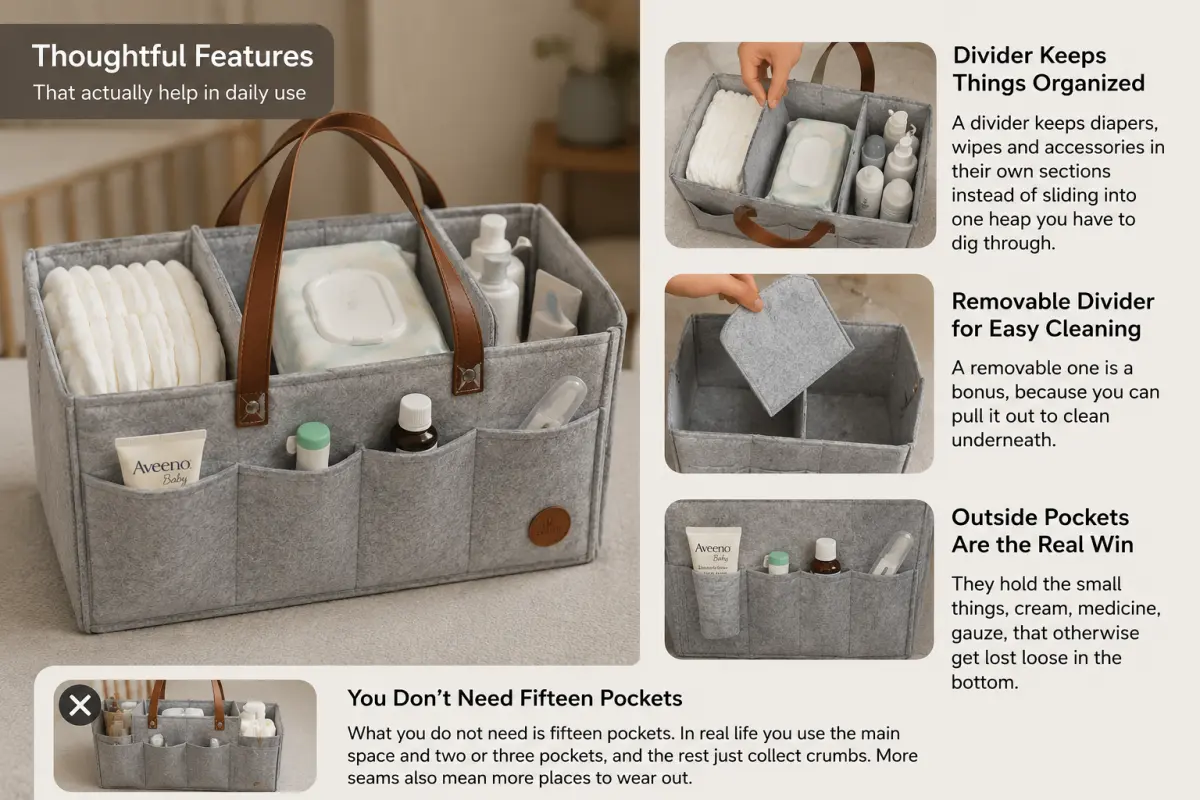
Two features genuinely help. A divider keeps diapers, wipes and accessories in their own sections instead of sliding into one heap you have to dig through. A removable one is a bonus, because you can pull it out to clean underneath.
A couple of outside pockets are the real win. They hold the small things, cream, medicine, gauze, that otherwise get lost loose in the bottom. What you do not need is fifteen pockets. In real life you use the main space and two or three pockets, and the rest just collect crumbs. More seams also mean more places to wear out.
Get the size right: big enough, not too big
A caddy should hold about 8 to 10 diapers, wipes, cream, a change of clothes, a burp cloth and one small toy. That’s it. Bigger sounds better and isn’t. Overstuff a caddy and it loses its shape, gets heavy, and stops being something you can grab with one hand while holding a baby with the other. If you’re cramming it full, it’s either too small or carrying too much.
It also has to fit where it lives, on a shelf, on the changing table, or beside the sofa, so check the measurements against your actual spot before you buy.
Handles you can actually carry
Since the whole point is carrying it from room to room, the handles matter more than they look. You want two sturdy handles you can grab by hand, and ideally ones comfortable enough to sling over a shoulder when it’s lightly loaded. Test this in your head with a full caddy, not an empty one. Thin or scratchy handles are the difference between a caddy you carry daily and one that just sits in the nursery.
Think about cleaning, and about later
Two quick things people forget. Cleaning: felt and fabric are usually spot-clean only, while plastic wipes down fully, so match that to how messy your changes get. And second life: both materials have one, but not equally. A fabric caddy becomes toy storage, craft storage or a car organizer, provided it still looks presentable, and after a couple of years of daily use that is not a given. A rigid plastic one carries on regardless, which is what we found with the Ubbi caddy we use. Fabric wins on price up front, plastic wins on how long it keeps earning its place.
Two things to skip
A caddy covered in fifteen pockets. The pocket count is a marketing number, and most of them never get used.
The “diaper caddy plus changing pad” bundle sets. The bundled pad is almost always the flimsiest version of both things. Buy the caddy you want and a pad you want, separately.
The bottom line
Choose your diaper caddy by material first, structured felt for most people, rope for a soft look, plastic only if easy wiping wins. Then check it holds its shape, has a divider and a few pockets, is the right size, and has handles you can actually carry. Do that and you’ll get one of the few baby buys that earns daily use and still has a life after diapers.
For the three we actually tested, and the one we’d buy again, see the best diaper caddies we’ve used. And once the caddy’s sorted, the closet it sits in usually needs the same treatment, which we cover in our closet organizer and divider picks.
Frequently asked questions
How do I choose the right diaper caddy?
Start with the material, because it decides almost everything else: felt holds its shape and looks tidy, woven rope looks soft and pretty, and plastic wipes clean but looks clinical. Then check that it keeps its shape when it's half-empty, has a divider and a couple of outside pockets, and is the right size for your changing area. Skip the ones with fifteen pockets and the caddy-plus-pad bundle sets.
What size diaper caddy do I need?
Big enough for about 8 to 10 diapers, wipes, cream, a change of clothes, a burp cloth and one small toy, and no bigger. A caddy you overstuff loses its shape and gets too heavy to actually carry, which defeats the point. If you find yourself cramming it full, it's too small or you're putting too much in it.
Does a diaper caddy need a divider and lots of pockets?
A divider, yes, it keeps diapers, wipes and accessories from all sliding into one pile. Lots of pockets, no. In real use you use the main space and two or three pockets, and the rest just collect crumbs. A couple of outside pockets for small things like cream and medicine is the sweet spot.