Diaper caddy vs diaper bag: what's the difference?
This post contains affiliate links. If you buy through them, we may earn a small commission at no extra cost to you.Learn more.
Short version: a diaper caddy moves a change around your house, and a diaper bag takes one out of it. Everything else about them follows from that. The caddy is open on top because you restock it from the shelf it sits next to. The bag closes because it has to survive a car boot, a cafe floor and a rainy walk, with no shelf anywhere.
They are not rivals, and the honest answer to which you need is usually both, in that order of importance. If you leave the house with the baby, nothing replaces the bag. The caddy is the one that earns its place at home, which is where most changes actually happen.
What each one actually is
A diaper caddy is a structured open basket with a divider and a couple of outside pockets. It lives on the changing table or beside the sofa, holds about a day of changes, and gets carried between rooms by two handles. It is designed to be grabbed with one hand while the other hand is holding a baby.
A diaper bag is a closed bag, most often a backpack now, with a zip, insulated bottle pockets, somewhere to put a changing mat, and straps that leave your hands free. It holds more of everything, because once you are out you cannot go back to the cupboard for a second wipe packet.
| Diaper caddy | Diaper bag | |
|---|---|---|
| Job | Moves a change around the house | Takes a change out of the house |
| Closure | Open on top | Zipped or clipped shut |
| Carry | Two handles, short trips | Shoulder or backpack straps, hands free |
| How much it holds | About a day of changes | A day out, with backup |
| Restocking | From the shelf behind it | Before you leave, or not at all |
| Cleaning | Spot clean or wipe, stays put | Washes harder, lives on floors |
| Typical cost | Lower | Higher |
The four differences that matter
It opens, or it closes
This is the root of it. An open caddy is fast: no zip, no flap, one hand in and out while the other one is on the baby. The price of that speed is that nothing is contained, so a caddy tips its contents on the floor if you knock it and offers no privacy in a public place.
A bag closes for exactly those reasons. That closure costs you a second every single time, which is nothing outside and genuinely annoying at 2 a.m. in your own hallway.
One is restocked, the other is packed
A caddy is a satellite of your changing station. It carries a day of changes because the shelf holding the rest is a step away, so running it light is the whole point.
A bag is packed against not being able to restock. That is why the list grows with how long you are out and why the second outfit belongs in it rather than in the caddy: at home the drawer is right there, and in a car park it is not.
One is carried, the other is worn
A caddy is carried the length of a hallway. Two handles are plenty for that, and the weight is only ever a room away from being put down.
A bag is worn for hours, which is why the backpack version has largely won. Straps, weight distribution and a back panel matter for a bag and are irrelevant for a caddy, and that is a good chunk of why bags cost more.
They get dirty in different ways
A caddy gets cream on the inside and lint on the outside, and it never leaves a clean room. A bag gets put down on the floor of a train, has milk leak into its lining and picks up whatever is on the ground at a playground.
That changes the cleaning entirely: a caddy is a spot clean and a lint roll, while a bag needs the lining dealt with, the bottle pockets that everyone forgets, and a real decision about whether it can survive a machine. Both routines are here: how to clean a diaper caddy and how to clean a diaper bag.
What goes in each
The contents overlap more than people expect, and the difference is quantity and backup rather than category.
A caddy holds roughly eight to ten diapers, a travel wipes case, cream in a pocket, one change of clothes, a burp cloth or two, a few disposable bags and one small toy. The full reasoning, including what to leave on the shelf, is in what to put in a diaper caddy.
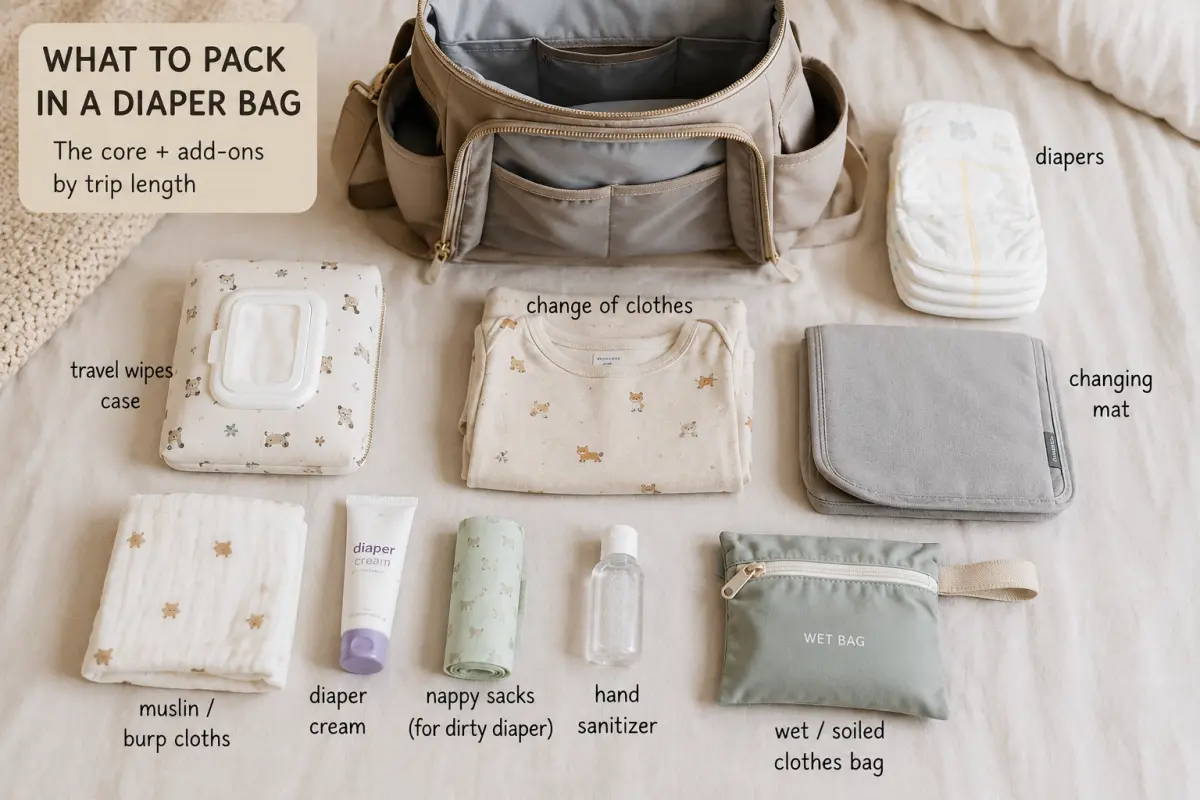
A bag holds all of that plus the things that only matter when there is no cupboard: a changing mat, more outfits, more wipes, bottles and whatever the feed situation requires, snacks once they are eating, and something for the parent. That list is in what to pack in a diaper bag.
Can one do the other’s job?
A bag can act as a caddy, and plenty of families start that way. It works, and what you notice after a fortnight is the zip. A closed bag is a two-handed object, and indoors you are usually down to one hand. If you are doing this, leave it open on the changing table rather than treating it like a bag, and accept that small things will disappear into deep pockets.
A caddy cannot really act as a bag. No closure means things tip out and nothing is private, the handles are wrong for carrying any distance, and it holds a day of changes rather than a day out. For a short hop to a grandparent’s house it is fine. For an actual day out it is not.
How many of each you end up with
Most families settle on one bag and more than one caddy, and the reason is the difference in cost and in job. A second bag is a real purchase that mostly duplicates the first. A second caddy is cheap and solves an actual problem, which is changing a baby on two floors or in two rooms without carrying the same basket up and down all day.
If you are changing in more than one place, two lightly packed caddies beat one heavy one that lives everywhere and nowhere. Each still gets the same short list, just split across two spots, and neither ends up so heavy that you stop picking it up.
What happens to each one afterwards
The caddy has the longer second life, which is worth knowing while you are choosing. A structured basket carries on as storage for books, bath things or craft supplies once nobody is in diapers, and a rigid plastic one carries on as almost anything. A felt caddy that has had a hard couple of years looks it, which is an argument for buying one that is built rather than cheap.
A diaper bag also survives, but as a different object rather than as storage. The insulated pockets, the mat and the wipe-clean lining make it a decent day bag for a toddler long after the diaper stage, which is the case for buying a plain-looking one rather than something covered in prints you will be finished with in a year.
If you can only buy one
Buy the bag. It is the harder job to improvise, it is the one with no substitute the moment you leave the house, and a basket you already own will stand in as a caddy for as long as you need it to.
Then add a caddy when you catch yourself carrying armfuls of diapers and wipes from the nursery to the living room, which is usually within a fortnight. At that point what to look for is structure, a divider and two or three pockets, and we go through it in how to choose a diaper caddy.
The bottom line
A diaper caddy is the indoor half and a diaper bag is the outdoor half of the same job. Open versus closed, restocked versus packed, carried versus worn, and they get dirty in different ways. Most families end up with both, and the useful order is the bag first because nothing else does what it does, then a caddy because most changes happen at home and walking to the nursery for every one of them gets old fast.
The other comparison people ask about is with the furniture rather than the bag, and that is diaper caddy vs changing table.
If you are picking either, the caddies we own are in the best diaper caddies we’ve used, and the bags are in the best diaper bag backpacks.
Frequently asked questions
What is the difference between a diaper caddy and a diaper bag?
A caddy is an open carrier that moves a change around your own house. A bag is a closed one that leaves it. That single difference explains the rest: a caddy is open on top so you can grab one-handed and restock from the shelf behind it, while a bag zips shut, carries hands-free and holds a longer list because you cannot top it up once you have gone. They are not competing products, they are the indoor and outdoor halves of the same job.
Do you need both a diaper caddy and a diaper bag?
If you leave the house with the baby, you need the bag. The caddy is the optional one, and it earns its place the moment you change diapers in more than one room, which is most families. If you are buying in order, buy the bag first because nothing else does its job, then add a caddy when you notice you are carrying armfuls of diapers and wipes between the nursery and the sofa.
Can you use a diaper bag as a diaper caddy?
You can, and it is a reasonable way to start. What you give up is speed, because a zipped bag is a two-handed object and at 2 a.m. you want one hand. Bags also swallow small things in deep pockets in a way an open caddy does not. If you are doing this, leave the bag unzipped and open on the changing table rather than treating it as a bag indoors.
Can you use a diaper caddy as a diaper bag?
Only for short trips, and mostly to the car or a grandparent's house. A caddy has no closure, so anything can tip out, nothing stays private in public, and there is no comfortable way to carry it plus a baby plus everything else. It also holds a day of changes rather than the longer list a day out needs.
What goes in a diaper caddy that does not go in a diaper bag?
Not much goes in one and not the other, the difference is quantity and backup. A caddy carries roughly a day of changes because the shelf behind it is the backup. A bag carries more of everything plus the things you only need when you cannot restock: extra outfits, a changing mat, snacks, disposable bags, and whatever you would hate to be without in a car park.
Which is cheaper, a diaper caddy or a diaper bag?
A caddy, usually by a good margin, since it is a basket with a divider rather than a structured bag with insulated pockets and padded straps. That is part of why buying the bag first makes sense: it is the purchase that is harder to improvise, while a caddy can be a basket you already own until you decide what you want.