Infant Optics baby monitor
This post contains affiliate links. If you buy through them, we may earn a small commission at no extra cost to you.Learn more.
Our verdict, if you don’t read another word: the Infant Optics DXR-8 PRO is a 5 out of 5 and the best baby monitor in this house, out of the four we own. It arrived as a gift, which means we would never have chosen it ourselves, and it has been the one we reach for ever since. Two years in, the picture is still clear, the sound is still clean, and the battery still lasts.
One note on scope. We cover this as gear. A baby monitor is a convenience device and not a safety one, and nothing here is a medical device. Anything touching safe sleep is a question for the AAP and the CPSC, and for the manual in the box, rather than a blog, including this one. What we can tell you is what it is like to own.
For how it lines up against the other three monitors here, see our best baby monitor roundup. This page is the DXR-8 PRO on its own.
What the Infant Optics DXR-8 PRO is, and what it claims
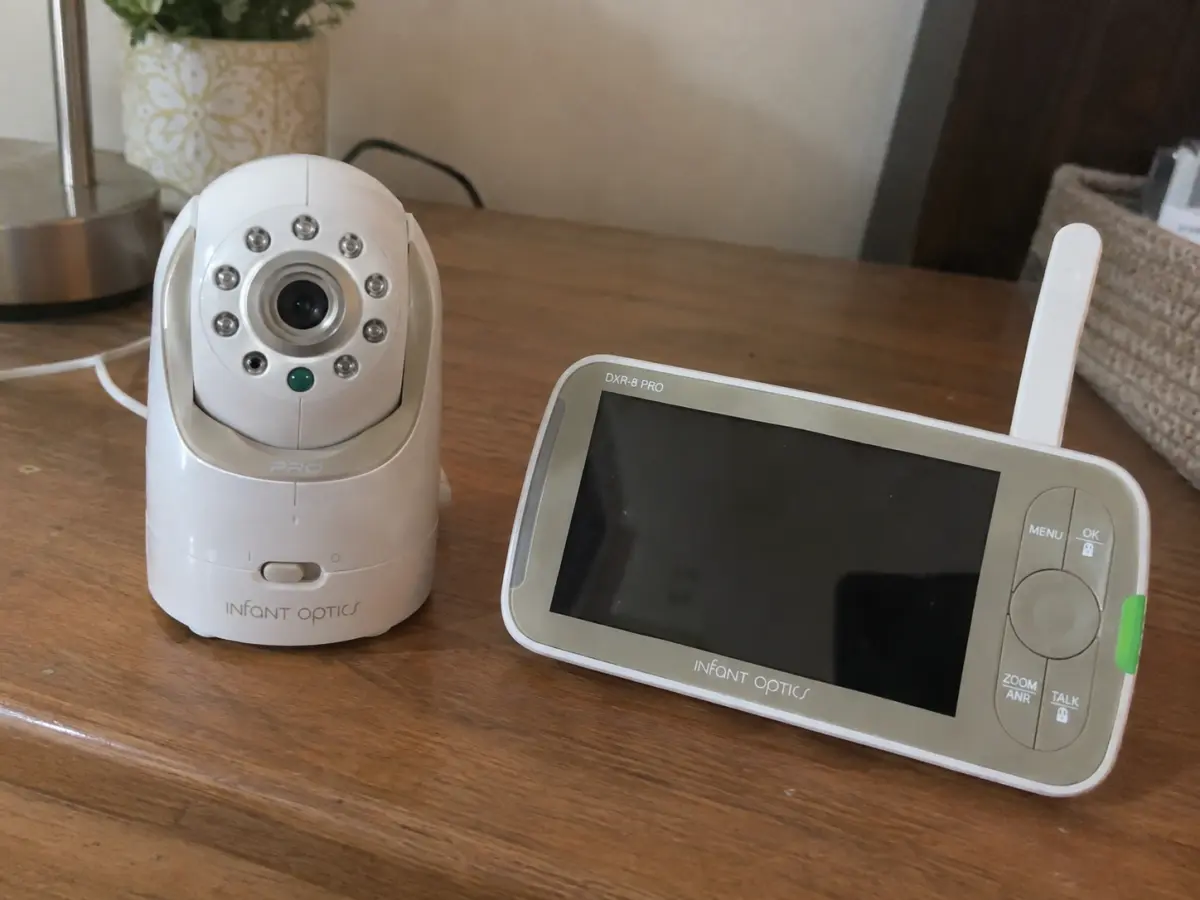
A dedicated video monitor: a white dome camera with an aluminium lens hood that wall mounts or stands on a shelf, paired with a 5 inch handheld screen. No phone involved and no account to make.
The published numbers are a 720p sensor, day and night vision, remote pan, tilt and zoom driven from the parent unit, and an FHSS connection between the two halves. The box holds the camera, the monitor with its rechargeable lithium-ion battery, an optical zoom lens, mounting screws and an anchor, a power adapter and a charging cable.
Three claims are the ones that actually separate it from the rest of the shelf, and all three have held up here: the lenses swap, the noise reduction is real, and the battery is replaceable.
The swappable lenses are the thing nobody else does
This is the only baby monitor we have used where framing is a hardware problem with a hardware answer. The standard lens handles an ordinary room. The optical zoom lens, also in the box, pulls detail from across the nursery. A wide-angle lens is sold separately if you need to fit more of the room into the shot. Changing one takes seconds on the camera.
That matters because camera placement is the part of owning a monitor that people redo three times, which we go through in how to use a baby monitor. On every other unit here, a shot that is too tight or too wide is fixed by moving the camera and rethinking the mount. On this one you change the lens and leave the mount alone.
Worth being clear about what optical zoom is doing, since every monitor on the shelf claims zoom. The digital zoom on our other units crops the picture and enlarges what is left, so you get a bigger, softer image. A zoom lens is glass. It is a different thing, and it is why the detail holds up when you use it.
Noise reduction is the feature we would miss most
Infant Optics calls it Active Noise Reduction and carries a patent number for it, 11,875,769 B2. The job it does is to filter the constant background of a nursery, fans, air purifiers, heaters, air conditioning, so that what comes through the handset is the baby instead of the room.
It sounds like listing filler. It is the feature that has changed our nights the most. A monitor that pipes fan hiss at you all night is one you quietly turn down, and a monitor you have turned down is not doing the one thing you bought it for. This one stays up because there is nothing to turn down.
The replaceable battery is why we expect to keep it
The parent unit takes a user-replaceable lithium-ion battery. Not a sealed pack, not a trip to a repair shop, not a reason to buy a whole new monitor.
Every other monitor in this house is a sealed unit on a clock. The VAVA is rated at about 5 hours from a 4500 mAh cell today, and whatever that number becomes in three years is what you are stuck with. On the Infant Optics, a battery that stops holding a charge is a battery, not a monitor.
Ours has not needed it. Two years of daily use and the runtime is still what it was, which honestly surprised us more than anything else about the unit. The point is that when it does go, the monitor does not go with it.
The screen, the picture and the sound
The screen is 5 inches, which is the smallest of the four monitors here, against just under 6 on the VAVA, 5.5 on the VTech and 6 on the HelloBaby. On paper that should count against it. In use it has not, because the picture on it is clean enough that you are not squinting at a small soft image the way you do on a cheap panel.
The picture is 720p, the same as our VAVA and well above the HelloBaby’s 480p. Resolution is close to the least useful number on a baby monitor box, and the reason this one reads well at night is the quality of the night vision rather than the pixel count.
The sound is the other half of it, and this is where the noise reduction pays off twice. It is clear, it is loud enough, and it is not carrying the fan along with the baby.
There is a microphone in the parent unit too, so you can talk back into the room, and it works properly rather than as a tinny afterthought.
What the listing gets wrong
One thing, and it is the same disease the VAVA listing has.
The bullets say no WiFi, no app, no cloud, and give FHSS as the connection protocol, which is the private radio link that a dedicated monitor uses and the reason people buy this category at all. An attribute field further down the same page then reads Wi-Fi. Those cannot both be describing the same device, and we are not going to declare which is right when we cannot verify it from outside the box. If a monitor that never touches your router is your entire reason for shopping, ask the seller before you order rather than trusting a spec table.
The same table carries an IP54 weather rating and an indoor and outdoor usage field, on a nursery camera. Baby gear listings are stuffed with copied and pasted attribute fields, and this is a good reminder to read the specification block as marketing rather than fact.
What we like
- Standard and optical zoom lenses in the box, swapped over in seconds on the camera
- Active Noise Reduction strips out fan and air conditioning noise, so you hear the baby
- The parent unit battery is user-replaceable, so the monitor outlives the cell
- Two years of daily use with no drop in runtime or picture quality
- Pan, tilt and zoom driven from the handset, so you never open the door
- Two-way audio that works properly rather than as an afterthought
- No app, no account and no cloud in the setup
What we don't
- The 5 inch screen is the smallest of the four monitors we own
- The listing carries a Wi-Fi attribute field that contradicts its own no-WiFi bullets
- The wide-angle lens is sold separately
- No remote viewing at all, which is the point of the category but still a limit
- No room temperature readout, which our VAVA has and we use
Who it’s for
Buy it if you want one monitor that keeps working for years rather than the one with the biggest number on the box. The lens swap, the noise filtering and the replaceable battery are all aimed at the same thing, which is the monitor still being good two years in. That is where ours is now.
Buy something else if you want the largest possible screen, in which case the VAVA is the one here, or if you want to check the room from outside the house, which no monitor in this category does by design.
The bottom line
A 5 out of 5, the only one we have given, and it earned it by being boring in the right way. Clear picture, clean sound, a mic that works, a setup that took minutes and two years without a single complaint from either of us. The lenses and the replaceable battery are what make it the one we would replace with itself.
If you want to see it against the other three in the house, that is our best baby monitor roundup, and the closest call is the VAVA. For getting a new one set up properly, we wrote how to use a baby monitor.
Frequently asked questions
Is the Infant Optics DXR-8 PRO worth it?
For us it is the best of the four monitors in the house and the only 5 out of 5 we have given one. Two years of daily use, a picture and a sound that have never been the problem, and a setup that took minutes. The things that make it our top pick are not on the front of the box: a battery you can replace yourself rather than a monitor you replace, noise reduction that strips out the fan noise, and lenses you can swap for the room you are in.
Does the Infant Optics DXR-8 PRO use WiFi?
Infant Optics says no WiFi, no app and no cloud, with the camera beaming a direct signal to the screen, and the listing also gives the connection protocol as FHSS, which is the private radio link a dedicated monitor uses. The one wrinkle is that the same listing has an attribute field reading Wi-Fi, sitting right next to the bullets that say there is none. Those two do not reconcile from the outside, and we would rather say so than pick one. If a monitor that never touches your router is the whole reason you are buying, confirm it with the seller before you order.
What is Active Noise Reduction on a baby monitor?
It is Infant Optics' filtering, patent number 11,875,769 B2, aimed at the constant background noise in a nursery: fans, air purifiers, heaters, air conditioning. The pitch is that what reaches you is the baby rather than the hiss of the room. We run a fan and it is the feature we would miss most if we changed monitors, because a monitor that hisses at you all night is one you end up turning down, and a monitor you turn down is not doing its job.
Can you replace the battery in the Infant Optics DXR-8 PRO?
Yes, and it is the reason we expect to still be using this one next year. The lithium-ion battery in the parent unit is user-replaceable, so a monitor that no longer holds a charge is a battery to swap rather than a monitor to rebuy. Ours is still going after two years of daily use and has not needed it yet, but every other monitor in this house is a sealed unit with a shelf life, and this one is not.
What lenses does the Infant Optics DXR-8 PRO come with?
A standard lens and an optical zoom lens are both in the box, and they swap over in seconds on the camera. A wide-angle lens is sold separately. That makes it the only monitor we own where the framing problem has an actual answer: the standard lens for an ordinary room, the zoom for detail from across the nursery, and the wide-angle if you need to fit more of the room in.
Infant Optics DXR-8 PRO or the VAVA?
The Infant Optics is our 5 and our top pick, and the VAVA is our 4.5. The VAVA has the bigger screen at just under 6 inches against 5, and it puts the room temperature on screen, which we like. The Infant Optics wins on the things that decide it over two years: the noise reduction, the replaceable battery and the swappable lenses. If the biggest possible screen is what you are shopping for, buy the VAVA. Otherwise buy this one.