Best baby monitor under $100: the three cheap ones we own
This post contains affiliate links. If you buy through them, we may earn a small commission at no extra cost to you.Learn more.
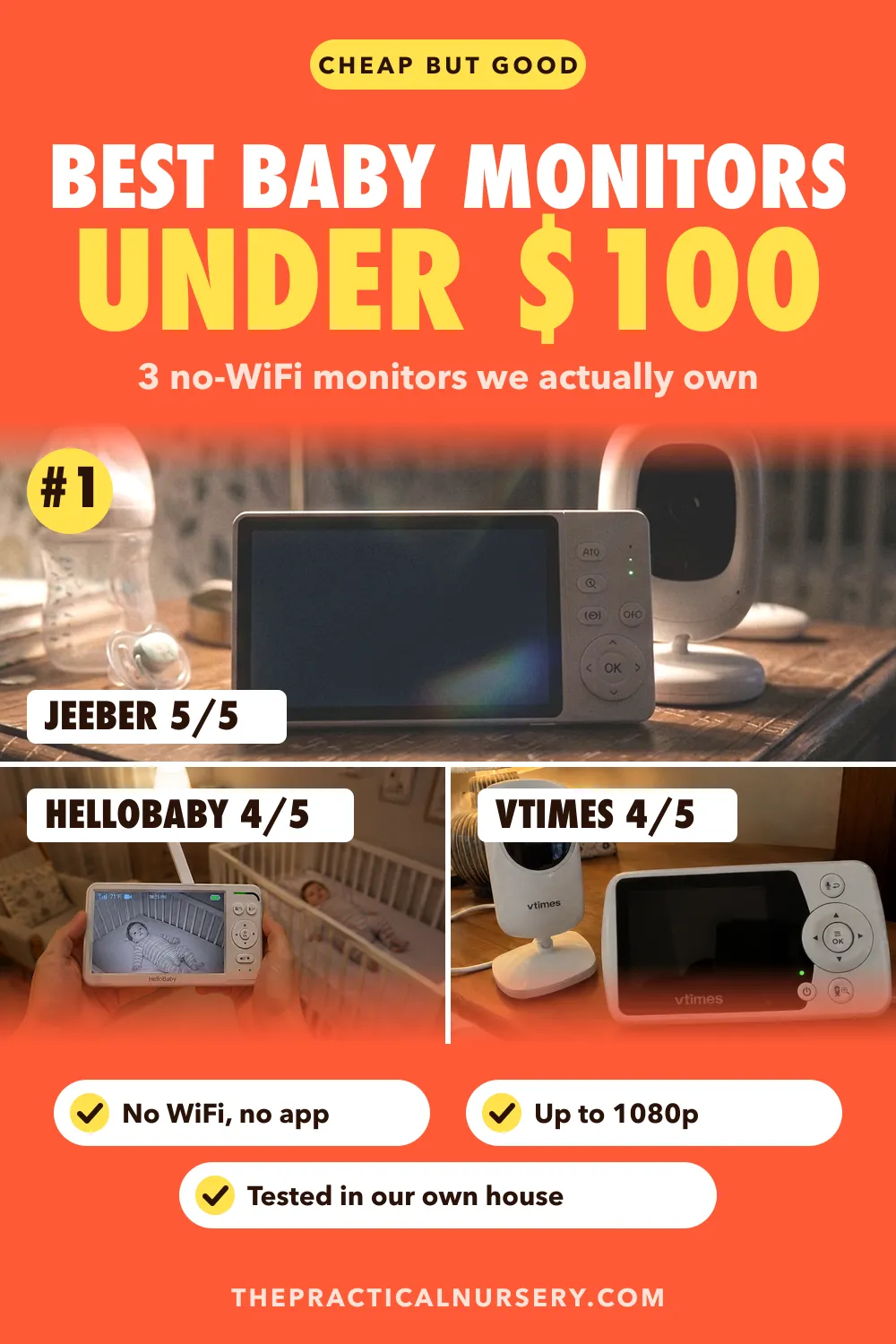
Our pick, if you don’t read another word: the best baby monitor under $100 in our house is the Jeeber VB619. It pairs a 5 inch 1080p screen with a camera that needs no WiFi, app or account, and we rate it 5 out of 5 for what it costs. If you need two cameras in the box, the HelloBaby HB6560 is the one. If you want the cheapest monitor that still does the job, the VTimes VT31 is it, as long as you can live with a 2.4 inch screen.
One note on scope. We review baby monitors as gear, and a monitor is a convenience device, not a safety one. Anything to do with safe sleep is a question for the AAP and the CPSC, not a blog, this one included. What we can tell you is what these are like to own.
We don’t print prices, because they change weekly and Amazon’s rules don’t allow it. All three sat under $100 when we checked, and the VTimes was the cheapest. Check the current price before you buy. If budget is not the constraint, our main best baby monitor roundup covers the more expensive monitors we own, including the Infant Optics we rate highest overall.
What a cheap baby monitor gives up
Cheap baby monitors are cheap for a reason, and the reason is almost always one of three things. The resolution drops, the screen shrinks, or you get one camera instead of two. Sometimes a listing makes up the difference with generous numbers for range or weather resistance, which we come back to below.
What a low price does not have to cost you is the connection. All three monitors here are no-WiFi monitors: the camera talks straight to the handset over a private 2.4 GHz FHSS radio link. There is no app to install, no account to create and nothing sitting on your home network. It is the simpler and more private way to build a baby monitor, and it costs nothing extra here. The one thing you lose is remote viewing, so you can only watch from inside the house.
So the question for each monitor on this page is which of those three things it gave up, and whether that is one you would notice.
The three side by side
| Monitor | Screen | Resolution | Cameras in the box | Zoom | Battery (screen) | Connection |
|---|---|---|---|---|---|---|
| Jeeber VB619 | 5 in IPS | 1080p | One, supports up to four | 3x digital | Rated 8 to 16 hr, VOX mode | No WiFi, 2.4 GHz FHSS |
| HelloBaby HB6560 | 6 in IPS, split screen | 480p | Two | Remote pan, tilt and zoom | Rated 16 to 30 hr, eco mode | No WiFi, 2.4 GHz FHSS |
| VTimes VT31 | 2.4 in | 480p | One | 2x digital | Not published (ours: about 7 to 8 hr), ECO mode | No WiFi, 2.4 GHz FHSS |
Each one made a different trade. The Jeeber gave up a second camera and kept the picture. The HelloBaby gave up resolution and kept two cameras and a very long battery. The VTimes gave up screen size, and in exchange it is the cheapest of the three.
1. Jeeber VB619: the cheap monitor we would buy first
The Jeeber is a single camera and a 5 inch IPS parent unit, and on paper it has the best picture of the three: 1080p on a screen big enough to read from a bed. It needs no WiFi, app or account. You power both halves on and they pair.
The feature list is long for the price. Two-way audio and built-in lullabies. Ten infrared LEDs for night vision that Jeeber describes as no-glow, so there is no red light in the room. A temperature sensor, feeding reminders, and nine language options. A VOX mode that switches the screen off while the room is quiet and wakes it when the camera hears sound, which is how Jeeber gets its rated 8 to 16 hours from the parent unit’s battery. The camera itself runs from the wall, and the box includes two power adapters and two 2 metre cables, so both halves can be plugged in overnight.
It also supports up to four cameras on the one screen, which matters if a second baby arrives or you want a camera in a playroom later. You buy the extra cameras separately, but you don’t have to replace the monitor to add them.
Jeeber backs it with a two year warranty and a 90 day return window of its own.
A few numbers on the listing are worth reading with care. The zoom is listed as 3x, but the same page gives the zoom type as digital, so treat it as a crop of the picture, not an optical zoom. The 178 degree viewing angle is given without saying whether it describes the screen or the camera lens. The 300 metre range assumes open air, not walls. And the listing marks it for indoor and outdoor use while also saying it is not water resistant. None of that changes our rating. It is simply the usual state of baby monitor listings.
What we like
- 1080p on a 5 inch IPS screen, the sharpest picture of our three cheap monitors
- No WiFi, app or account, and it pairs as soon as both halves are on
- VOX mode sleeps the screen until the baby makes a sound
- Supports up to four cameras on one screen, so it can grow with the family
- Two-way audio, lullabies and a room temperature readout
- Two year warranty from Jeeber
What we don't
- One camera in the box, so a second room means buying another
- The 3x zoom is digital, not optical
- Range and outdoor claims on the listing are more generous than a house allows
- No remote viewing, which is the design, but still a limit
2. HelloBaby HB6560: two cameras and a battery that lasts all day
The HelloBaby is the one to buy if two cameras matter more than sharpness. It ships as a two-camera set with a 6 inch split-screen handset, the largest screen on this page, and like the others it needs no WiFi, app or account.
Its standout is the battery. HelloBaby rates it at 16 to 30 hours depending on mode, with an eco mode on top, and in daily use through naps ours very rarely needs charging. That changes how you use a monitor. It goes from the nightstand to the kitchen to the garden and back, and you stop thinking about charge at all.
The cost is resolution. At 480p it has the softest picture here, and you notice it if you zoom in to study something. For the glance a monitor mostly gets, from a few feet away in a dark room, the big screen does more for you than the extra pixels would. The camera pans, tilts and zooms from the handset, and a light bar on the front runs from green to red as the room gets louder, so you can see a baby crying with the sound muted.
The split screen has one catch worth knowing. You see both cameras at once but hear only the one you have selected, and you switch between them by hand. The full story is in our HelloBaby monitor review.
What we like
- Two cameras in the box, so a shared room or a second child is covered
- The largest screen here at 6 inches
- Rated 16 to 30 hours of battery, and ours rarely needs charging
- Pan, tilt and zoom from the handset
- A green to red noise light that shows crying with the volume down
What we don't
- 480p, the softest picture of the three
- Split screen shows both cameras but plays sound from one at a time
- No remote viewing
3. VTimes VT31: the cheapest one that does the job
The VTimes is the cheapest monitor we own. It is one camera and a portable parent unit with a 2.4 inch screen, running over the same kind of 2.4 GHz FHSS link as the other two, with no WiFi or app pairing. VTimes sells it as plug and play.
The feature list is short and covers the basics. Night vision, two-way audio, a 2x digital zoom and an ECO mode that puts the screen to sleep to save battery and wakes it when the camera picks up sound. The box has the camera, the parent unit, two power adapters and a mounting kit, so the camera can stand on a shelf, go on a wall, or clip to a crib or window with the bracket. VTimes covers it with a 12 month warranty.
The screen is where the saving shows. At 2.4 inches it is less than half the width of the other two, and at 480p it is not sharp either. A screen that size is enough to see whether a baby is asleep, and not much more. VTimes does not publish a battery life figure. Ours runs about 7 to 8 hours on a charge, which is an evening rather than a full day. VTimes asks you to charge it with the original accessories and not to run the battery flat, which is sensible advice for any lithium-ion device.
One oddity on the listing: the alert type is given as motion only, while the ECO mode is described as waking on sound. We would go by the ECO description, which is the feature the product is built around, but it is the kind of contradiction worth knowing about before you rely on either.
What we like
- The cheapest monitor we own
- No WiFi or app pairing, sold as plug and play
- ECO mode sleeps the screen until it hears the baby
- Mounting kit in the box: shelf, wall, crib or window
- Portable parent unit you can carry around the house
What we don't
- A 2.4 inch screen, which is small from across a dark room
- 480p and a 2x digital zoom, so very little detail
- No published battery life figure, and ours lasts about 7 to 8 hours
- The listing contradicts itself on motion versus sound alerts
Why all three of our cheap monitors skip WiFi
Every monitor on this page is a no-WiFi one, and at this price that makes sense. A no-WiFi monitor has no app or cloud service behind it, so what you pay goes into the camera and the screen you look at.
There is a privacy side as well. A camera that pairs only with its own handset over a private radio link is not on the internet, so it cannot be reached over the internet. There is no account to be breached and no app to update. For a camera that points at a cot, that is a reasonable thing to want, and here it costs nothing extra.
The limit is remote viewing. None of these will show you the nursery from work or from a grandparent’s phone. If that matters, you are shopping for a WiFi monitor, and the VTech in our VTech baby monitor review can run either way. For the no-WiFi monitors we own at every price, including the Infant Optics, see the best non-WiFi baby monitors.
What we would check before buying any cheap baby monitor
Look at the screen size before the resolution. You will mostly glance at a monitor from a few feet away, often half asleep, and a bigger screen helps more than extra pixels do. The HelloBaby at 480p on 6 inches is easier to read than the VTimes at 480p on 2.4.
Count the cameras. If a second child is coming or two children share a room, a two-camera set like the HelloBaby, or a monitor that takes extra cameras like the Jeeber, saves you replacing it later.
Read the battery claim as rated, not tested. Rated hours assume the most frugal mode, and the only number that means anything is how often it ends up on the charger in your house.
Discount the range and weather claims. Range figures on listings like these assume open air, and all three of ours carry an outdoor use claim or a weather rating. A nursery camera sits indoors behind walls, so plan around that.
Check whether the zoom is optical or digital. At this price it is digital, which means a cropped, softer picture, not a closer one.
Where we land
For most people shopping under $100, the Jeeber VB619 is the one we would buy: the best picture of the three on a screen big enough to read, with no WiFi, app or account, and room to add cameras later. We rate it 5 for the budget category. The HelloBaby HB6560 is a 4 and the better pick for two cots or for anyone who hates charging things. The VTimes VT31 is also a 4, earned on price. It is the one to buy when the budget is the whole decision.
Those ratings are our judgment, not an average of the table, and they are scored against other cheap monitors, not against the best monitors we own. For those, see the main best baby monitor roundup. For getting the most out of whichever one you buy, including where to put the camera, see how to use a baby monitor.
Frequently asked questions
What is the best baby monitor under $100?
Of the three cheap monitors we own, the Jeeber VB619, which we rate 5 out of 5 for the budget category. It has a 5 inch screen at 1080p, needs no WiFi, app or account, and has a VOX mode that sleeps the screen until the baby makes a sound. The HelloBaby HB6560 is the one to pick if you need two cameras in the box, and the VTimes VT31 is the cheapest of the three if you want the basics and nothing else.
Are cheap baby monitors any good?
The ones we own are, as long as you know what the low price takes away. Usually it is resolution, screen size or a second camera, and sometimes the listing overstates things like range or weather resistance. What a cheap monitor does not have to give up is the connection. All three of ours are no-WiFi monitors that pair the camera straight to the handset, which is also the simpler and more private setup.
Do cheap baby monitors need WiFi?
None of ours do. The Jeeber, the HelloBaby and the VTimes all use a 2.4 GHz FHSS radio link between the camera and the parent unit, so there is no app, no account and nothing on your home network. The trade is that you can only watch from inside the house, within range of the camera.
Is a 2.4 inch baby monitor screen too small?
It is small, and it is the main thing you give up with the VTimes VT31. A monitor is mostly glanced at from a few feet away in a dark room, and a bigger screen does that job better. If the budget allows, a 5 or 6 inch screen like the Jeeber or HelloBaby is easier to live with. If it does not, the VTimes still shows you whether the baby is asleep, which is the question you are asking.
How long does a cheap baby monitor battery last?
It varies a lot, so check the listing. Jeeber rates the VB619 screen at 8 to 16 hours, with VOX mode stretching it. HelloBaby rates the HB6560 at 16 to 30 hours depending on mode, and in daily use ours rarely needs charging. VTimes does not publish an hours figure for the VT31. Ours lasts about 7 to 8 hours on a charge, and it has an ECO mode that sleeps the screen until it hears sound.