Bottle warmer vs hot water: which is better?
This post contains affiliate links. If you buy through them, we may earn a small commission at no extra cost to you.Learn more.
Bottle warmer vs hot water is a real question with an uncomfortable answer for a site that reviews bottle warmers: the free method works. Standing a sealed bottle in a jug of warm water is on the CDC’s short list of acceptable ways to warm a bottle, it costs nothing, and for a lot of families it is all they ever need.
What a warmer buys is not a better bottle. It is consistency and attention, which are worth different amounts to different households. We own four warmers and we still use the jug, so this is not a pitch.
What each one actually is
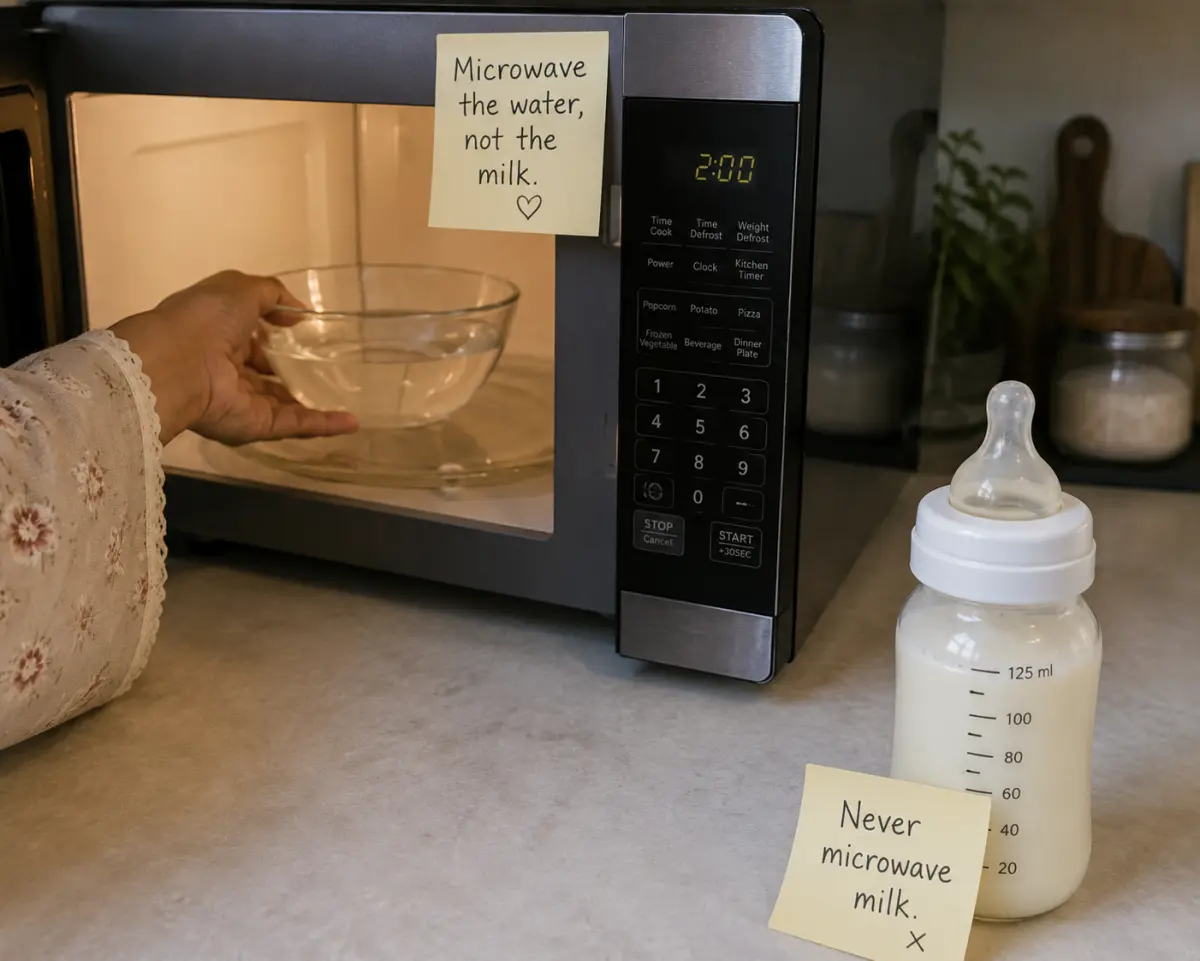
The water bath is exactly what it sounds like. You stand the sealed bottle in a jug or mug of warm water, leave it a few minutes, swirl it, and test it. The heat moves gently through the bottle, which is why the method is on the CDC’s list while putting the milk in a microwave is not, and we went through that distinction in bottle warmer vs microwave.
A bottle warmer is the same principle with the variables removed. It holds a set temperature rather than starting hot and cooling, it stops when it is done if it has a shut-off, and it produces roughly the same result on the hundredth bottle as the first.
| Hot water bath | Bottle warmer | |
|---|---|---|
| Cost | Nothing | A purchase, plus counter space |
| Speed | A few minutes, dropping as the water cools | About 3 to 4 min on our fast one, 8 to 10 on our gentle one |
| Consistency | Varies with water temperature and volume | Repeatable once you know the setting |
| Attention needed | You judge it, every time | Set it and step away, if it shuts off |
| At 3 a.m. | Boil, pour, wait, test | One dial |
| Away from home | Only where there is hot water | Only where there is power, unless cordless |
Where the jug genuinely wins
Cost is the obvious one and not the interesting one. What makes the water bath hold up is that it is available everywhere and it never breaks.
You already own a mug. There is nothing to descale, nothing to replace when it stops holding a charge, and no chamber to wipe out. In a kitchen where counter space is already spoken for, that matters more than the price. It also travels in a way that a countertop warmer does not: a cafe, a relative’s kitchen, a hotel room with a kettle, all of them can produce warm water.
For a household doing one or two warm bottles a day, we would not tell anyone they need to buy anything. We make that case in baby items you don’t need, and a warmer sits closer to that line than the rest of our feeding gear.
Where the warmer wins, and it is not speed
The assumption is that a machine is faster, and that is only half true. Our fast countertop warmer does a fridge-cold 5oz bottle in about three to four minutes. Our gentle one takes eight to ten, which is roughly what a mug of hot water does, so buying a warmer does not automatically buy speed. The full set of our timings is in how long a bottle warmer takes.
What a warmer actually removes is judgment. A jug of water starts at whatever temperature you poured it and drops from there, so the same three minutes produces a different result depending on how hot the water was, how much of it there is, how cold the bottle was and how long you stood there. You correct for all of that by testing, which works, and which requires you to be paying attention.
A warmer holds one set of conditions. Once you know that your bottle takes four minutes on setting two, it takes four minutes on setting two at 3 a.m. as well, and that is the hour when this stops being a small convenience.
The second thing it removes is the wait for the kettle, which nobody counts and which is real. Boiling water, letting it stand, and then warming the bottle is a longer sequence than the warmer’s own cycle even when the cycle is slow.
What the water bath cannot do
There are three jobs where the jug runs out, and they are worth knowing before you decide it covers everything.
Frozen milk is the clearest one. Thawing is a different task from warming, closer to a slow climb than a short one, and a jug of water that is cooling the whole time is a poor tool for it. Warmers that advertise a thaw setting are telling you they treat it as a separate job. Our Momcozy countertop one does the thaw gradually rather than making you juggle bowls of water and guess, which is the single thing it does that a mug genuinely cannot.
Large bottles are the second. Volume is the biggest factor in how long anything takes, and a 10oz bottle in a mug of cooling water is a long, drifting wait where you end up topping the water up partway through.
The third is doing it repeatedly through a night without waking up properly. A jug asks for a small judgment each time, and small judgments are exactly what you have least of at 3 a.m.
The hybrid most people land on
The middle version of this is the one we actually run, and it is worth saying out loud because it does not appear on many comparison pages: the warmer at night, the jug when the warmer is not where you are.
That means the warmer sits in the room where night feeds happen and does the feeds that matter most, and the water bath handles the daytime ones in the kitchen, the ones at someone else’s house, and the ones where the milk only needs taking off the chill. Neither method has to win outright, and treating it as a binary is what makes people either over-buy or feel bad about the mug.
Getting the water bath right
Two things go wrong with this method and both are easy to avoid.
The first is water straight off the boil. It overshoots by a long way, which means either a long wait for it to come back down or a bottle that is hotter than you want. Hot tap water, or boiled water that has stood for a few minutes, is what you are after.
The second is not moving the bottle. Water warms the outside of the milk first, so a swirl partway through evens it out. Swirl rather than shake, then test before feeding. That last step is not optional on any method, including a warmer.
For anything about the milk itself, how it should be stored, thawed or handled before it gets anywhere near a jug, the CDC is the source rather than us.
So which should you buy?
Try the jug first. It is free, it is on the CDC’s list, and a fortnight of using it tells you more about whether you want a machine than any article can, this one included.
Buy a warmer if the jug is failing you in a specific way you can name: the temperature is inconsistent, the night feeds are taking more out of you than they should, or you are warming enough bottles a day that the kettle routine has become its own chore. Those are good reasons. A registry list is not one.
If you get there, our four are in the best baby bottle warmers, and what to look for is in how to choose a baby bottle warmer.
The bottom line
Hot water works, costs nothing and travels. A warmer is more consistent and asks less of you, which is worth most at the hour when you have least to give. Speed is not the dividing line, since our gentle warmer takes about as long as a mug does. Whichever you use, swirl it and test it, and take anything about the milk itself to the CDC rather than a gear blog.
Frequently asked questions
Is a bottle warmer better than hot water?
Better at different things. A warm-water bath costs nothing, needs no counter space and is on the CDC's short list of acceptable ways to warm a bottle. A warmer is more consistent, needs less of your attention, and holds a steadier temperature than a jug that starts cooling the moment you pour it. If you feed once or twice a day, the jug is genuinely enough. If you are doing night feeds, the warmer is buying back attention at the hour you have least of it.
How do you warm a bottle with hot water?
Stand the sealed bottle in a jug or mug of warm water and leave it a few minutes, swirling rather than shaking to even it out, then test the temperature before feeding. The water warms the milk gently through the bottle, which is why the method is on the CDC's list while microwaving the milk is not. Boiling water straight from the kettle is hotter than you need, and it is the part of this method people most often get wrong.
Is the hot water method slower than a bottle warmer?
Not always, and that surprises people. Our fast countertop warmer does a fridge-cold 5oz bottle in about 3 to 4 minutes, but our gentle water-bath warmer takes 8 to 10, which is roughly what a mug of hot water does. So the honest comparison is that a warmer can be much faster, not that it always is. What a warmer gives you consistently is a hands-off result at a steady temperature.
Do you need a bottle warmer at all?
No, and we say so in every warmer article we write. Plenty of babies take milk at room temperature or cool, and for the ones who want it warm, a jug of water does the job. A warmer earns its place when the number of feeds, the time of night, or the amount of attention you have left makes a hands-off machine worth the counter space and the money.
Can you use boiling water to warm a bottle?
You do not need it, and we would not. The point of the water bath is a gentle transfer of heat, and water straight off the boil overshoots that by a wide margin, which then means waiting for it to come back down. Hot tap water or boiled water left to stand for a few minutes does the job. Whatever you use, test the milk before it goes anywhere near the baby.