How long does a bottle warmer take to warm a bottle?
This post contains affiliate links. If you buy through them, we may earn a small commission at no extra cost to you.Learn more.
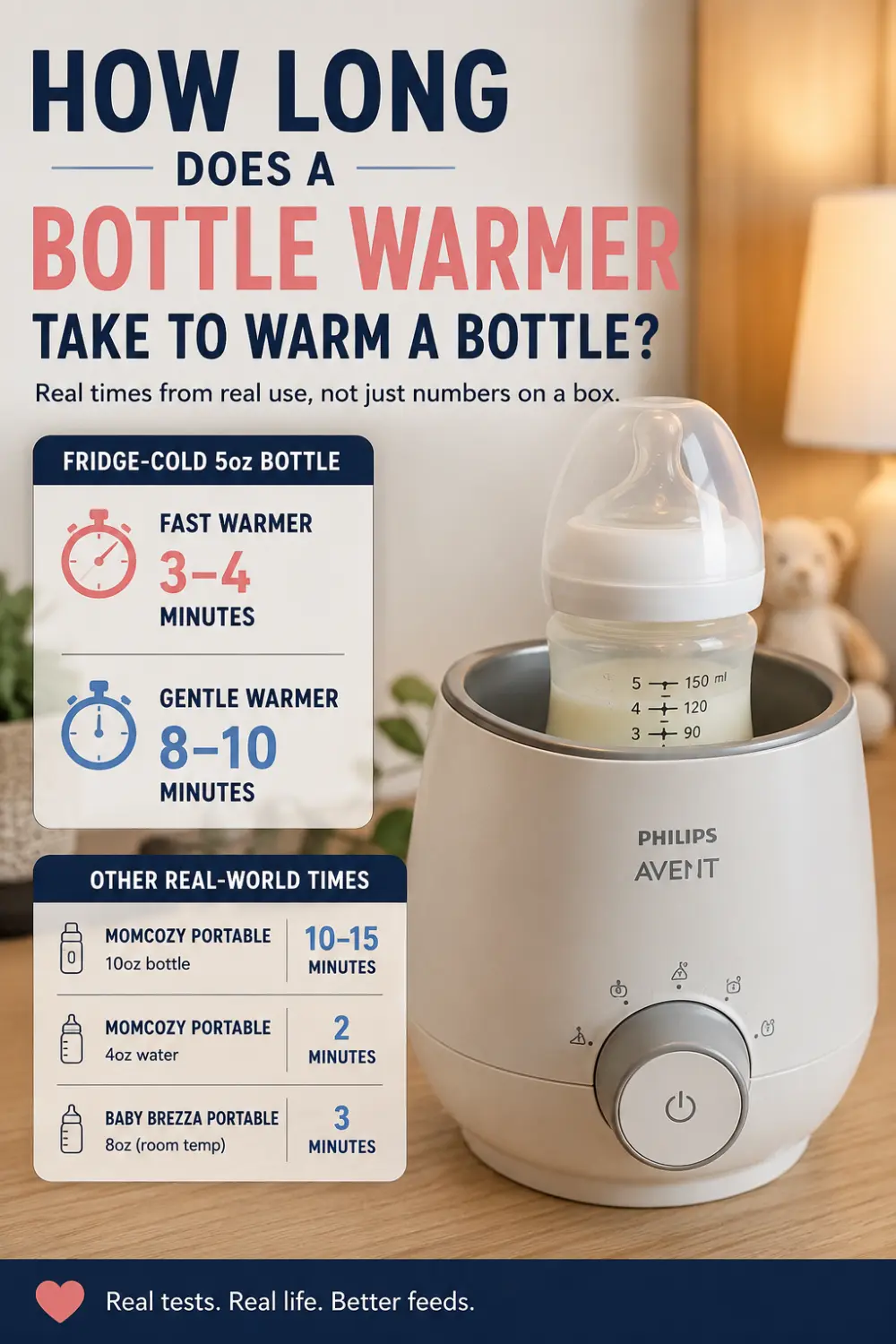
The short answer, if you don’t read another word: a bottle warmer takes about 3 to 4 minutes for a fridge-cold 5oz bottle if it is a fast one, and about 8 to 10 minutes if it is a gentle one. Those are our own stopwatch times, not numbers off a box. The range is wide because two warmers doing the same job can be four times apart, and because the size of the bottle and where it started matter more than the brand on the front.
One honest note first. We cover the gear here. Safe milk temperatures, how long warmed milk can sit and how to handle breast milk are questions for the CDC and your pediatrician rather than a blog, including this one. What we can tell you is how long these machines actually take, because we have timed ours.
The times we actually measured
We timed a fridge-cold 5oz bottle with a phone stopwatch across a few real sessions, on the two countertop warmers we have lived with, and we have a good sense of the portables from daily use.
| Warmer | Bottle | Time | Where the number comes from |
|---|---|---|---|
| Philips Avent Fast | Fridge-cold 5oz | About 3 to 4 minutes | Our phone stopwatch, a few sessions |
| Kiinde Kozii | Fridge-cold 5oz | About 8 to 10 minutes | Our own timing |
| Momcozy portable | 10oz | About 10 to 15 minutes | Our own use, everyday bottles |
| Momcozy portable | 4oz water | About 2 minutes | Momcozy rated figure |
| Baby Brezza portable | 8oz from room temperature | About 3 minutes | Baby Brezza rated figure |
The two rows that tell you the most are the first two. Same bottle, same starting temperature, same kitchen, and one warmer takes roughly a third of the time of the other. That gap is not a quality difference. It is a design choice, and we go through it in detail in Avent vs Kozii.
The cheapest countertop warmer we own, the Tommee Tippee Easiwarm, warmed a bottle within five minutes in our use. We cover it in our Tommee Tippee bottle warmer review, and rank it against the Avent and the Momcozy in the best mid-range bottle warmer.
What actually changes the answer
Four things move the number, and only one of them is the warmer itself.
Volume is the biggest. A 4oz bottle and a 10oz bottle are not the same job, and no warmer makes them close. Our cordless portable is rated at about 2 minutes for 4oz of water, and the same unit took us 10 to 15 minutes on a 10oz bottle. Nothing was wrong with it. There was simply two and a half times as much liquid in the way.
Starting temperature is next. Room temperature to body temperature is a short trip. Fridge-cold is a much longer one, and frozen is a different task altogether, closer to thawing than to warming. Any warmer that advertises a defrost or thaw setting is telling you that it treats these as separate jobs, and so should you when you are planning.
The warming method sets the pace. A rapid steam warmer moves heat into the bottle quickly. A circulating warm-water bath moves it in gently and evenly, which takes longer on purpose. Neither is broken. They are aimed at different priorities, which is the whole subject of how to choose a baby bottle warmer.
The bottle itself matters more than people expect. Glass holds and passes heat differently from plastic, and a thick insulated bottle slows everything down, which is the point of an insulated bottle. If you switch bottle types, expect your timings to shift and re-learn them once rather than assume the warmer has changed.
Why the box time never matches your kitchen
Rated times are not dishonest, they are just measured under the conditions that produce the best number. Usually that means a small volume, often starting at room temperature rather than fridge cold, with the warmer already at its working temperature.
Our Philips Avent is the honest case: Philips Avent quotes about 3 minutes for a 5oz bottle, and our own stopwatch put a fridge-cold 5oz bottle at about 3 to 4 minutes. Close enough that the quoted figure was useful. Our cordless portable is the other case, where the rated 2 minutes is for 4oz of water and our real bottles were 10oz, so the gap between the box and the kitchen was ten minutes wide.
The way to read any rated time is to look for the volume and the starting temperature it was measured at. If a listing does not say, assume the friendliest possible conditions, then plan for longer. That single habit will save you more frustration than picking a different brand.
Portable warmers are not automatically slower
Cordless warmers used to be the slow option by definition, and that is no longer reliably true. Our Momcozy portable warms at a pace close to our countertop warmer, which for a 10oz bottle meant 10 to 15 minutes. The Baby Brezza portable is built specifically to close that gap and is rated at 3 minutes for 8oz from room temperature, a figure we quote as the manufacturer’s because we have not stopwatched it ourselves.
What is genuinely different about a portable is not the speed, it is the battery. A rated warm count assumes small volumes and ideal conditions, exactly like a rated warm time, so we halve any rated count in our heads before planning a day around it. We compare the two we carry in the best portable bottle warmer for travel.
Thawing frozen milk runs on a different clock
Warming and thawing get talked about together and they are not the same job. Bringing a cold bottle up to body temperature is a few minutes of work. Taking frozen milk back to liquid is a much longer process, and it is the reason warmers advertise defrost or thaw as a separate setting rather than folding it into the warming time.
If a warmer quotes you one number, that number is for warming. Nothing we own thaws frozen milk in anything close to its warming time, and we would treat any product claim that suggests otherwise with suspicion. The all-in-one warmer we tried handles thawing as its own mode for exactly this reason, and we cover how that machine splits the jobs in our Momcozy bottle warmer review.
The planning consequence is simple. Frozen milk is a decision you make hours ahead, not a thing you solve at the moment of hunger, and no warmer on the market changes that arithmetic. How long frozen milk keeps and how it should be thawed for safety are questions for the CDC and your pediatrician, not for us.
How to time your own warmer in one night
This is one part of getting a new warmer working the way you want, and the rest of the routine, from water levels to what to do when a bottle comes out uneven, is in how to use a bottle warmer.
None of the numbers above are as useful to you as your own, because your bottles and your fridge are not ours. Getting your real figure takes one feed and a phone.
Use the bottle you actually use, filled to the volume you actually fill it, straight from where it actually lives. Start the stopwatch when you start the warmer and stop it when the milk is where you want it. Do that across two or three feeds rather than once, because a single run can be thrown off by a warmer that was already warm from the last bottle.
Write the number down somewhere you will find it at 3 a.m. Ours is the difference between guessing and knowing, and knowing is what lets you start the warmer at the right moment instead of hovering over it. If your timing comes out much worse than the quoted figure, check volume and starting temperature before you blame the machine. Those two explain almost every gap we have seen.
Faster is not always the goal
It would be easy to read all of this as an argument for buying the quickest warmer on the shelf, and that is not quite what we think. Speed is a real feature at 3 a.m., and we chose it. But rapid warming is also where uneven heating shows up, which is why some families feeding breast milk deliberately pick a slower, gentler warmer and consider the extra minutes well spent.
The one thing that is not a shortcut is the microwave. It heats unevenly and creates hot spots, and the CDC is blunt about it. A bowl of warm water takes a few minutes and does the job without that risk, which we cover in bottle warmer vs. microwave.
The habit that makes the wait irrelevant
Whatever your warmer takes, the fix is the same and it is not a purchase. Start the warmer before your baby is hungry rather than after the crying begins. Three minutes and ten minutes feel almost identical when nobody is waiting on them, and both feel endless when someone is.
For night feeds that means getting the bottle going as you get up, not once you are back in the nursery. For days out it means starting the portable when you park, not when you sit down. We build the whole routine around that one habit, and it does more for the experience of feeding than any spec on the box.
The bottom line
Expect about 3 to 4 minutes for a fridge-cold 5oz bottle from a fast countertop warmer and about 8 to 10 from a gentle one, both from our own stopwatch, and expect a big 10oz bottle to take 10 to 15 minutes in a portable. Check what volume and starting temperature any advertised time was measured at, add a margin for your own bottles, and start the thing early. The warmers we have timed and what each one is best at are all in the best baby bottle warmers we have used.
Frequently asked questions
How long does a bottle warmer take to warm a bottle?
For a fridge-cold 5oz bottle, a fast countertop warmer takes about 3 to 4 minutes and a gentle water-bath warmer takes about 8 to 10. Those are our own phone-stopwatch times across a few real sessions, not brochure figures. Bigger bottles take longer: warming a 10oz bottle in our cordless portable took 10 to 15 minutes. Frozen milk is a different job again and takes far longer to thaw than to warm.
Why does my bottle warmer take longer than the box says?
Because the quoted time almost always assumes the easiest conditions, usually a small bottle starting at room temperature rather than a full one straight from the fridge. Volume and starting temperature are the two things that change the answer most. Halve any rated figure in your head, or check which volume and starting point it was measured at, and you will be much closer to what you actually see.
Is a faster bottle warmer better?
Not automatically. Speed is genuinely useful at 3 a.m., and it is why the fast warmer is the one that lives on our dresser. But rapid warming is also where uneven heating and hot spots creep in if you walk away from it, which is why some families feeding breast milk deliberately choose a slower, gentler warmer. For anything about safe temperatures and milk handling, follow the CDC and your pediatrician rather than a blog.
How long does a portable bottle warmer take?
It depends on the model and the volume more than on the fact that it is cordless. Our 17oz Momcozy portable warmed a 10oz bottle in 10 to 15 minutes, close to what our countertop warmer does with the same bottle. Baby Brezza rates its portable at 3 minutes for 8oz from room temperature, which is a manufacturer figure rather than one we have timed.