How to warm breast milk without a bottle warmer
This post contains affiliate links. If you buy through them, we may earn a small commission at no extra cost to you.Learn more.
To warm breast milk without a bottle warmer, stand the sealed bottle in a jug or mug of warm water for a few minutes, swirl it, and test it before feeding. That is the warm water bath, and it is one of the two methods the CDC lists as acceptable. The other is a bottle warmer, which you do not have, which is why you are here.
We own four warmers and we still use this method most days, usually because the warmer is in the wrong room. It is not a downgrade or a stopgap, it is the method the machines were built to automate.
One boundary before the how. Everything on this page is about moving heat into a bottle. How breast milk should be stored, how long it keeps, how to thaw it and what to do with what is left after a feed are questions for the CDC and your pediatrician. We are not going to improvise numbers on any of that.
The warm water bath, properly
Fill a mug, jug or bowl with warm water, deep enough that the milk level in the bottle sits below the water line. That last part is what people miss: if the water only reaches the bottom third of the bottle, the top third stays cold and you end up with a bottle that is warm at one end.
Stand the sealed bottle in it and leave it a few minutes. The seal matters, both because you do not want tap water getting in and because a capped bottle is what lets you swirl it without making a mess.
Swirl it partway through rather than at the end. Water heats the outside of the milk first, so moving it is what turns a hot edge and a cold middle into one temperature. Swirl rather than shake.
Then test before it goes anywhere near the baby, every single time, no matter how many bottles you have done this way. That step is not a formality, it is the whole safety mechanism of a method that has no thermostat in it.
Do not use water straight off the boil
The most common way this goes wrong is reaching for the kettle and using the water immediately.
Boiling water overshoots what you need by a wide margin. The result is either a bottle that gets hotter than you wanted while you are not watching, or a few minutes of waiting for the water to come back down, which makes the whole method slower than it should be. Hot tap water is usually enough. If you are boiling, let it stand for a few minutes first.
There is no prize for the water being hotter. The bottle only ever gets as warm as the water around it, so hotter water buys you a smaller margin of error rather than a faster result.
The microwave, used the one way that is fine
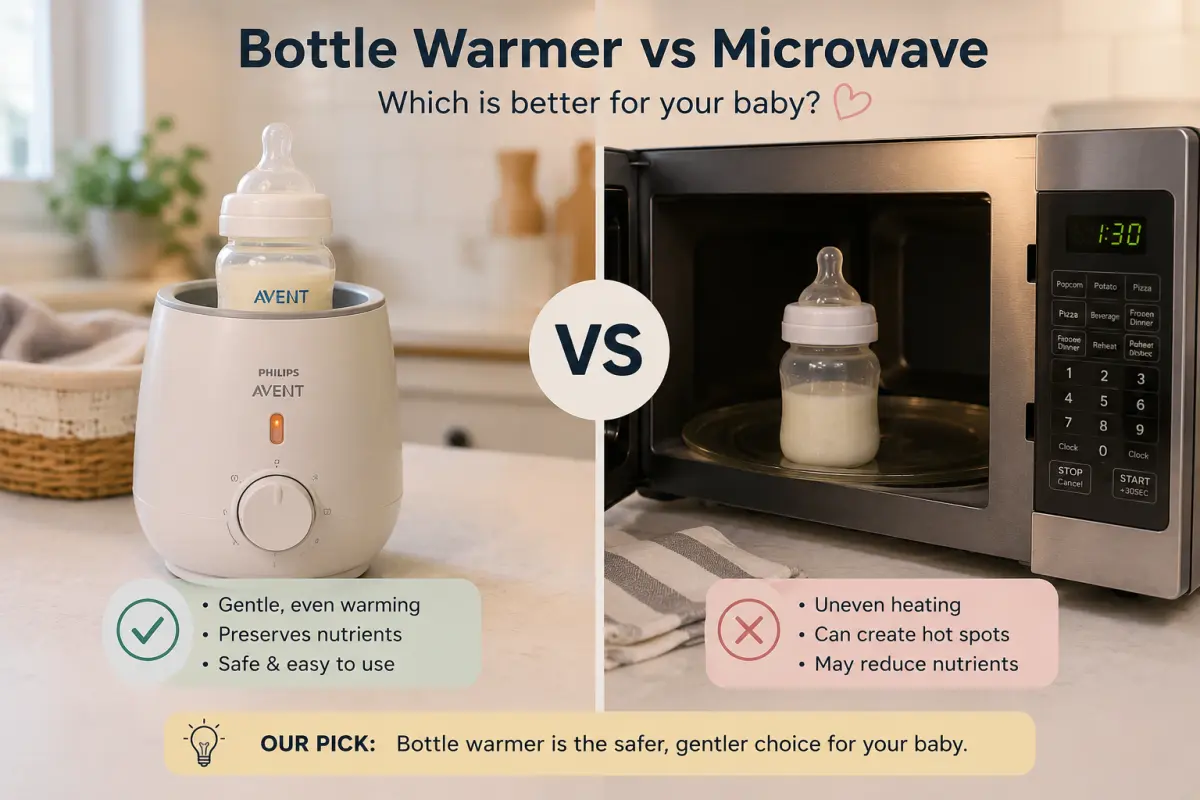
The CDC’s wording on microwaving milk is blunt: never use a microwave, because it heats unevenly and creates hot spots that can burn a baby’s mouth and throat. That is not our sentence and we are not softening it.
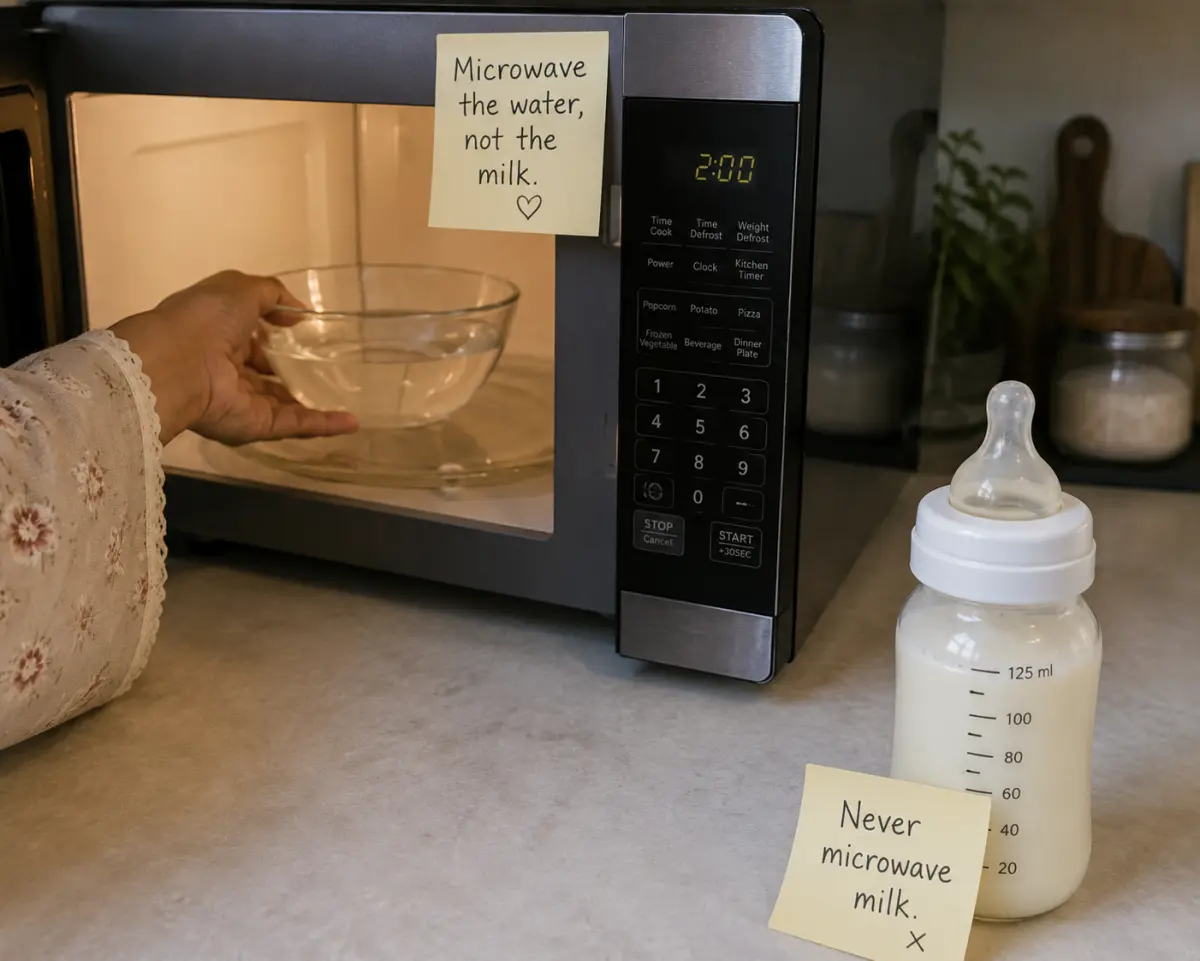
What the microwave can do is heat the water. Put a mug of water in, take the mug out, then stand the sealed bottle in that water and warm it exactly as above. The milk never goes in the microwave. This is the version we use when the kettle feels like too many steps, and we wrote the full comparison, with the CDC’s own quote, in bottle warmer vs microwave.
The running tap version, for when you have nothing
Away from home, holding the sealed bottle under warm running water works. Turn it as you go so one side is not doing all the warming, and test it the same way.
It uses a startling amount of water to warm one bottle, which is why we treat it as the version for a public bathroom or a kitchen you do not want to rummage in, rather than the everyday method. Any sink with a warm tap will do it, and it needs nothing you have to carry.
Storage bags warm differently from bottles
A bag has a lot more surface area against the water than a bottle does, so it takes heat faster and it is easier to overshoot. Give it less time than you think, move it around in the water, and check it earlier than you would check a bottle.
The other thing bags do is leak if the seal has been stressed, so stand a bag in water rather than running a tap over it, and pour it into a bottle before you feed rather than trying to judge temperature through the bag.
Frozen milk is a different job
Thawing is not warming with more time. It is a separate task, it takes considerably longer, and doing it by repeatedly topping up a mug of cooling water is a poor version of it.
This is the one place a machine has a genuine advantage, since warmers with a thaw setting handle it as its own cycle. If you are working without one, plan it ahead rather than starting when a baby is already hungry, and follow the CDC guidance on thawing rather than anything you read on a gear site.
The methods we would avoid
Three shortcuts come up often enough to be worth naming, and none of them is worth the minutes it saves.
The milk in the microwave is the one with an actual authority behind the objection, and the CDC’s wording covers it. Heat the water if you want, never the milk.
A pan on the hob is the next. It sounds like the same idea as a water bath and it is not, because a pan sitting on a burner keeps climbing rather than holding at one temperature, so what you are doing is warming milk over an active heat source with no upper limit. If you want to use a pan, take it off the heat first and treat the water in it as a bath.
The last is skipping the test because the bottle feels right. A bottle can feel pleasant in your hand and still have a warmer core, particularly if it has not been swirled, and your hands are a worse thermometer than you think after a few night feeds.
Does the bottle itself change this?
A little, and it is worth knowing if your timings suddenly shift. Glass moves heat differently from plastic, and a thick insulated bottle slows everything down, which is exactly what an insulated bottle is for.
None of that makes the method different, it just means your few minutes is not universal. Learn the timing for the bottles you actually own and re-learn it if you switch, which we go through alongside the glass bottles we use in the best glass bottles for breastfed babies.
Do you need a warmer after all this?
Honestly, often not. If this method is working, the machine buys you consistency and one less decision rather than a better bottle, and we lay that trade out in bottle warmer vs hot water.
The case for buying one gets stronger with the number of night feeds, and weaker if your baby happily takes milk cool. We keep a warmer in the room where night feeds happen and a mug in the kitchen, which tells you roughly where we think the line is.
The bottom line
Warm water, deep enough to cover the milk line, a few minutes, a swirl, and a test. Never the microwave for the milk itself, and no need for boiling water. Bags warm faster than bottles and frozen milk is its own planned job. For anything about the milk rather than the heat, the CDC and your pediatrician are the sources, not us.
Frequently asked questions
How do you warm breast milk without a bottle warmer?
Stand the sealed bottle or bag in a jug or mug of warm water for a few minutes, swirl it partway through to even it out, then test the temperature before feeding. That is the warm water bath, and it is one of the two methods the CDC lists as acceptable, the other being a bottle warmer. It needs no equipment beyond something to hold the water and it works anywhere there is a hot tap or a kettle.
Can you warm breast milk in the microwave?
No. The CDC is direct about this: never use a microwave, because it heats unevenly and creates hot spots that can burn a baby's mouth and throat. The workaround that keeps the microwave useful is to heat a mug of water in it, take the mug out, and then stand the sealed bottle in that water. The microwave heats the water and the water warms the milk, so the milk never goes in the microwave at all.
Can you warm breast milk under a running tap?
You can, and it is the method to use when you have no container to spare. Hold the sealed bottle under warm running water, turning it as you go so it warms evenly rather than on one side. It uses a lot of water for one bottle, which is why we treat it as the away-from-home version rather than the everyday one.
How long does it take to warm a bottle in warm water?
A few minutes for a normal bottle, and longer than you would guess for a big one, because volume is the biggest factor in any warming method. For reference, our gentle countertop warmer takes 8 to 10 minutes on a fridge-cold 5oz bottle, and a mug of water is in the same territory. Frozen milk is a different job again and takes far longer, which is why thawing is worth planning rather than improvising.
Do you have to warm breast milk at all?
Not necessarily. Plenty of babies take milk cool or at room temperature, and warming is about preference rather than requirement for most. If your baby has never refused a cool bottle, the whole question is optional. For anything about storing, thawing or handling breast milk itself, follow the CDC and your pediatrician rather than a gear blog.