Best glass bottles for breastfed babies, ranked
This post contains affiliate links. If you buy through them, we may earn a small commission at no extra cost to you.Learn more.
Our pick, if you don’t read another word: of the glass bottles for breastfed babies we have fed with, the Philips Avent Natural Response is the one we reach for, and it gets 4.8 out of 5 from us. The Thyseed anti-colic glass bottle comes second at 4.5 for its wide breast-shaped nipple and the fact that there is almost nothing to wash, and Dr. Brown’s Options+ wide-neck glass takes third at 4, held back by leaking and a stubborn cap rather than by how it feeds. All three are borosilicate glass, all three ship a slow flow nipple, and the thing that separates them is entirely the nipple and the plumbing behind it.
One honest note before anything else. We review gear here. Whether to introduce a bottle to a breastfed baby, when to do it, what to do if feeding at the breast changes afterwards, and anything touching colic, reflux or milk storage are questions for your pediatrician or an IBCLC lactation consultant, not a blog. What we can tell you is what these three bottles are like to fill, feed with and wash several times a day.
Why glass at all, and what it has to do with breastfeeding
Nothing, is the honest answer to the second half. Glass does not make a bottle better for a breastfed baby. The nipple does that, and most of these nipples also come fitted to plastic bottles from the same brands.
What glass buys you is the boring stuff you notice at month six. It does not pick up a milk smell, it does not stain, it does not go cloudy in the dishwasher, and it does not scuff, which matters because every scuff inside a plastic bottle is somewhere residue can sit that a brush does not properly reach. A glass bottle that looks clean is clean. It also takes daily sterilizing for years without degrading, so a set can outlast more than one baby. The CDC’s four sanitizing methods, and who actually needs to do it daily, are in how to sterilize baby bottles.
The costs are just as plain. Glass is heavier, it costs more, and it breaks. That last one stops being theoretical the week your baby starts holding her own bottle and discovers what happens when she lets go. Our split ended up being glass at home and something plastic in the diaper bag, and we would not argue with anyone who lands in the same place. We set out that trade properly in glass vs plastic baby bottles.
So the sensible way to shop is the way we did it. Decide on glass for the cleaning and the longevity, then choose between glass bottles purely on the nipple.
The three, side by side
| Bottle | Neck | Nipple approach | Air handling | Parts to wash | Our verdict |
|---|---|---|---|---|---|
| Philips Avent Natural Response | Wide | Opens only under active sucking, so she paces the feed | Valve integrated into the nipple | 4 | Buy: our everyday bottle |
| Thyseed anti-colic glass | Wide | Softest nipple here, wide and breast-shaped, three holes at the tip | Pressure-sensing valve in the base | 3 | Buy for the fewest parts at the sink |
| Dr. Brown's Options+ wide-neck glass | Wide | Breast-shaped Level 1 slow flow, faster levels sold separately | Internal vent insert, removable as she grows | 5 with the vent, 4 without | Buy if swallowed air is the problem |
1. Philips Avent Natural Response glass bottle
A wide-neck borosilicate bottle with Philips Avent’s Natural Response nipple and an anti-colic valve built into the nipple itself. Four parts total: bottle, nipple, screw ring, cap.
The nipple is the whole reason it sits at number one. Most bottle nipples drip. Turn one upside down and milk runs out on its own, which means a baby who has paused to breathe or swallow is still getting milk arriving in her mouth. The Natural Response nipple has a slit that opens under active sucking and closes when she stops, so milk comes out when she draws it out and not before. The rhythm of the feed goes back to her, which is the pattern a breastfed baby already knows.
Philips Avent rates the borosilicate body as BPA-free and safe for the dishwasher, steam and UV sterilizers, and boiling water. Those are their specifications rather than our measurements. What we can speak to is the washing, which has not clouded, stained or scratched it.
Two caveats worth knowing before you buy. Some babies take to a non-dripping nipple on the first feed and others need a handful of feeds to work out that they have to do the work now, so do not judge it on one attempt. And the flow number matters more here than on a dripping nipple. Too slow and she fights it and tires out, too fast and you have lost the reason you bought it.
What we like
- The nipple releases milk only while she is actively drinking, so the feed runs at her pace
- Glass has stayed clear and unscratched, with no milk smell and nothing stained into it
- Wide neck fills, brushes out and dries properly, and fits most warmers without an adapter
- Only four parts, so there is little to lose and little to scrub at midnight
What we don't
- Heavier than plastic, which matters once she holds the bottle herself
- It is glass, so a chipped bottle has to be thrown out
- Some babies need a few feeds to adjust to a nipple that does not drip on its own
This is the pick for most breastfed babies starting bottles, and it is the one we own the most of. The full write-up, including what borosilicate actually buys you, is in our Philips Avent Natural Response glass bottle review.
2. Thyseed Anti-Colic Glass Baby Bottle
Thyseed solves the air problem in a third place. Instead of venting through the nipple or through a tube in the middle of the bottle, it puts a valve in the base that senses the pressure change as your baby drinks and lets air in from below. The practical upshot is a bottle with almost nothing in it: wide-neck borosilicate body, nipple, ring. Three parts, and the shortest wash-up here.
The nipple is wide and breast-shaped to encourage a deeper latch, and it is the softest silicone of the three. There are three holes at the tip rather than one, which spreads the flow out instead of sending it in a single stream, and the effect when a baby latches on is closer to hand expressing than to a tap being turned on. Thyseed sells six flow rates, so the bottle is intended to follow her from newborn upwards, and the listing we bought pairs an 8 oz body with a slow flow nipple rated 3m+. The 5 oz newborn version with the extra slow 0m+ nipple is in the best baby bottles for newborns. Thyseed specifies food-grade borosilicate glass, silicone from Wacker and polypropylene from TotalEnergies, and rates the parts for the top rack of the dishwasher.
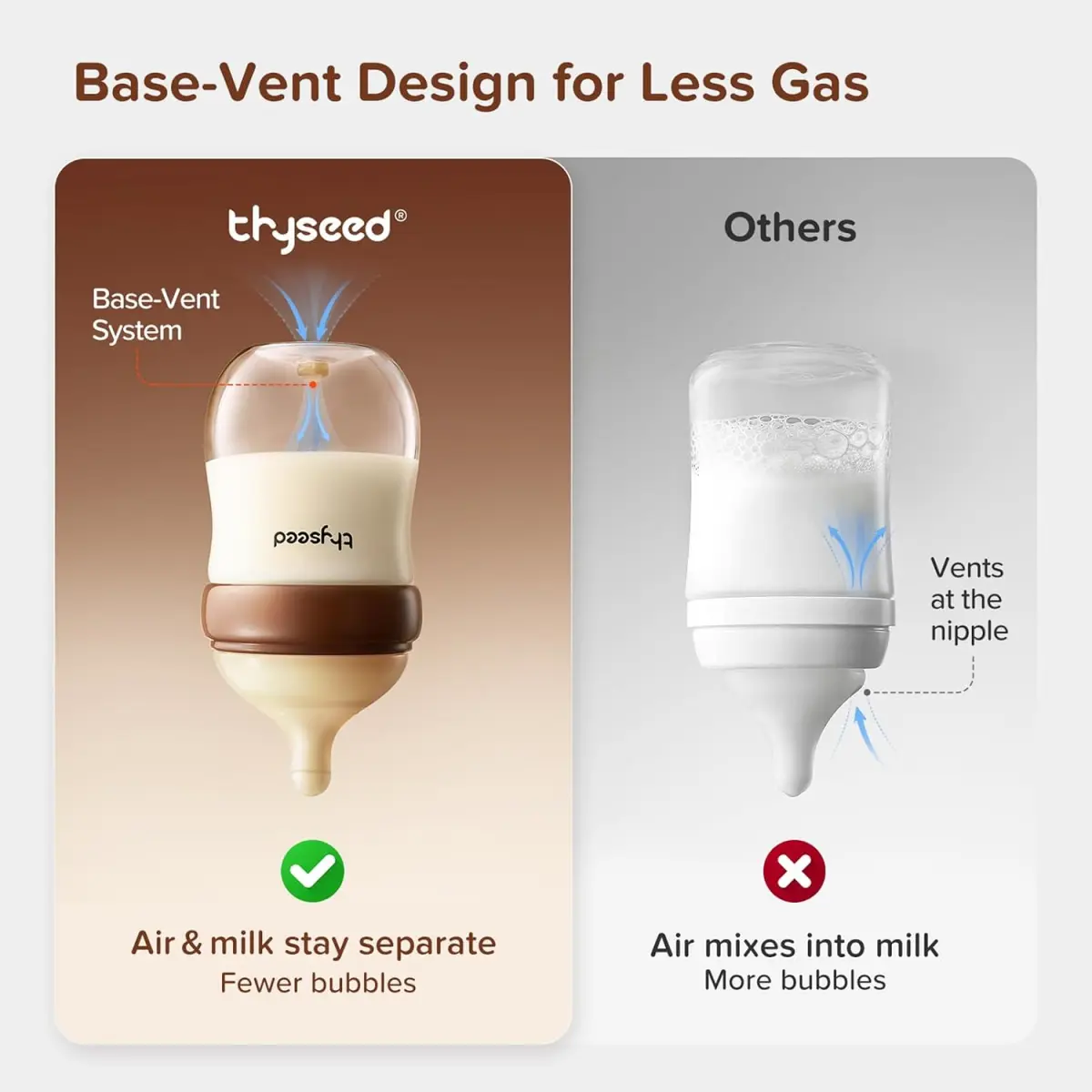
What keeps it off the top spot is not how it feeds. It is that Thyseed is the least established of the three, which matters on a thing you buy replacement nipples for over two years, and that the valve sits in the base, which is the end that takes the knocks and sits in warm water. Neither has bitten us. Both are worth knowing before you buy six of anything.
What we like
- Three parts total, the shortest wash-up of anything here
- The softest nipple here, wide and breast-shaped, with three holes at the tip rather than one
- Six flow rates available, so the same bottle follows her up
- Wide neck fills and brushes as easily as the Avent
What we don't
- The anti-colic valve lives in the base, which is the part most exposed to knocks and warm water
- Smaller brand, so replacement nipples and long-term availability are less certain
- Fewer parents have used it, so there is less collected experience to compare yours against
This is the pick if you want a soft, wide, breast-shaped nipple and you are tired of drying racks. It rates 4.5 from us.
3. Dr. Brown’s Anti-Colic Options+ wide-neck glass bottle
The vented one, and the specialist of the group. Dr. Brown’s runs an internal vent down the inside of the bottle that carries air past the milk to the top, so air goes into the bottle rather than into your baby as she drinks. Dr. Brown’s describes it as clinically proven to reduce colic and to decrease spit-up, burping and gas. That is their claim, and it is a claim about the bottle rather than a diagnosis about your baby. Colic has several possible causes and it belongs in a conversation with your pediatrician.
The detail we like most is that the vent comes out. Once your baby is past the stage where swallowed air is a daily problem, you lift the insert out and carry on with the same bottles instead of buying a second set. Few brands let you change the bottle rather than change bottles.
The version we would buy is the wide-neck glass one, which is the shape that fills and brushes like the other two here rather than the narrow bottles Dr. Brown’s is better known for. It comes as a 9 oz body with a Level 1 slow flow nipple for newborns, and faster levels are sold separately as she grows. The nipple is breast-shaped, and Dr. Brown’s pitch for it is a consistent flow that lets a baby feed at her own pace. Dr. Brown’s rates the glass as heat and thermal shock resistant and safe for the dishwasher on the top rack, electric and microwave sterilizers, and boiling water.
It finishes third on handling rather than on feeding. A vented bottle is a bottle with a hole in the top of it by design, so shaking it or tipping it upside down puts milk where you did not want milk. Ours also has a cap that fights you at both ends of a feed, which is a strange thing to notice about a bottle until you are doing it one-handed at 3 a.m. Add the vent insert itself, which comes out and goes back in at every wash and has to dry before it does, and you have a bottle that asks more of you than the other two.
The flow warning above is the one worth repeating. Nipple levels are not interchangeable across brands, and a baby happily on Level 2 with one bottle is not automatically on Level 2 with another. On a vented bottle a level that is too fast and a bottle that already leaks compound each other.
What we like
- Internal vent moves air past the milk instead of into your baby, and the maker has clinical backing for the colic claim
- The vent lifts out once she outgrows needing it, so the bottles keep working
- Wide neck, so it fills, brushes and dries as easily as the Avent
- Rated by Dr. Brown's for top-rack dishwasher, electric and microwave sterilizers, and boiling
What we don't
- Leaks if you shake it or turn it upside down, which a sealed bottle would not do
- The cap is a struggle to get off and back on, and worse one-handed
- An extra part to remove, wash and dry at every feed, and the one part you can lose
- Level 2 was noticeably faster here than Level 2 on our Avent nipples, so do not assume levels carry across brands
This is the pick if the thing you are actually trying to solve is swallowed air rather than pacing. It rates 4 from us, and the gap to the other two is handling rather than feeding. The bottle itself is lovely, and the size is right.
What actually decides this, if you only compare one thing
Compare nipples. Everything else on a glass bottle is close enough that it will not change your day.
The flow rate is first, and it is the one people get wrong. Each of these ships a slow flow nipple and sells faster ones separately, and a flow that is too fast is what turns a calm feed into a gulping one. Check which level is in the box you are buying, since it varies. And do not assume a level number carries across brands. Ours went from Level 2 on the Avent to Level 2 on the Dr. Brown’s and got a noticeably faster feed out of it, which is a mistake you make once. Go by how your baby copes rather than the age printed on the packet, and take the question to your pediatrician rather than to a review site if she is struggling with it.
Second is whether the nipple drips when you tip it. A dripping nipple keeps delivering while she pauses. The Avent is built specifically not to, and that single behavior is why it is our first pick for a baby coming off the breast.
Third is nipple shape, which is about the latch rather than the flow. All three of these are wide and breast-shaped, and all three brands make the same claim about encouraging a deeper latch. They are still not identical in the hand, and some babies clearly prefer one over another. There is no way to know which yours is until she tries, which is the argument for buying one or two rather than a set of six.
Fourth is air handling, and the three of them solve it in three different places: in the nipple, in the base, or in an insert through the middle. More plumbing means more parts on the drying rack, and that trade is most of why our order came out the way it did. It is also the thing that decides how long washing takes, which we go through in how to clean baby bottles properly. If venting is the specific reason you are shopping, we ranked the bottles on that basis alone in anti-colic baby bottles.
Fifth is neck width, which decides whether the bottle fits your warmer. All three here are wide, which is the safer bet and part of why we ended up with these three. If you are looking at narrow bottles instead, check the warmer first. We go through the fit question properly in how to choose a baby bottle warmer. If you have not bought one yet, the warmers we would pick for these bottles are ranked in the best bottle warmer for glass bottles, the rest of the models we use are in the bottle warmers we have tested, and if you are not sure you need one at all we made that case honestly in bottle warmer vs microwave.
What we would skip
Glass bottles with no silicone sleeve available, if your baby is at the grabbing stage. The sleeve is grip and it is damage limitation, and a bottle line that does not offer one is a line you will outgrow early.
Buying a set of six before your baby has fed from one. The nipple is the part she has an opinion about, and it is the part you cannot return once the packet is open. One or two first, then commit. We work the number through properly in how many baby bottles do you actually need.
Any bottle sold on the promise that it cures colic. Reducing swallowed air is a mechanical claim we are happy to repeat. Curing colic is not a claim a bottle gets to make, whoever is making it.
Where we landed
Buy the Philips Avent Natural Response glass bottle if you want one recommendation and your baby is moving between the breast and bottles. Buy the Thyseed if you want a wide breast-shaped nipple and the shortest wash-up of the three. Buy the Dr. Brown’s wide-neck glass bottle if swallowed air is the problem you are actually trying to solve, and accept the extra parts at the sink as the price of it.
We use all three and the whole set gets sterilized together, which is the real answer for most households: you end up with more than one bottle, and the bottle you buy second is usually the one your baby picked. If you are feeding formula rather than expressed milk, the ranking changes, and the bottles that mix and wash best are in best baby bottles for formula feeding. For where bottles sit against everything else you are being told to buy, our realistic baby registry checklist has the short list of what earns its place.
Frequently asked questions
What is the best glass bottle for a breastfed baby?
Of the three we feed with, the Philips Avent Natural Response glass bottle is the one we hand to a new parent first, and we rate it 4.8 out of 5. Its nipple only releases milk while the baby is actively sucking, so the feed runs at her pace rather than gravity's, which is the closest thing a bottle does to the pattern a breastfed baby already knows. The Thyseed is second for its wide breast-shaped nipple and the fact that there are only three parts to wash, and Dr. Brown's is third, and is the one to buy if swallowed air is the problem you are actually trying to solve.
Are glass bottles better than plastic for breastfeeding babies?
The glass itself has nothing to do with breastfeeding. What glass buys you is a hard, non-porous surface that does not stain, hold milk smells, go cloudy or scratch, and that survives repeated sterilizing for years. Whether a bottle suits a breastfed baby is decided by the nipple shape and flow rate, not the material. Plenty of plastic bottles use the same nipple. We chose glass for the cleaning and the longevity, then chose between glass bottles on the nipple.
Do glass bottles cause nipple confusion?
Bottle material is not what that conversation is about, and we are not the people to have it with you. Whether and when to introduce a bottle to a breastfed baby, and what to do if feeding at the breast changes afterwards, is a question for your pediatrician or an IBCLC lactation consultant. What we can tell you is the mechanical part: a slow flow nipple that only releases milk under active sucking makes a bottle feed slower and more effortful, which is what the paced-feeding designs are trying to achieve.
Which nipple flow should you start a breastfed baby on?
All three of these ship a slow flow nipple and sell faster levels separately as the baby grows, though the exact level in the box varies by listing, so check before you buy. Beyond that, the right level depends on your baby and how she is actually feeding, which is a judgment for you and your pediatrician rather than a number a blog can give you. Watch how she copes with the flow rather than going by the age printed on the packet, since babies differ a lot at the same age.
Are glass baby bottles safe if they break?
All three of these are borosilicate glass, the same family used in cookware and labs, which handles sudden temperature change far better than ordinary glass. It is still glass. It can break on a tile floor, and a bottle with a chip or a crack in it goes in the bin rather than back in the rotation. Silicone sleeves, sold for most glass bottle lines, help with grip and with containing a break if one does go down. Follow the care instructions that ship with your bottle rather than any blog, including this one.
Can you put glass baby bottles in the dishwasher and sterilizer?
All three makers rate their bottles for dishwasher cleaning, with Thyseed and Dr. Brown's specifying the top rack only, and for steam or boiling sterilizing. That is the practical case for glass over plastic if you sterilize daily, since borosilicate takes repeated heat cycles without clouding or degrading the way plastic gradually does. Check the current instructions in your box, since manufacturers do update them.
How many bottles do you need?
We got by with four to six in rotation, which is enough to cover a day of feeds without running the dishwasher at midnight. Buy one or two of a bottle first and see whether your baby takes to that nipple before you commit to a set of six, because the nipple is the part she has an opinion about and it is the part you cannot return once opened.