Dekor diaper pail
This post contains affiliate links. If you buy through them, we may earn a small commission at no extra cost to you.Learn more.
Our verdict, if you don’t read another word: the Diaper Dekor EKO Classic is a 5 out of 5 and the one we would hand a new parent who does not want to think about this purchase. It is the cheapest of the three pails in our house to buy and the cheapest to keep running, the pedal means you never touch it, and the odor control has held up in daily use.
One note on scope. We cover this as gear. A diaper pail is a convenience product rather than a necessity, which we argue in what is a diaper pail, and nothing here is safety guidance. What we can tell you is what it is like to own.
For how it sits against the other two pails here, see our best diaper pail roundup. This page is the Dekor on its own.
What the Dekor EKO Classic is, and what it claims
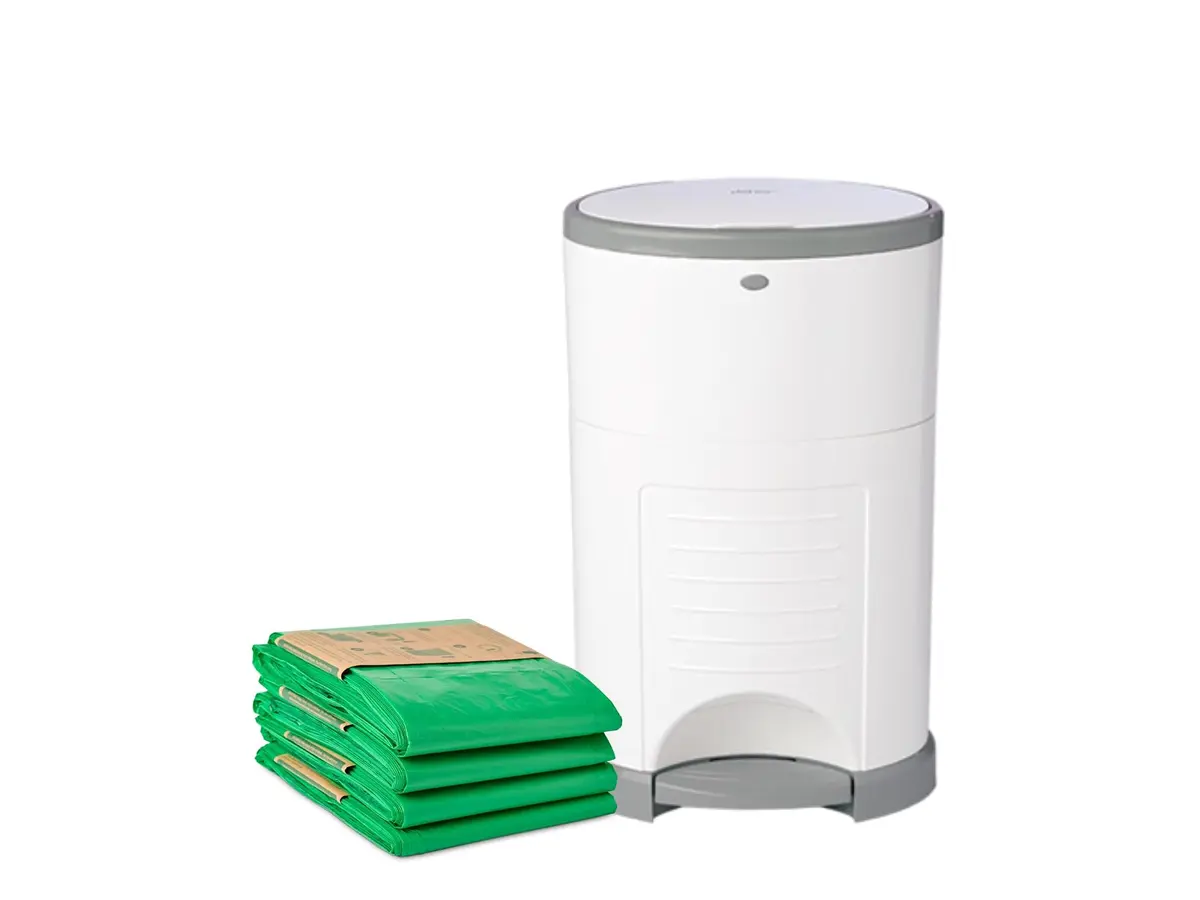
A 15 litre oval pail with a step pedal, sold as a gift set: the pail itself, one refill already fitted, and eight more in the box, which Dekor puts at around a year of liners.
The published claims are worth listing plainly, because most of them are the reason to buy it. Hands-free step and drop operation. A body made from 70 percent GRS certified post-consumer recycled closed-cell ABS, which Dekor says will not absorb odor and cannot rust the way metal can. A pre-installed refill rated at up to 495 newborn diapers. A continuous liner you cut to length rather than a bag per emptying. A quiet-close lid. And a trap door insert that lifts out when you are done with diapers, turning the thing into an ordinary pedal bin.
The pedal is the part you feel every day
Step, drop, walk away. That is the whole interaction, and it is the difference between a pail you use properly and one you leave propped open because your hands are full.
It matters more than it reads on a spec sheet, because the moment you are dealing with a pail is almost always the moment you have a baby on one arm. Nothing to slide, nothing to twist, nothing to push a diaper past with your fingers. Our Ubbi has a sliding lid that needs a free hand, and it is a genuinely good pail, but the hand it asks for is the one you do not have.
The lid closes quietly, which is not a headline feature and is exactly the sort of thing you notice at 3 a.m. next to a room with a sleeping baby in it.
The liner system is where the money actually is
This is the part that separates it from the refill system people complain about.
A conventional cartridge pail gives you one bag per emptying, so emptying a half-full pail wastes half a bag and you end up waiting until it is worth it. Dekor’s refill is a continuous tube. You pull down what you need, cut it, tie it off, and the rest stays in the pail for next time. Empty it whenever you like and it costs you exactly the length you used.
That changes the economics and the habit at the same time. The pail stops being something you ration and starts being something you empty when it suits you, which is also the single best thing you can do for how a nursery smells.
Then there is the bag question, and we want to be straight about both halves of it. Dekor recommends its own Classic refills, the ones with the end-of-liner markings, and those are what the pail is designed around and what the company stands behind. It will also take a generic bag, which is what keeps the running cost near zero once the eight in the box are gone. Both of those are true, and which you do is your call rather than something forced on you by the hardware. That is more freedom than a cartridge-locked pail gives you.
The plastic question, honestly
We have argued elsewhere on this site that plastic pails absorb odor and steel ones do not, so it would be strange to skip past that here.
Dekor’s answer is the type of plastic: closed-cell ABS rather than the ordinary porous kind, which the company says does not take odor in and, unlike metal, cannot rust. That is a real distinction rather than marketing noise, since closed-cell means the surface is not the open network that lets smell work its way in. It is also a manufacturer claim, and the only honest test of it is time.
What we can tell you is what ours does now: it has stayed neutral in daily use, and it cleans with ordinary household cleaner without any special handling. What we cannot tell you yet is what it smells like after two years, which is exactly the point at which a cheap plastic pail usually gives itself away. When we know, this page will say so.
What we like
- True hands-free operation, which is the one thing you notice with a baby on one arm
- Continuous liner you cut to length, so emptying early costs you nothing
- Gift set arrives with one refill fitted and eight more, around a year of liners
- Takes a generic bag as well, so the running cost need not be a subscription
- Closed-cell recycled ABS that cleans with ordinary household cleaner and cannot rust
- The trap door insert lifts out, so it becomes a pedal bin after diapers
What we don't
- Dekor recommends only its own Classic refills, so generic bags are your call rather than theirs
- It is still plastic, and the no-odor claim is one only time can settle
- The 495 diaper and 15 litre figures are ceilings, not how often you will actually empty it
- A pedal and a trap door are more moving parts than a sliding lid has
Capacity, and how often you actually empty it
Dekor rates the fitted refill at up to 495 newborn diapers and the pail at 15 litres. Both numbers are ceilings rather than plans.
What decides when a pail gets emptied is never how much will physically fit. It is how much smell you are prepared to store, and on that measure the continuous liner changes the calculation more than the capacity does. Because you cut only what you use, there is no cost to emptying it early, so the pail stops being something you ration and becomes something you deal with when it suits you. That habit does more for how a nursery smells than any figure on the box.
The practical shape of it in our house is emptying on a rhythm rather than on a signal. By the time any pail is telling you it is full, it has been holding that for a while.
The footprint, and where it ends up living
It is an oval body rather than a round one, which makes it easier to stand against a wall or beside a changing table than its volume suggests. Ours lives in the washroom rather than the nursery, which is where its second life as a plain pedal bin will happen anyway, and the footprint has never been the reason for that.
Worth measuring your own space before ordering anyway. Capacity is advertised in large type and dimensions in small type across this entire category, and the pail you want in the nursery is the one that actually fits where the changing happens.
It is sold as a gift, and that is a fair description
The set is the pail, a refill already fitted, and eight more in the box. For a registry that is a genuinely sensible thing to receive, because it is the rare baby item that arrives with its consumable already covered for about a year, so the person opening it is not immediately shopping for something else.
It also survives the end of diapers, which most pails do not. Lift the trap door insert out and it is a plain pedal bin for a bathroom or a laundry room, so the thing does not become landfill the week you finish potty training. Neither point changes how it performs day to day, and both are reasons it is the one we would put on a registry.
Who it’s for
Buy it if you want the most pail for the least money, or if you want the hands-free version of this product without paying for a premium finish. It is also the easiest of the three to recommend as a gift, which is presumably why it is sold as a set.
Buy something else if you specifically want steel, in which case our Ubbi is the one here, or if you would rather have the absolute best seal at the moment of drop-in and do not mind a refill subscription. That second case is the Diaper Genie, and we put the two side by side in Diaper Genie vs Diaper Dekor.
The bottom line
A 5 out of 5, earned on value rather than luxury. The pedal makes it usable one-handed, the continuous liner makes emptying it early free, and the box of refills means you are not spending again for about a year. The open question is what closed-cell plastic smells like in two years, and we will update this page rather than guess.
If you are choosing between pails rather than reading about this one, the best diaper pail roundup puts all three we own side by side, and how to clean a diaper pail covers keeping whichever you buy from turning.
Frequently asked questions
Is the Diaper Dekor EKO Classic worth it?
We rate it 5 out of 5 and it is the pail we would point a new parent at first, because it is the cheapest of the three we own to buy and to keep running. You step on the pedal, drop the diaper and walk away, the odor control has held up, and the gift set arrives with a refill fitted and eight more in the box, which is around a year of liners before you spend anything.
Can you use regular trash bags in a Dekor diaper pail?
Dekor recommends its own Classic refills, the ones with the end-of-liner markings, and that is what the pail is designed around. In practice it will take a generic bag, which is what saves the money over the years you are in diapers. Our advice is to know both things: the refills are what the manufacturer stands behind, and the pail is not locked to them the way some refill systems are.
How does the Dekor continuous liner work?
Rather than one bag per emptying, the refill is a continuous tube of liner. You pull down as much as you need, cut it and tie it off, so a half-full pail costs you a half-length of liner instead of a whole bag. That is the part that quietly saves money, because it lets you empty whenever you feel like it rather than waiting for the pail to justify a full bag.
How many diapers does the Dekor EKO Classic hold?
Dekor rates the pre-installed refill at up to 495 newborn diapers, and the pail itself at 15 litres. Treat both as ceilings rather than targets. Like any pail, what decides how often you empty it is how much smell you are willing to store, not how much the manufacturer says will physically fit.
Is the Dekor pail plastic, and does plastic hold odor?
It is plastic, and Dekor's answer to the usual objection is the type: 70 percent GRS certified recycled closed-cell ABS, which the company says does not absorb odor and cannot rust the way a metal pail can. Closed-cell is a genuinely different argument from ordinary porous plastic, and we can tell you that ours has stayed neutral in daily use. We have not owned it long enough to tell you what it smells like in two years, and we will say so here when we know.
Does the Dekor pail work after diapers?
That is one of the nicer touches. The trap door insert lifts out, and what is left is a hands-free step pedal bin you can use in a bathroom or a laundry room. Most pails are finished the day you are, so a second life is worth something when you are weighing which one to buy.