Parker Baby diaper caddy review: the one we'd buy again
This post contains affiliate links. If you buy through them, we may earn a small commission at no extra cost to you.Learn more.
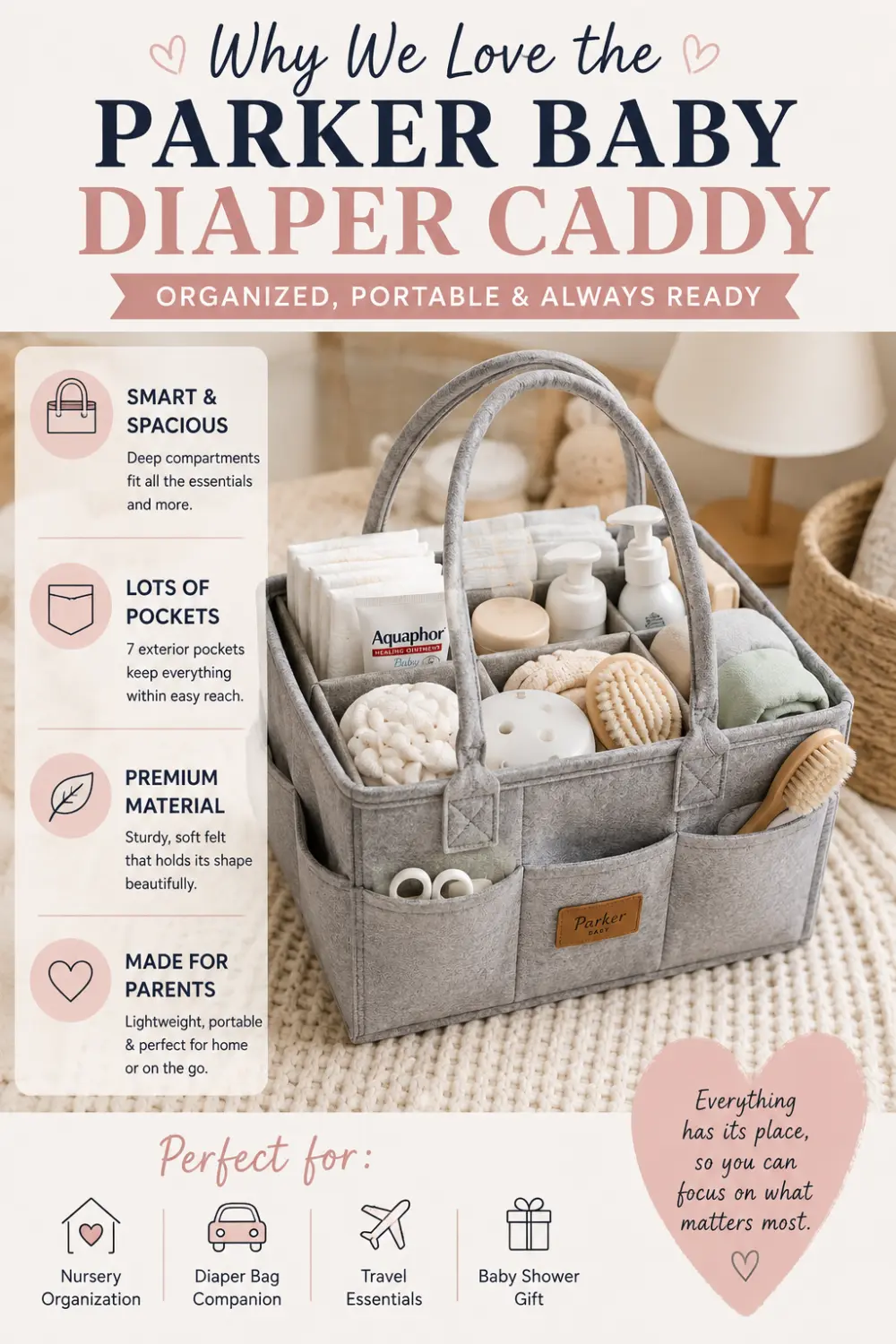
Our verdict, if you don’t read another word: the Parker Baby diaper caddy earns 5 out of 5 and it is the single most-used organizer in our house. It is a structured felt basket with a removable divider, outside pockets and two handles, which sounds boring, and it is boring. That is exactly why it works. Seven or eight months of daily use and it still holds its shape and still looks presentable when people come over.
This is the caddy we picked first in our best diaper caddy roundup, where we put it against a structured fabric basket and a woven rope one. This page is the longer version: what living with it is actually like, and the one thing about it that annoys us.
What the Parker Baby caddy actually is
A structured felt basket with a removable divider down the middle, pockets around the outside, and two handles. There is no clever mechanism and nothing to break, which is most of the point.
Felt is the material that decides how this thing behaves. It is stiff enough to stand up on its own, which a soft fabric basket and a woven rope caddy are not, and that single property is what makes the difference in daily use. We go through the full material trade-off in how to choose the right diaper caddy.
The divider is what makes it work
Plenty of caddies ship with a divider. The question is whether it stays where you put it, and this one does. Ours lives in permanently and only comes out when we clean underneath it.
What that buys you is three working sections instead of one bucket: baby accessories in one, wipes in another, diapers in their own. The value of that is not tidiness for its own sake, it is that you stop digging. When everything shares one compartment, the thing you need is always at the bottom, and you find it by unpacking the caddy one-handed while a baby waits on the mat.
A divider that slides the moment you lift the caddy gives you none of that, because the sections merge on the first trip between rooms. That is the difference between a divider as a feature and a divider that actually works.
The outside pockets are the underrated part
This is the feature we would not have paid attention to before owning it, and it turned out to be the real win. The pockets around the outside hold the small flat things that otherwise sink: we keep medicine and gauze in ours.
The reason it matters is that small items behave differently from bulk. Diapers and wipes stay where you put them. A tube of cream, a thermometer, nail clippers, a spare pacifier will all work their way under the diaper stack within a day. Giving them a shallow pocket on the outside, where you can see them without opening anything, solves that completely.
One sensible caveat on the medicine. Store anything medicinal the way its label and your pharmacist direct, rather than by what is convenient in a caddy, and think about where the caddy itself sits once your baby is mobile and reaching.
It holds its shape, which sounds trivial and is not
A caddy that slumps when it empties is a caddy you have to hold open. That is fine at a changing table with both hands free, and useless on a sofa with a baby on one arm.
The Parker keeps its shape whether it is full or nearly empty. Structured felt is stiff enough to stand up on its own, so the caddy stays open and you reach in one-handed without thinking about it. Woven rope looks lovely and does the opposite: it loses its shape as soon as you pack it properly, which is why we would only put a few things in one.
Over months this is also what keeps it looking presentable rather than tired. A slumped, misshapen basket on a shelf reads as clutter. This one still looks like furniture.
The honest drawback: felt picks up lint
Every material trades something, and this is what felt trades. It attracts lint and pet hair, and it needs an occasional lint-roll to stay looking sharp.
It is also spot-clean only. You cannot put it in the washing machine, so a real spill is a scrub-and-dry job rather than a wash cycle. Neither of those has come close to outweighing the structure for us, but they are the two things to know before buying, and they are the reason someone who expects mess would be better off with plastic.
That is the honest split between this and the hard plastic caddy we also use, which wipes clean with a baby wipe and cannot slump, but does not look soft on a shelf and costs more. We reviewed that one separately in our Ubbi diaper caddy review, and put the two head to head in Ubbi vs Parker Baby.
Felt against the other caddy materials
| What you notice | Structured felt | Fabric basket | Woven rope | Hard plastic |
|---|---|---|---|---|
| Holds shape when empty | Yes | Mostly | No, slumps when packed | Yes |
| Cleaning | Spot-clean only | Spot-clean | Spot-clean | Wipe with a baby wipe |
| Lint and pet hair | Picks it up | Some | Less noticeable | None |
| Look on a shelf | Tidy and calm | Soft | The prettiest | Clean but reads as plastic |
| Second life after diapers | Toy or craft storage | If it still looks good | If it still looks good | Almost guaranteed |
Felt is the one we would pick for most people, and the Parker is the felt one we own. If your priority is how it looks in a soft-styled nursery, rope wins on looks and loses on structure. If cleaning is the thing you expect to resent, go plastic.
What we like
- Removable divider genuinely stays put, splitting accessories, wipes and diapers cleanly
- Outside pockets keep small items like medicine and gauze from sinking into the main compartment
- Keeps its shape even half-empty, so it stays open while you reach in one-handed
- Structured felt still looks presentable after seven or eight months of daily use
- Real second life later as toy or craft storage
What we don't
- Felt picks up lint and pet hair, so it needs an occasional lint-roll
- Spot-clean only, it cannot go in the washing machine
- Not the choice if you want something you can simply wipe out
What we keep in it
Eight to ten diapers rather than the whole pack, a travel wipes case, cream, one change of clothes, a burp cloth or two, and one small toy. That is the working list, and it is deliberately short, because a caddy you overstuff loses its shape and stops being something you carry.
The divider does the sorting and the outside pockets take the small stuff. If you want the full method, including the front-to-back packing order that makes it usable one-handed, we wrote it up in how to organize a diaper caddy.
Who it is for, and who should skip it
Buy this one if you change diapers in more than one room, if you want a caddy that stays open and usable one-handed, or if you would rather the thing on your shelf looked like furniture than like baby gear. It is also the sensible pick if you want something that outlives the diaper stage as storage.
Skip it if you expect regular spills and would rather wipe a caddy out than scrub it, in which case plastic is the better material, or if lint on felt is the kind of thing that will bother you every time you look at it. For where a caddy sits against everything else on the list, our realistic registry checklist covers what earns its place.
The bottom line
The Parker Baby diaper caddy takes 5 out of 5 from us on the strength of three unglamorous things: a divider that stays put, pockets that stop small items disappearing, and enough structure to keep standing when it is half empty. Seven or eight months in, ours still holds its shape and still looks presentable. The felt needs an occasional lint-roll and it will never be wipe-clean, and neither has made us wish we had bought something else.
Frequently asked questions
Is the Parker Baby diaper caddy worth it?
In our use, yes, and we rate it 5 out of 5. It has been the main caddy in our house for seven or eight months and it is the single most-used organizer we own. The structured felt holds its shape even half-empty, the removable divider splits it into sections that actually stay put, and the outside pockets keep small things from getting lost. The one drawback is that felt picks up lint and needs an occasional lint-roll.
Does the divider in the Parker Baby caddy actually stay in place?
Yes, which is the difference between this and caddies where the divider slides around the moment you pick it up. Ours lives in permanently and only comes out to clean underneath. It splits the caddy into three working sections: baby accessories in one, wipes in another, and diapers in their own, so nothing gets buried while you dig.
What do the outside pockets on the Parker Baby caddy hold?
They are for the small things that would otherwise sink to the bottom of the main compartment. We use ours for medicine and gauze. Anything small and flat works: cream, a thermometer, nail clippers, a spare pacifier. Keep medicines stored the way their label and your pharmacist direct rather than by what is convenient in a caddy.
Does the Parker Baby caddy slump when it is half empty?
No, and that is the main argument for structured felt over a soft fabric basket or woven rope. It keeps its shape whether it is full or nearly empty, so it stays open while you reach into it one-handed. A caddy that collapses in on itself needs a hand you do not have spare when you are holding a baby.
How do you clean a felt diaper caddy?
Spot-clean it, and do not put it in the washing machine. Felt is the trade-off here: it is the most structured material and the one that holds up best, but it cannot be thrown in the wash and it picks up lint and pet hair, so it needs an occasional lint-roll. If wipe-clean matters more to you than structure, a hard plastic caddy is the better fit.
Is the Parker Baby caddy useful after the diaper stage?
Yes, and that is a real part of its value. It is a structured felt basket with a divider, so once the diapers are done it carries on as toy storage, craft storage or a car organizer. Fabric caddies that have slumped and stained by then tend not to get a second life. Ours still looks presentable enough to keep using.