How to organize a diaper caddy
This post contains affiliate links. If you buy through them, we may earn a small commission at no extra cost to you.Learn more.
Learning how to organize a diaper caddy is really one idea done well: every item gets one home, and you pack them front to back by how often you reach for them. Get that right and a change takes one hand and no rummaging, even at 2 a.m. with your eyes half shut. We have run the same caddy daily between the nursery and the living room for over a year, and this is the layout we keep coming back to after trying the messier ones first.
This is not about which caddy to buy. If you are still at that stage, we cover the material, size and pockets that matter in how to choose the right diaper caddy, and the three we actually tested in the best diaper caddies we’ve used. This is what to do with the one you already own so it stays useful instead of turning into a slumped bag of loose wipes.
Start by deciding what earns a spot
You cannot organize a caddy that is overpacked, so the first step is subtraction. A caddy that carries the right amount organizes itself half the time, and a caddy stuffed past its shape fights you no matter how neatly you start.
The working list is short, and we go through it item by item, including how many of each and what belongs on the shelf instead, in what to put in a diaper caddy. Get that list right before you arrange anything, because everything below assumes you are working with a caddy carrying roughly a day of changes rather than a store cupboard.
Pack front to back by how often you reach
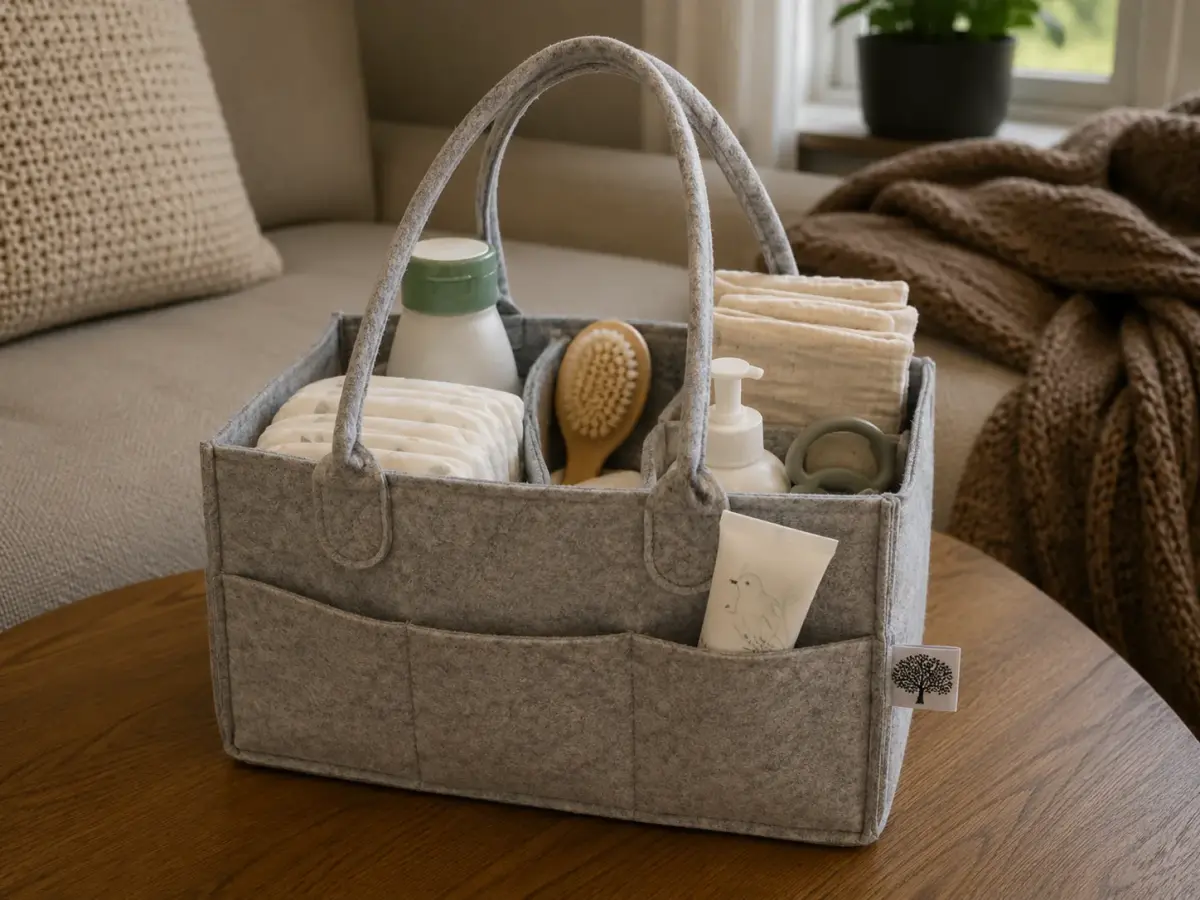
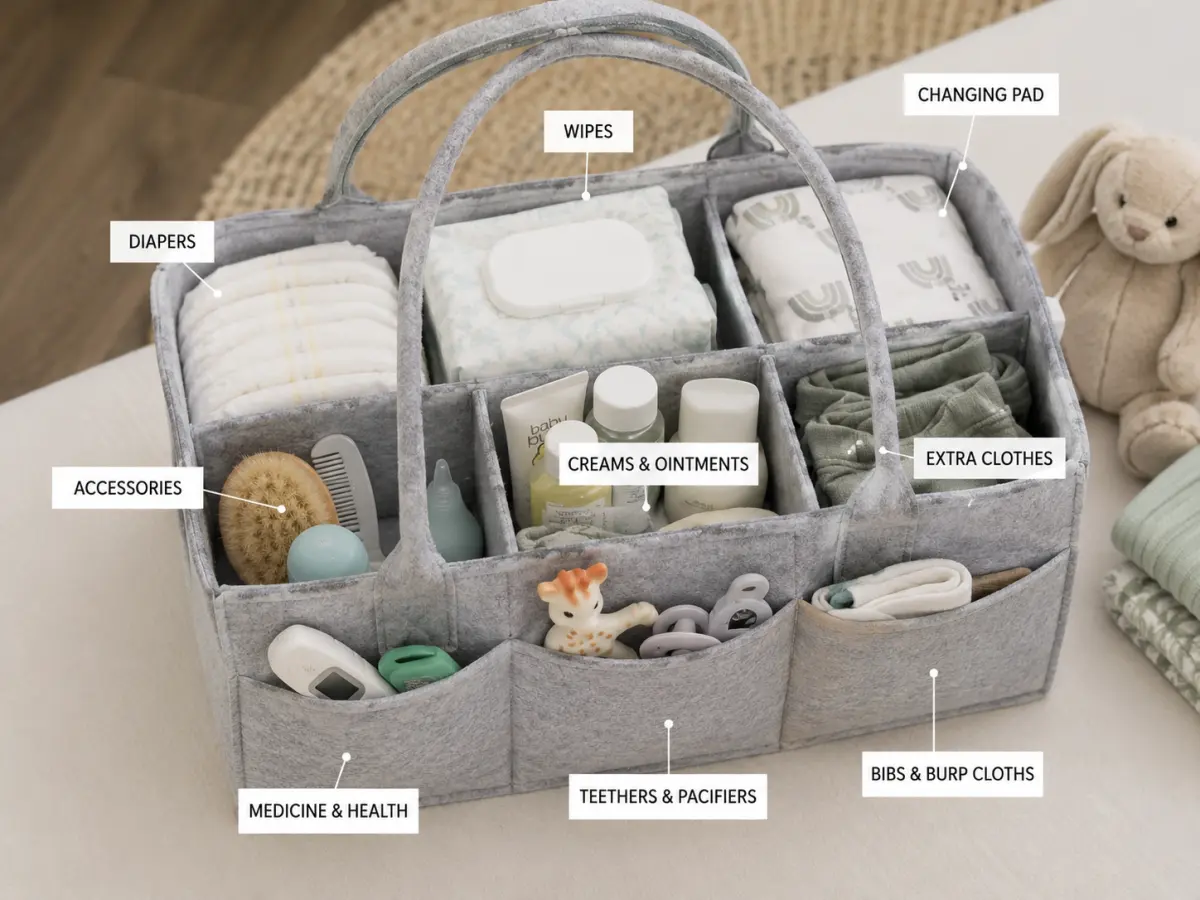
Once the list is right, order it. Think of the caddy as having a front and a back, and put the things you grab every single change at the front where your hand lands first. For us that is diapers and wipes. The things you reach for less, the change of clothes, the burp cloths, the spare toy, go behind them. Cream sits in a pocket, which we will come to.
The reason this matters is speed under pressure. When you are holding a wriggling baby with one hand, you want the other hand to find a diaper without a search. A caddy packed in a random order makes you look inside every time, and looking inside is exactly what you cannot do with your hands full. Front to back by frequency turns the caddy into something you operate by feel.
Use the divider to make zones
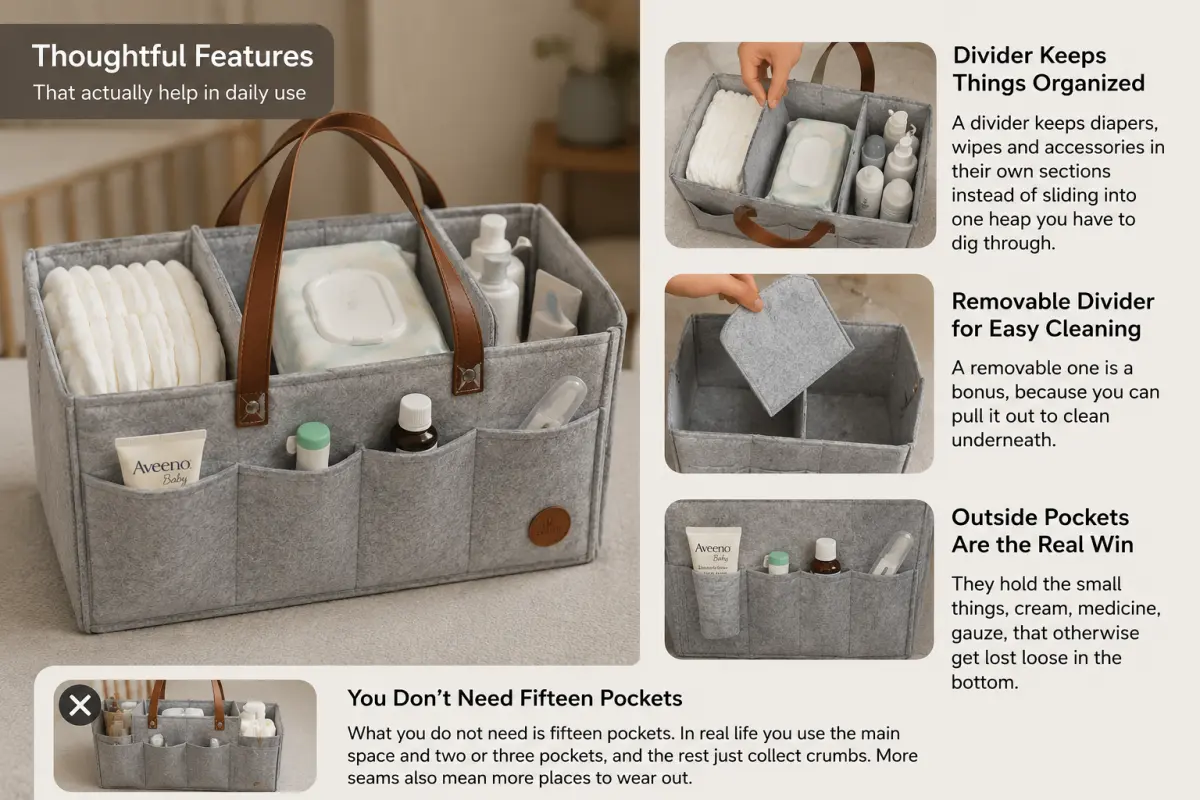
Almost every decent caddy has a divider, and it is the single most underused feature. Its job is to keep diapers in one zone and everything else in another, so the two never merge into one pile you have to dig through. We keep diapers on one side of the divider and the soft stuff, wipes, cream reachable, burp cloth, clothes, on the other.
If your caddy has a removable divider, even better, because you can pull it out to wipe underneath on your weekly reset. What matters is whether it stays put once the caddy is moving, since one that slides merges your zones on the first trip between rooms. The Parker Baby caddy is the one we use, and its divider lives in permanently. If yours did not come with one, a stiff piece of felt or a small fabric box dropped inside does the same job. Two clear zones beat one open bucket every time, and it is the difference between a caddy that looks organized for a day and one that stays that way for months.
Stand diapers up, do not stack them flat
This is the small trick that makes the biggest visible difference. Stack diapers flat and you get a sliding pile where you can never tell how many are left. Stand them upright in a row, like files in a drawer, and two good things happen: you can pull one out with a single finger, and you can count what is left at a glance without touching anything.
Standing them up also holds the shape of that zone, because a packed row of diapers braces the side of the caddy and stops it slumping inward. It is the same reason a full bookshelf stands straighter than a half-empty one. Once you have packed a caddy this way a few times, the flat stack starts to look like the obvious mistake it is.
Small stuff lives in the pockets
The outside pockets exist so the little things stop disappearing into the bottom. Cream, a spare pacifier, nail clippers, a small tube of anything, all of it goes in a pocket, not loose in the main space where it slides under the diapers and vanishes until you tip the whole caddy out.
Give each pocket a rough job and keep it that way. Ours run to cream in the front pocket where we grab it mid-change, and the odd small extras in the side. You do not need many pockets for this, and a caddy covered in fifteen of them mostly collects crumbs in the ones you never assign. Two or three pockets, each with a purpose, is the sweet spot. If you want the reasoning on why more pockets is not better, it is the same one we make in the choosing guide.
Orient everything toward your changing hand
There is a second layer to front-to-back order that most people never think about: which direction things face. You keep one hand on the baby and work with the other, so set the caddy up for that free hand. If you reach with your right, turn the wipes case so its opening faces right and pull-out is a straight tug, not an awkward twist. Face the row of diapers the same way, so the edge you grab is the one nearest your hand.
It sounds fussy written down, and then it saves you a fumble on every single change. The same goes for the cream pocket: keep it on the side you reach from, not the far side you have to lean across the baby to get to. Organizing is not only where things sit, it is which way they point, and a caddy set up for your actual hand is noticeably faster than one packed neatly but blind to how you use it.
Keep a restock rhythm, not a scramble
An organized caddy that runs empty is not organized, it is just tidy and useless. The habit that keeps ours working is refilling it on a rhythm rather than when it hits zero. We top the diapers and wipes back up once it drops to about half, which in practice means a quick refill most evenings, so it is never the frantic dash of finding it empty during a blowout.
Pair that with a weekly reset, which is also when the cleaning happens, and we go through that in how to clean a diaper caddy. Once a week, tip the caddy out, wipe the inside and the divider, bin the odd stray crumb and dried wipe, and repack it in the same order. It takes two minutes and resets any drift from the week, because even a well-organized caddy slowly gets messy as things get shoved back in the wrong spot on a bad day. The reset is what makes the system survive real life rather than lasting one neat afternoon.
If you change in more than one room
Most families do not change diapers in a single spot, and carrying one caddy up and down stairs all day gets old fast. If you change on two floors or in two rooms, it is often easier to run two lightly packed caddies than one heavy one that lives everywhere and nowhere. Each stays organized by the same rules, just with a smaller load, and you are never caught on the wrong floor.
Keep each one at the height you actually change at, on the changing table or beside the sofa, not tucked in a low cupboard. A caddy you have to crouch and dig for is a caddy you quietly stop using, and then all the organizing in the world does not help.
The bottom line
Organizing a diaper caddy comes down to packing light, giving every item one home, and ordering it front to back by how often you reach. Stand the diapers up, split the caddy into zones with the divider, put the small stuff in the pockets, and keep a restock rhythm with a quick weekly reset. Do that and the caddy does its one job, a full change in one hand from anywhere in the house, for as long as you need it.
If the caddy itself is the weak link rather than the layout, start with the best diaper caddies we’ve used, and once the changing corner is sorted, the registry checklist covers what else around it actually earns its place.
The caddy handles the house. Leaving it is a different packing problem, since you cannot restock from the shelf and the list grows with how long you are out, and we cover that in what to pack in a diaper bag.
Frequently asked questions
How do you organize a diaper caddy?
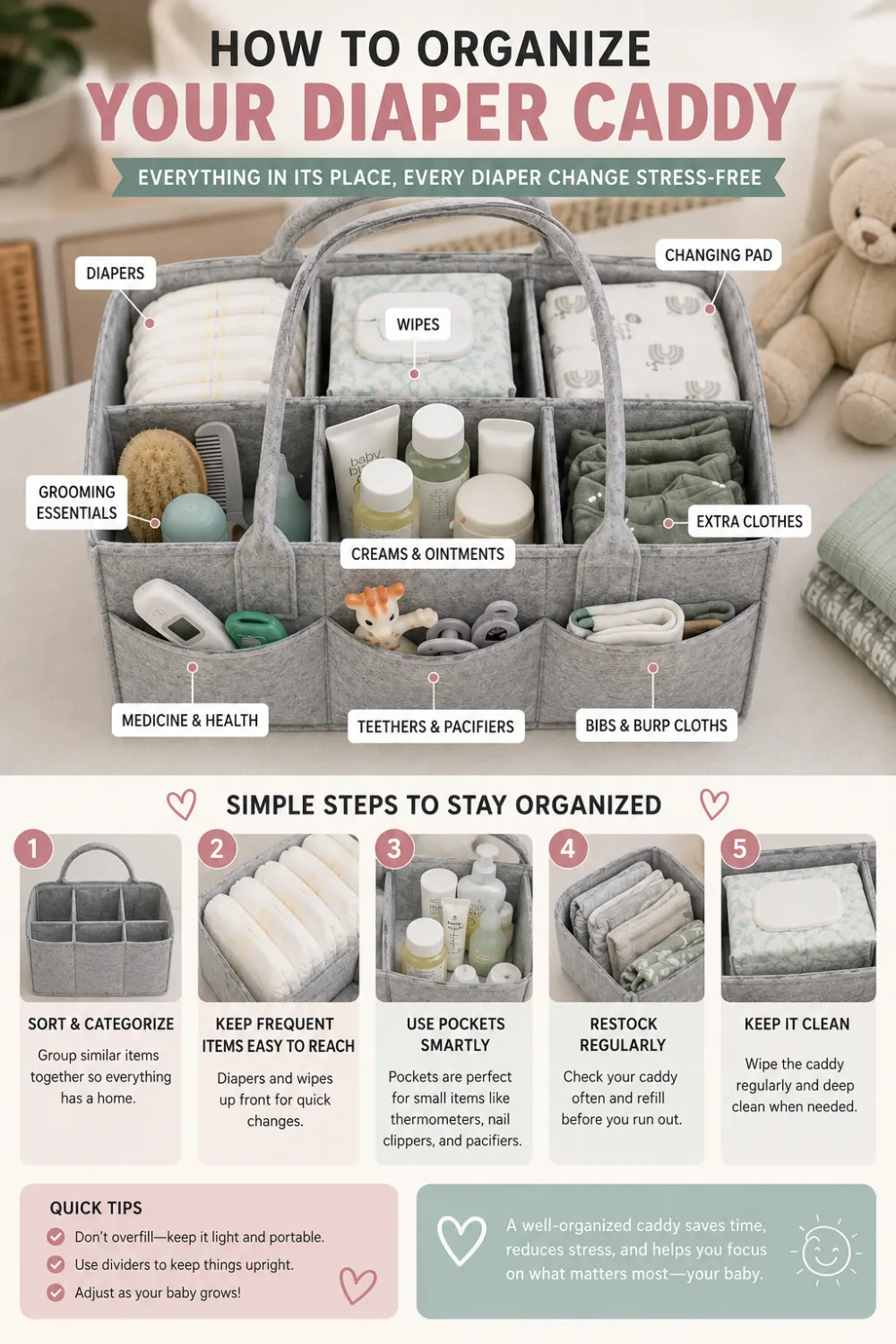
Give every item one home and pack front to back by how often you reach for it. Stand diapers upright in the main compartment so you can count them at a glance, keep wipes where your dominant hand lands, and put small things like cream and a spare pacifier in the outside pockets. Use the divider to split diapers from everything else. The goal is a caddy you can restock and grab without looking inside.
What should go in a diaper caddy?
The short version is eight to ten diapers, a travel wipes case, diaper cream, one change of clothes, a burp cloth or two and a single small toy. We go through each item, how many of it, and what to leave on the shelf instead, in what to put in a diaper caddy. This page is about arranging whatever you have decided to carry.
How do you keep a diaper caddy from getting messy?
Two habits do almost all the work: refill it on a set rhythm rather than when it runs dry, and put each thing back in its own section as you use it. A caddy gets messy when it becomes a place you drop things, not a place with assigned spots. A weekly reset, empty it, wipe it, repack it in order, keeps it tidy for months.
Where should you keep a diaper caddy?
Wherever you change diapers most, at the height you change them. For a lot of families that is the changing table in the nursery and a second spot by the sofa. If you change in more than one room, it is often easier to run two lightly packed caddies than to carry one everywhere. Keep it out of a low cupboard, since a caddy you have to bend and dig for is one you stop using.