What to pack in a diaper bag: the checklist that changes by trip
This post contains affiliate links. If you buy through them, we may earn a small commission at no extra cost to you.Learn more.
Most diaper bag checklists fail for the same reason: they give you one list, and the list is built for the worst day you will ever have. What to pack in a diaper bag genuinely changes with how long you are out, and treating a twenty minute errand like a day trip is how you end up carrying five kilos to buy milk. The approach that works is a small core that lives in the bag permanently, plus a short set of additions you make for the length of the trip.
One note on scope. This covers what goes in the bag. Anything medical, including medication, sunscreen for young babies, and how long milk or formula can safely sit out, is a question for your pediatrician and the CDC rather than a blog. We link out where it matters instead of guessing.
The core list that lives in the bag permanently
These are the things that should never come out. If you have to think about them, you will eventually leave one behind.
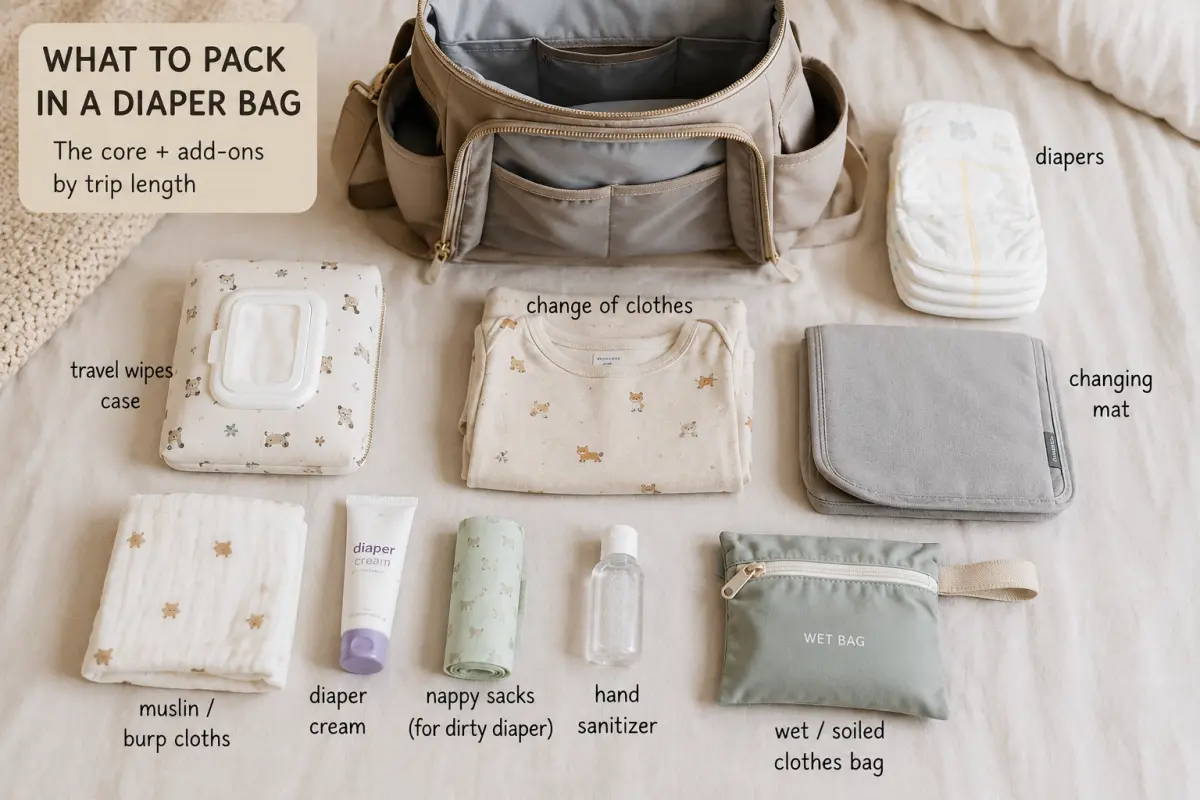
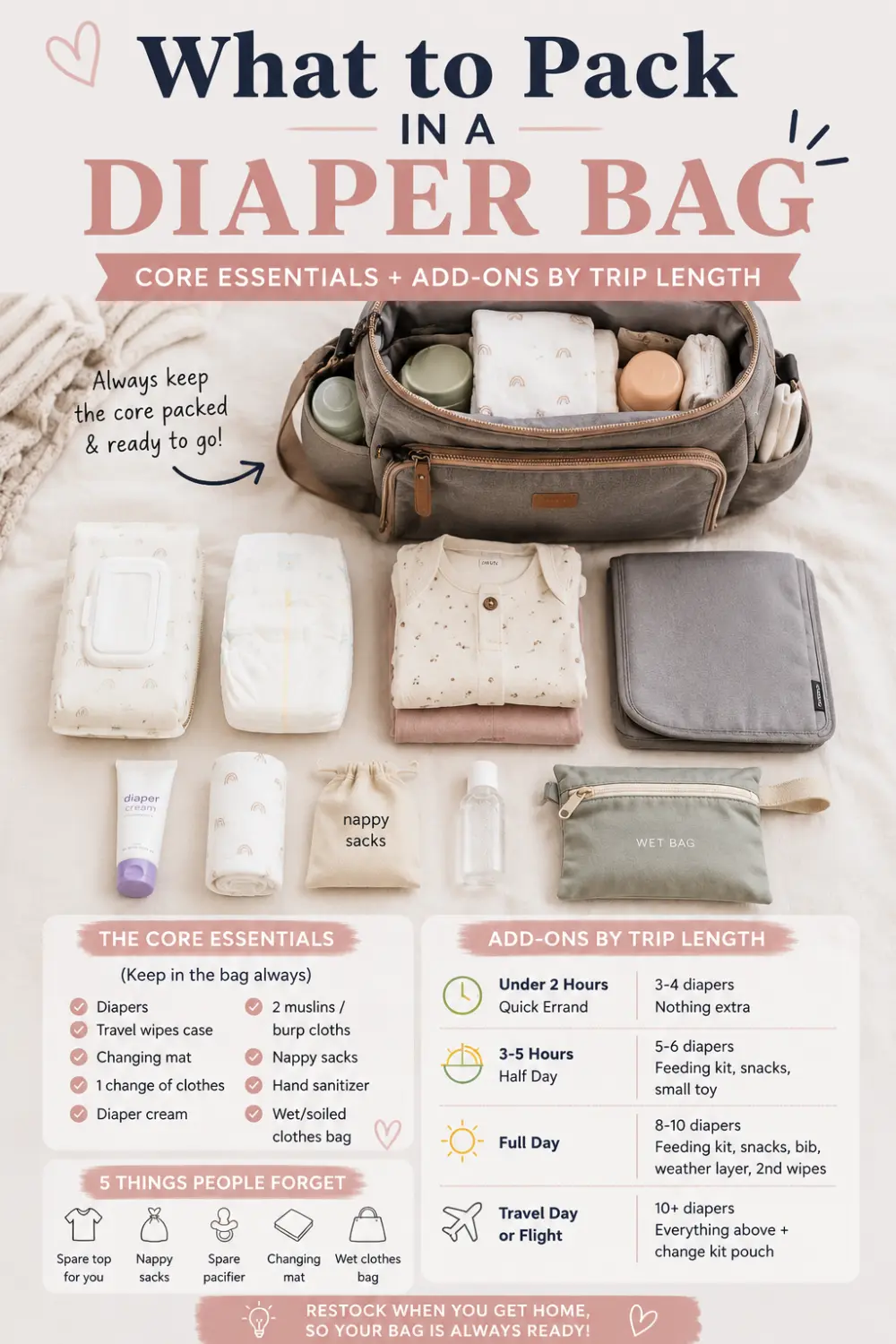
Diapers, a travel wipes case, a changing mat, one full change of clothes, diaper cream, two muslins or burp cloths, nappy sacks for the dirty diaper, hand sanitizer, and a small bag for wet or soiled clothes. That is the whole permanent kit, and it fits comfortably in any bag worth buying.
The reason to keep this packed rather than assembled per trip is that the alternative is deciding nine things while getting a baby out of the door. Restock the core when you get home, the same way you would a diaper caddy, and the bag is always ready.
How much of each, by how long you are out
| Trip length | Diapers | Clothes | Also add |
|---|---|---|---|
| Quick errand, under 2 hours | 3 to 4 | The one spare set already in the bag | Nothing. Go. |
| Half day, 3 to 5 hours | 5 to 6 | One spare set, plus a spare top for you | Feeding kit, snacks if on solids, a small toy |
| Full day out | 8 to 10 | Two spare sets, one spare top for you | Feeding kit, snacks, bib, weather layer, second wipes pack |
| Travel day or flight | 10 plus | Two sets in the bag, more in the case | Everything above, plus a change kit in a pouch you can grab alone |
A simple way to plan the diaper count is one for every hour you expect to be out, plus two spare. It sounds generous and it is roughly right, because the day you under-pack is the day it matters. For a ceiling, our Skip Hop Forma takes eight to ten stacked with room for wipes, so if a normal outing has you packing past that, the problem is the packing rather than the bag. We compared its capacity against the Ruvalino in Skip Hop Forma vs Ruvalino, and against all four bags we have carried in the best diaper bag backpacks we have used, where capacity is the thing that separates an everyday bag from a travel one.
The feeding kit, kept separate
Whatever your feeding setup is, keep it together as one unit rather than scattered through the bag. Bottles, a formula dispenser if you use one, a bib, and something to wipe with.
Bottles belong in the insulated side pockets, not the main compartment. That is the whole reason those pockets exist: a bottle comes out without unpacking anything, and it comes out while you are holding a baby with the other arm. Worth being clear that an insulated pocket slows a temperature change down, it does not hold milk at a safe temperature indefinitely. How long milk or formula can safely sit out is a question for the CDC and your pediatrician, and it is worth asking rather than assuming.
The five things people actually forget
Everyone remembers diapers and wipes. These are the ones that get left behind, and each of them turns a small problem into a long one.
A change of clothes for you, not just the baby, because whatever happens to their outfit usually happens to your shoulder at the same time. Nappy sacks, for the times there is no bin and you have to carry it. A spare pacifier if your baby uses one, since the floor claims them constantly. The changing mat itself, which has a habit of being taken out at home and left on a bed. And a small bag for wet or soiled clothes, so the dirty set is not loose against everything clean. That last one is also what saves the bag itself, since a leak left sitting in the lining is how a bag starts to smell. If yours already has, how to clean a diaper bag covers getting it out.
Add those five to the permanent core and most of the bad outings stop happening.
What to leave at home
Over-packing is the more common failure, and it has a real cost, because a heavier bag is one you carry all day and start resenting.
Leave the full pack of diapers and the bulk wipes box at home, take a travel case and restock from the pack. Leave the third and fourth outfit unless you are traveling. Leave the toy pile, since one small thing is genuinely enough and the rest end up on a cafe floor. And leave anything you have carried for a month without touching, which is the honest test for every item in there.
The bag is a grab-and-go kit. The cupboard is the cupboard.
Where each thing should live
Packing order matters as much as the list, because the bag is judged on whether you can get one thing out while holding a baby.
Put the things you reach for in a hurry in the outside pockets: wipes, a pacifier, your phone, nappy sacks. Bottles go in the insulated side pockets. The main compartment takes the bulk you need rarely and slowly, so diapers, the change of clothes and the mat go there, with the spare clothes at the bottom because they are the least urgent thing you own.
That layout is also why the pockets-versus-space trade decides which bag suits you, which we went through in our diaper bag buying guide. A pocket-heavy bag gives every one of these a fixed home and costs you main-compartment room. A simpler bag gives you one big space and lets small things roam.
Restocking, so you never check
The bag only works if it is packed before you need it, and the habit that makes that automatic is restocking on arrival rather than departure.
When you get home, put back what you used. It takes under a minute while you are still carrying the bag, and it means you never stand at the door doing an inventory. The alternative is checking the bag every time you leave, which is both slower and less reliable, because a check made in a hurry is a check that misses the thing you used last.
Once a week, take everything out. Sizes change, seasons change, and there is always a snack in there that should not be. That is also when you notice the outfit in the bottom is now two sizes too small, which is the most common way a change of clothes turns out to be useless at the exact moment you need it.
How the list changes as they grow
The core stays the same the whole way through, which is the argument for setting it up properly once.
With a newborn, the bag is dominated by feeding and spare clothes, because both come up far more often than you expect and usually together. Once solids start, snacks and a bib join permanently and the feeding kit changes shape. Once they are crawling and walking, changes get less frequent but messes get bigger, so the spare top for you stops being optional.
What does not change is that the permanent core covers the emergency, and the trip length decides the rest. For everything else worth having ready before the baby arrives, our realistic registry checklist has the short list of what earns its place.
The short version
Keep diapers, wipes, a mat, one change of clothes, cream, muslins, nappy sacks, sanitizer and a wet bag in the bag permanently. Add diapers at roughly one per hour out plus two spare, a feeding kit in the insulated pockets, and a spare top for yourself once you are out past a couple of hours. Leave the bulk supplies, the extra outfits and the toy pile at home. Restock when you walk in rather than when you walk out, and the bag stops being a thing you have to think about at all.
Frequently asked questions
What do you actually need in a diaper bag?
The core list is short: diapers, wipes, a changing mat, one full change of clothes, diaper cream, a couple of muslins or burp cloths, nappy sacks, and hand sanitizer. That covers a normal outing. Everything else is trip-specific, which is why a single fixed checklist never quite works. Pack the core permanently so it lives in the bag, then add for the length of the trip.
How many diapers should I pack in a diaper bag?
A simple way to plan it is one diaper for every hour you expect to be out, plus two spare. For a two-hour errand that is four, and for a long day it is closer to eight to ten. Our Skip Hop Forma holds eight to ten stacked with room for wipes, which is a useful ceiling to know, because if you are packing past that for a normal day out you are almost certainly over-packing.
What do people forget to pack in a diaper bag?
The same few things every time: a change of clothes for the adult rather than only the baby, nappy sacks for the dirty diaper when there is no bin, a spare pacifier if your baby uses one, and the changing mat itself, which tends to get taken out and left on a bed. A small bag for wet or soiled clothes is the other one worth adding permanently.
What should I not pack in a diaper bag?
The full pack of diapers, the bulk wipes box, more than one change of clothes for a normal outing, and a pile of toys. All of it eats the main compartment and adds weight you carry all day for no reason. The bag is a grab-and-go kit, not a store cupboard. Restock it at home instead of carrying the cupboard with you.
How do I organize a diaper bag so I can find things one-handed?
Give the things you reach for in a hurry the outside pockets, and keep the main compartment for bulk. Wipes and a pacifier should never require you to open the bag fully. Bottles go in the insulated side pockets so they come out without unpacking anything. Pack the change of clothes and spare diapers at the bottom, since you need them rarely and slowly.
Does what you pack change as the baby gets older?
Yes, and mostly it gets bigger rather than smaller. Newborn packing is dominated by feeding and spare clothes because of how often both are needed. Once solids and crawling start, you add snacks, a bib and a spare top, and the changing frequency drops. The core list stays the same throughout, which is why it is worth keeping it permanently packed.