Can you leave a bottle in a bottle warmer?
This post contains affiliate links. If you buy through them, we may earn a small commission at no extra cost to you.Learn more.
Can you leave a bottle in a bottle warmer? Two different questions are hiding inside that one, and most pages answer the wrong one confidently. The first is about the machine: will the warmer cope with being left running, and will it turn itself off. The second is about the milk: how long warmed milk can sit before you should not use it.
We can answer the first properly, because we own four warmers and have left bottles in all of them at one point or another. The second is a food safety question, and the honest thing to say is that it belongs to the CDC and your pediatrician rather than to us. We are a gear site. We are not going to invent a number of minutes.
The machine question: what happens when you walk away
What your warmer does when you stop paying attention depends entirely on whether it has a true automatic shut-off, and that varies more between models than you would expect.
Our Kiinde Kozii has a timer with a real shut-off, so it stops on its own at the end of the cycle. Older versions of our Philips Avent do not, which means the dial stays where you left it and the warmer keeps doing what it was told. Our Baby Brezza portable beeps and shuts down when it reaches temperature. The differences are not about quality, they are about what each maker assumed you would be doing while the bottle warmed.
The assumption matters most at the hour when it is least true. At 3 a.m. you are not standing over the counter counting. You are half asleep with a baby on one arm, and the feature that earns its place is the one that does not need you.
Keep-warm modes are a different thing entirely
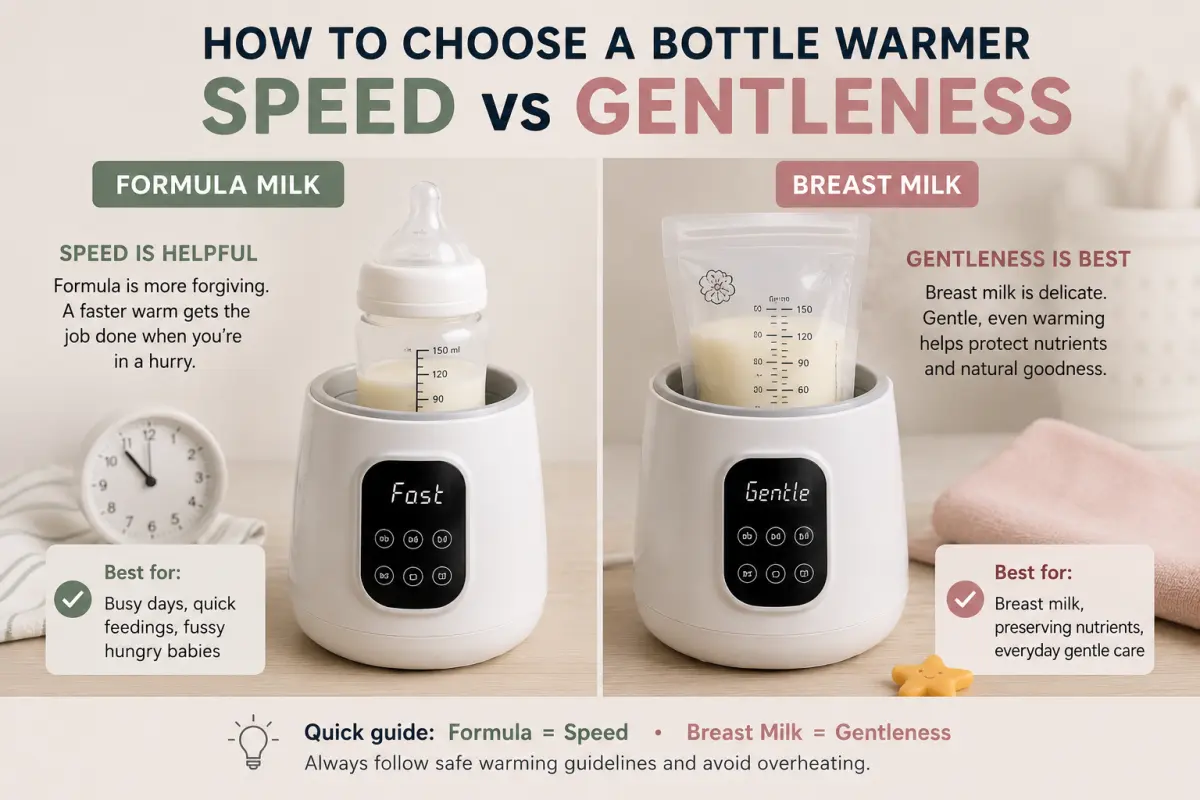
A keep-warm setting is not the warmer failing to stop. It is the warmer being told to hold the bottle at temperature once the cycle ends, and some units will do that for a very long time. Our Momcozy countertop warmer has a 24 hour keep-warm mode, which is the longest span of anything in our kitchen.
It is worth separating what that tells you from what it does not. The presence of a 24 hour setting is a fact about the appliance. It is not a recommendation about milk, and reading it as one is the mistake this whole article exists to head off. A manufacturer can build a dial that goes to 24 hours without making any claim at all about what should be sitting in it.
Where a keep-warm mode genuinely helps is the gap between warming a bottle and a baby actually taking it, which anyone who has warmed a bottle for a baby who then fell back asleep will recognise. What it costs you is on the machine side, and that is the part we can be specific about.
What leaving it running does to the warmer
Everything a water-bath or steam warmer does depends on there being water in the chamber. Leave one running and the water evaporates, which means the element ends up working against an empty chamber. That is not dangerous in our experience, but it is not good for an appliance you want to keep for two or three years.
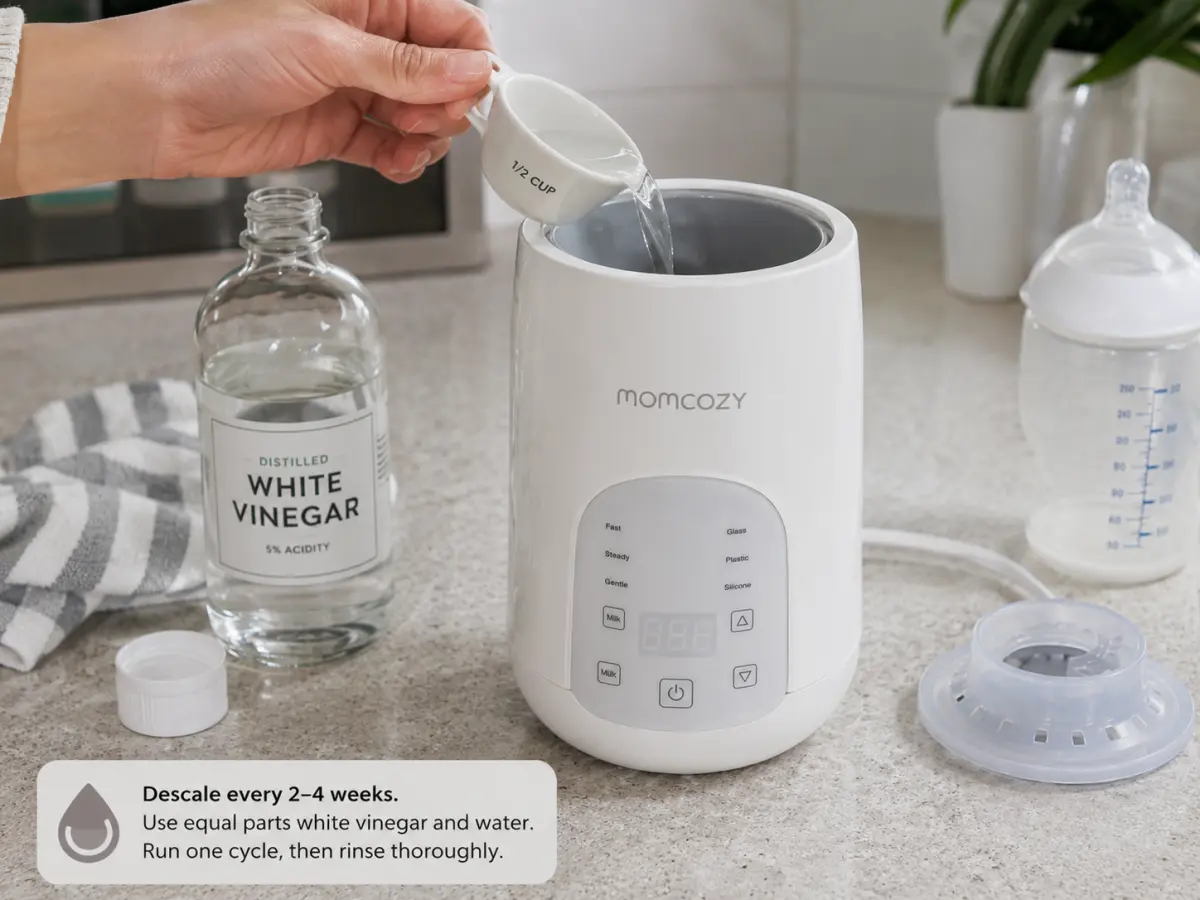
The bigger nuisance is scale. Every mineral in the water you poured in stays behind when the water leaves, so a warmer that has boiled itself dry a few times has a chamber lined with the stuff. Scale slows heating and makes it less even, which is the opposite of what you bought the warmer for. If you live somewhere with hard water, this happens faster than the manual suggests, and the descaling routine we use is in how to clean a bottle warmer.
None of that is an emergency. It is a slow tax on the machine, and an auto shut-off is what stops you paying it.
Even then, check what the shut-off actually stops. On our Tommee Tippee Easiwarm the timer switches off by itself, but the water keeps heating until the dial is turned off, which we cover in our Tommee Tippee bottle warmer review.
Portables change the machine half of the question
A cordless warmer is a different object from a countertop one here, and the difference runs both ways.
There is no mains power behind it, so a portable cannot sit heating indefinitely in the way a plugged-in warmer can. Ours stop at the end of a cycle, and the Baby Brezza announces it with a beep. What a portable does instead is hold heat, because the liquid is sitting in an insulated stainless cup rather than a bath of water that is cooling in open air. The practical effect is that a portable keeps a bottle usable for longer without doing anything at all, which is useful on a day out and does nothing to change the food safety side.
The other difference is that a portable spends its life closed and moving. Our Momcozy portable locks shut, which is what stops it emptying itself into a bag, and it also means a bottle left in there is not sitting open in a warm chamber collecting whatever is in the air. Again, that is a statement about the container rather than about the milk.
The milk question is not ours to answer
Here is where a lot of articles quietly start giving medical advice with a confident tone and no source. The question of how long warmed milk can be held, whether it can be re-warmed, and what to do with what is left after a feed, is a food safety question about a food that goes to an infant.
The CDC publishes guidance on handling and storing breast milk, and your pediatrician knows your baby. Between those two you have a real answer. What you will not get from us is a number invented to make this page feel complete, because a wrong number here is the kind of mistake that does not get undone by a correction.
The same applies to whatever your warmer’s manual says about its own keep-warm setting. Read it, because it is specific to the machine you own.
The habit that makes the question go away
The reason we rarely have to think about this is a change in when we start the warmer rather than anything about the warmer itself.
Warming in advance sounds efficient and it creates the exact situation this article is about: a bottle sitting at temperature while a baby does something unpredictable. Starting the warmer when you are genuinely ready means the bottle is used within a couple of minutes of finishing, every time.
That only works if you know your own warmer’s real timing, which is a five minute job to establish once. Ours ranges from about three to four minutes for a fridge-cold 5oz bottle on the fast countertop warmer to eight or ten on the gentle one, and we set out how to time your own in how long a bottle warmer takes. Once you know your number, warming in advance stops feeling necessary.
Buy the shut-off, not the mode list
If you are choosing a warmer and this question is on your mind, the feature to weight is the automatic shut-off, and it is worth more than a long menu of programs.
A shut-off protects the machine, removes one decision from the middle of the night, and means a forgotten bottle is a smaller problem than it would otherwise be. A screen full of modes mostly goes unused, because in practice you warm bottles to roughly the same point every time. We go through which features have actually mattered across four warmers in how to choose a baby bottle warmer.
The bottom line
The machine will usually tolerate being left, especially if it shuts itself off, and what it costs you is water, scale and a bit of the appliance’s life. That part we can tell you from owning four of them.
The milk is the question that actually matters, and it has a proper source in the CDC and your pediatrician. Use them for it. If you want the rest of what we have learned about these machines, the warmers we own are in the best baby bottle warmers, and the case for skipping the microwave entirely, with the CDC’s own wording, is in bottle warmer vs microwave.
Frequently asked questions
Can you leave a bottle in a bottle warmer?
There are two questions inside that one and they have different answers. The machine side is usually fine if your warmer has a true auto shut-off, because it stops on its own rather than sitting hot with a bottle in it. The milk side is a food safety question about how long warmed milk can be held, and that belongs to the CDC and your pediatrician rather than a gear blog. We can tell you what our warmers do when you walk away. We are not going to tell you what the milk does.
Do bottle warmers turn off automatically?
Some do and some do not, and it is worth checking before you buy rather than after. Our Kiinde Kozii has a timer with a true automatic shut-off. Older versions of the Philips Avent do not, so you switch those off yourself. Our Baby Brezza portable beeps and shuts itself down at the end of a cycle. The absence of a shut-off is not a fault, but it does mean the warmer is relying on you to be awake enough to remember.
What is a keep-warm setting on a bottle warmer?
It holds the bottle at temperature after the warming cycle finishes instead of letting it cool. Our Momcozy countertop warmer has a 24 hour keep-warm mode, which is the longest of anything we own. What the setting does mechanically is clear. Whether milk should be held warm for any given length of time is a different question, and the answer to that one comes from the CDC and your pediatrician, not from the length of time a manufacturer built into a dial.
Can you leave a bottle warmer on overnight?
We do not, and the reason is the machine rather than a rule. A warmer left running boils its water away, and a heating element working in a dry chamber is how you shorten the life of an appliance. Hard water makes it worse, because everything left behind when water evaporates stays in the chamber as scale. If your warmer has an auto shut-off, this mostly takes care of itself.
What happens if you forget a bottle in the warmer?
On the machine side, usually nothing dramatic. The water finishes evaporating, the warmer either shuts off or sits hot, and you are left with a chamber that wants descaling. The milk is the part that matters more, and how long it has been sitting is the question to take to the CDC guidance rather than to a stopwatch. When we have forgotten one, we have not tried to work out whether it was still fine.