Do you need a bottle sterilizer? An honest answer from parents who own three
This post contains affiliate links. If you buy through them, we may earn a small commission at no extra cost to you.Learn more.
Do you need a bottle sterilizer? Not necessarily. A plug-in sterilizer is a convenient way to do one of the four sanitizing methods the CDC lists, and the other three, boiling, a hot dishwasher and a bleach solution, need no extra machine at all. Where a sterilizer earns its counter space is when you sanitize often and have a lot to get through: pumping, feeding every feed from a bottle, or more than one baby. That is where we ended up, and we now own three.
One honest note first. We review gear. Whether your baby’s bottles need sanitizing, and how often, is a medical question for your pediatrician, not a buying question for us. What we can tell you is when a machine is worth having once you know how often you will be sanitizing.
What the guidance says
The CDC treats sanitizing as an extra step after washing. They say to do it daily if your baby is less than 2 months old, was born prematurely, or has a weakened immune system, and otherwise describe it as additional germ removal on top of normal cleaning. The AAP notes that parents and pediatricians are less concerned with sterilizing than they were a generation ago.
The CDC lists four ways to sanitize: boiling for 5 minutes, steam from a microwave or plug-in system, a dishwasher with hot water and a heated drying cycle, or a bleach solution. A plug-in sterilizer is one of those four, not something extra on top. We go through all four, with the CDC’s own times, in how to sterilize baby bottles.
So the honest framing is this. A sterilizer does not make bottles cleaner than the other methods. It makes sanitizing easier. Whether that is worth paying for depends on how often you do it and how much you have to do.
When a sterilizer earns its counter space
You sanitize often. If your pediatrician has told you to sanitize daily, a machine that runs on its own and switches itself off saves you a pan of boiling water every day.
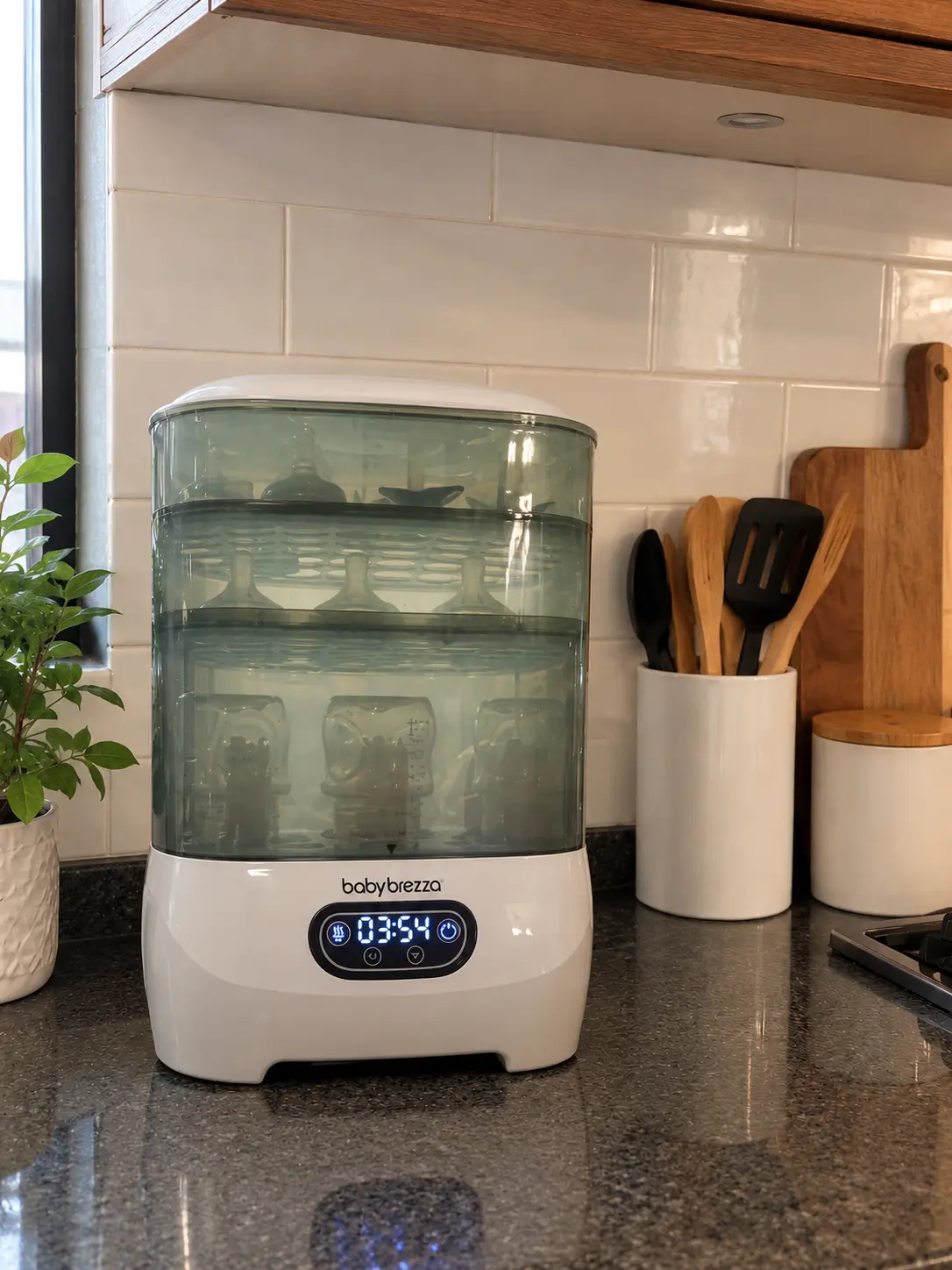
You pump. A breast pump adds valves, membranes, flanges and connectors to every load, and small parts are awkward to boil and slow to dry on a rack. Our Baby Brezza takes two full sets of pump parts alongside 8 bottles.
You bottle feed every feed. The more bottles go through the sink, the more a machine that sanitizes and dries a full load at once is worth.
You have more than one baby. This is what pushed us. Once our second baby arrived and the number of bottles went up, we bought the Baby Brezza for its capacity and speed.
You want the drying done for you. This is the underrated part. Drying is the slowest step of any method, and a sterilizer and dryer does it inside the closed machine, then holds the parts until you need them.
When you can skip it
Your dishwasher has a hot water setting and a heated drying cycle. The CDC says that if you wash this way, a separate sanitizing step is not necessary. If your machine has those settings, a sterilizer is a convenience rather than a need.
You only give the occasional bottle. A pan of boiling water once in a while costs nothing and takes no counter space.
Your pediatrician has told you daily sanitizing is not needed for your baby. Then a sterilizer is mostly a drying rack with a lid.
Your counter is already full. Every plug-in sterilizer takes up room, and the compact ones still need a spot near a socket.
Sterilizer, dishwasher or a pan of water
| Plug-in sterilizer and dryer | Dishwasher | Boiling | |
|---|---|---|---|
| On the CDC list | Yes, as steam | Yes, with hot water and a heated dry | Yes, 5 minutes |
| Extra cost | The machine | None if you own one | None |
| Hands-on time | Load it and press a button | Load it with the rest of the dishes | Watch the pan |
| Drying | Done inside the machine | Done by the heated cycle | Air dry on a rack |
| Counter space | Needs a spot near a socket | None | None |
| Best for | Pumping, lots of bottles, more than one baby | Households already running it daily | Occasional bottles |
Whichever you use, wash first. Sanitizing is the step after cleaning, never instead of it, and the washing routine is in how to clean baby bottles properly.
If you decide to buy one
Buy a sterilizer and dryer rather than a sterilizer only. The steam part is quick. The drying is what takes your time, and the dryer is what saves it.
Then size it to your household. For one baby, a machine that holds 6 bottles is enough, and both our Momcozy and our Dr. Brown’s do that. For two babies, or a lot of pump parts, you want more room, and our Baby Brezza holds 8 bottles and two pump part sets. Be wary of the bottle count on the box. Our Momcozy is sold as holding 8 and fits 6 for us.
Expect some upkeep. Steam leaves scale, so every machine needs descaling, and some have parts like the Baby Brezza’s vents that need replacing.
We rank the three we use, with who each one suits, in the best bottle sterilizer and dryer. If you want to understand how these machines work first, see what is a bottle sterilizer.
Questions to answer before you buy
How often will you sanitize? Ask your pediatrician first. If the answer is rarely, a pan of water or the dishwasher covers you. If it is daily, a machine starts to make sense.
How many bottles and parts go through your kitchen in a day? Count a real day, including pump parts, pacifiers and teethers. A handful of bottles is easy by hand. A full load every evening is where a sterilizer and dryer pays off.
Does your dishwasher have a hot water setting and a heated drying cycle? If it does, and you run it every day anyway, you may already have what you need.
Do you have the counter space? A sterilizer needs a permanent spot near a socket. If your counter is already full, that is a real cost, not a small one.
Is a second baby likely soon? A machine sized for one baby can fall short with two, which is what we found with our 6-bottle Momcozy. If you expect to need more room, buying bigger once is cheaper than buying twice.
How a sterilizer changes the number of bottles you need
A machine that sanitizes and dries a full load in one go means clean bottles come back faster than they would from a drying rack. That can let you run a smaller rotation. It cuts the other way too: a 6-bottle machine is not much use if you own 12 bottles and want them all done at once. We work through the numbers in how many baby bottles do you actually need.
Where we landed
You do not need a bottle sterilizer to keep bottles safe. The CDC lists boiling and a hot dishwasher alongside steam, and your pediatrician is the one to ask how often your baby’s bottles need sanitizing at all.
You might want one anyway. If you pump, bottle feed every feed or have more than one baby, a sterilizer and dryer takes a daily chore off your hands and stops wet parts piling up on the counter. For us, it became a life saver once our second baby arrived. If you are still building your list of what to buy, our baby items you don’t need and realistic baby registry checklist cover the rest.
Frequently asked questions
Do you need a bottle sterilizer?
Not necessarily. A plug-in sterilizer is one of four sanitizing methods the CDC lists, alongside boiling, a dishwasher with hot water and a heated drying cycle, and a bleach solution. Whether your baby needs bottles sanitized daily is a question for your pediatrician. A sterilizer earns its place when you sanitize often and have a lot to get through, such as when you pump, bottle feed every feed, or have more than one baby.
Is a bottle sterilizer worth it?
It was for us. We own three, and the biggest, bought after our second baby arrived, has been a life saver for keeping up with the bottles. If you feed one baby the occasional bottle and have a dishwasher with a hot drying cycle, you may never miss one.
Can you use a dishwasher instead of a bottle sterilizer?
The CDC says that if your dishwasher runs with hot water and a heated drying cycle, a separate sanitizing step is not necessary. If yours has those settings, it can do the job without a separate machine. Put small parts in a closed basket so they do not end up in the filter.
Is boiling bottles as good as using a sterilizer?
Both are on the CDC's list, so the difference is convenience rather than whether it works. Boiling costs nothing but means watching a pan and air drying the parts afterwards. A sterilizer and dryer runs on its own, switches itself off and dries everything inside the machine.
Do you need a sterilizer with a dryer?
Not strictly, but it is the part we would pay for. Drying is the slow part of sanitizing, and a dryer does it inside the closed machine instead of leaving wet parts on a rack. All three machines we own are sterilizer and dryers.