What is a bottle sterilizer, and how does it work?
This post contains affiliate links. If you buy through them, we may earn a small commission at no extra cost to you.Learn more.
A bottle sterilizer is a machine that uses heat, usually steam, to sanitize baby bottles and feeding parts after they have been washed. The kind most people mean plugs in on the counter, turns a little water into steam inside a closed chamber, and switches itself off when it is done. A sterilizer and dryer goes one step further and dries everything with warm air before you open the lid. We use three of the sterilizer and dryer kind at home, and this page explains what they are and how they work.
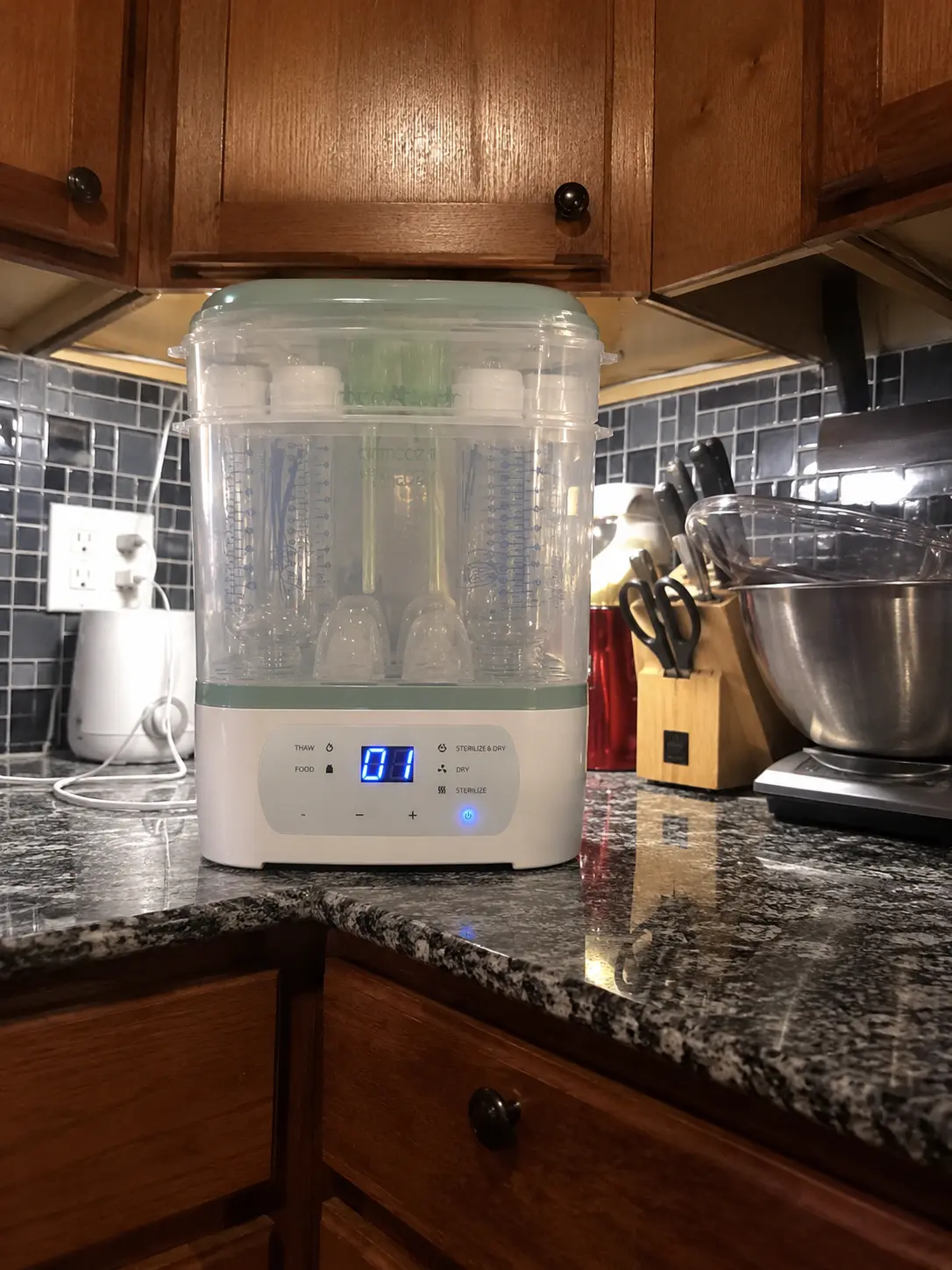
One honest note first. We review gear. Whether your baby’s bottles need sanitizing at all, and how often, is a question for your pediatrician, and the CDC publishes the current guidance. A plug-in steam sterilizer is one of four sanitizing methods the CDC lists, and we set out all four in how to sterilize baby bottles. This page is about the machine itself.
Cleaning, sanitizing and sterilizing are different jobs
These words get used interchangeably, and they are not the same thing.
Cleaning is washing. Milk and formula leave a film inside a bottle and in the nipple, and soap, hot water and a brush, or a dishwasher, are what remove it. That happens after every feed. Our routine is in how to clean baby bottles properly.
Sanitizing is an extra step after cleaning that uses heat or a chemical to kill more of the germs that are left. The CDC calls it sanitizing. Most parents, and most product boxes, call it sterilizing, which is why the machines are sold as sterilizers.
The point to hold on to is the order. A sterilizer works on bottles that are already clean. It is not a way to skip the washing.
How a plug-in steam sterilizer works
The machine has three parts that matter: a base with a heating plate and a small water reservoir, racks or bins that hold the bottles and parts, and a lid that closes the chamber.
You pour the water in, load the washed items so the openings face down, close the lid and press a button. The heating plate boils the water, and the steam rises through the racks and surrounds everything inside. Steam reaches into the corners of a nipple or a pump valve that would be awkward to get at any other way, which is a large part of why these machines exist.
On the three we use, the steam stage is short. The Baby Brezza takes 10 minutes, and the Momcozy takes 8 to 15 depending on the setting. When the steam stage ends, a sterilizer-only machine stops, and a sterilizer and dryer moves on to drying. All three of ours shut themselves off at the end of the cycle, so nobody has to remember to turn them off.
What the dryer part adds
Drying is the slow part of any sanitizing method. After boiling or steaming, parts come out wet, and the CDC’s advice is to let them air dry thoroughly rather than drying them with a towel, which can put germs back on. On a drying rack, that can take a long time, and the parts sit out in the kitchen while it happens.
A sterilizer and dryer does the drying inside the closed machine with a fan. On our three, drying takes between 20 and 60 minutes depending on the machine and setting, and the Baby Brezza filters the air it blows through. When the cycle ends, everything is dry and you can leave it inside until you need it. The Dr. Brown’s keeps its contents sterilized for up to 24 hours with the lid closed, and the Momcozy has a 24-hour storage function too.
That is the real case for paying for the dryer. It is less about the steam and more about not having a rack of wet parts on the counter at midnight.
The other kinds of bottle sterilizer
The plug-in steam machine is the one we own, but it is not the only kind.
| Kind | How it works | Dries the parts | Notes |
|---|---|---|---|
| Plug-in steam sterilizer | A heating plate turns water into steam in a closed chamber | No, you air dry | Simple, and needs counter space |
| Plug-in steam sterilizer and dryer | Steam, then a fan dries everything inside | Yes | The kind we use. Takes the longest per cycle, with no wet rack afterwards |
| Microwave steam sterilizer | A box or bag of water heated in the microwave makes the steam | No | Small and cheap. Limited by what fits in your microwave |
| UV sanitizer | Ultraviolet light instead of heat | Some models do | A different method from steam. Not one of the CDC's four |
The CDC’s four methods are boiling, steam from a microwave or plug-in system, a dishwasher with hot water and a heated drying cycle, and a bleach solution. A UV sanitizer is not on that list. If you are weighing one up, read the CDC’s guidance and talk to your pediatrician first.
You can also sanitize without buying anything. A pan of boiling water and a dishwasher with the right settings are both on the CDC’s list, and whether a machine is worth it over those is the question we answer in do you need a bottle sterilizer.
What you can put in one
Most plug-in sterilizers take more than bottles. Ours are made for bottles, nipples, rings and caps, breast pump parts, pacifiers, teethers and sippy cups. The Baby Brezza takes glass bottles and parts from any brand, and the Dr. Brown’s takes narrow and wide-neck bottles.
Two things to check before you load anything:
- Whether each item is rated for steam. Glass bottles generally are. Some plastic parts, and some small silicone or valve parts, have their own care rules, and the instructions that came with the item are the ones that count.
- How much actually fits. Listings are generous. Our Momcozy is sold as holding 8 bottles and fits 6, 7 at most, once real bottles with nipples and rings go in.
What a sterilizer does not do
It does not wash. Anything that goes in should already be clean, which is why the Dr. Brown’s instructions start with putting clean contents in.
It does not rescue damaged parts. A cracked bottle or a torn nipple has places that neither washing nor steam can reach properly, and it needs replacing instead. The signs to look for are in how often should you replace baby bottles.
It does not decide how often you need to sanitize. That is a question for your pediatrician, not a feature of the machine.
Looking after one
Every steam sterilizer needs descaling. Water leaves minerals behind when it boils, and they build up on the heating plate as scale. Left alone, the machine gets harder to keep clean. We descale our Baby Brezza with vinegar, and the manual for your own machine will tell you how and how often.
Some machines also have parts that wear. On the Baby Brezza, the vent parts need changing out from time to time, and it is worth buying spares when you buy the machine.
Beyond that, wipe the chamber and racks, let the machine dry between cycles, and follow the care instructions in the box.
Features worth looking for
If you are comparing machines, these are the features that made a difference to us, roughly in order.
A dryer. It turns a sterilizer from a pot with a lid into something that hands you dry, ready parts. All three of ours have one.
Real capacity. Look for how many bottles fit with nipples and rings on, not the headline number, and whether there is room for pump parts in the same load. The Baby Brezza’s three layers hold 8 bottles and two full pump part sets.
Separate modes. Being able to run the dryer on its own, or use the machine as storage, is useful more often than you would think. All three of ours can sterilize only, dry only, or both.
A countdown and an auto shut-off. A countdown tells you whether to wait for a bottle or wash one, and an auto shut-off means you can start a cycle and walk away. The Baby Brezza and the Momcozy both show the time left, and all three switch themselves off.
Extras you will actually use. The Momcozy also thaws and heats baby food. That is worth having if you do not already own a bottle warmer, and close to pointless if you do.
The three we use
We own three plug-in sterilizer and dryers: the Baby Brezza Bottle Sterilizer and Dryer Advanced, the Momcozy 8-in-1 and the Dr. Brown’s Clean. They differ mainly in how much they hold, how fast they run, what extra modes they have and what they cost. We rank them, with who each one suits, in the best bottle sterilizer and dryer.
Frequently asked questions
What is a bottle sterilizer?
A machine that uses heat, usually steam, to sanitize baby bottles, nipples, breast pump parts and other feeding items after they have been washed. The common kind plugs in, heats a small amount of water into steam inside a closed chamber, and switches itself off when the cycle is done. A sterilizer and dryer then dries everything with warm air, so the parts do not sit wet.
How does a steam bottle sterilizer work?
You pour water into the base, load washed items onto the racks and close the lid. A heating plate turns the water into steam, which fills the chamber and surrounds everything inside. On the three we use, the steam stage takes between 8 and 15 minutes depending on the model and setting, and then the machine stops or moves on to drying.
What is the difference between a sterilizer and a sterilizer and dryer?
A sterilizer only does the steam stage, so you take the parts out wet and air dry them. A sterilizer and dryer adds a fan that dries everything inside the closed machine afterwards, which on our three takes between 20 and 60 minutes. All three we own are the sterilizer and dryer kind.
What can you put in a bottle sterilizer?
Bottles, nipples, rings, caps, breast pump parts, pacifiers, teethers and sippy cups, as long as each item is rated for steam. Glass bottles generally are. Check the care instructions for each item, since some plastic parts have their own limits.
Does a bottle sterilizer clean bottles?
No. It sanitizes items that are already clean. Bottles still need washing first to get milk residue off, and a sterilizer is the step after that, not a replacement for it.
How do you look after a bottle sterilizer?
Descale it regularly, because steam leaves mineral scale on the heating plate. We descale our Baby Brezza with vinegar, but follow the method in your own manual. Some machines, like the Baby Brezza, also have vent parts that need replacing over time.