How many baby bottles do you actually need?
This post contains affiliate links. If you buy through them, we may earn a small commission at no extra cost to you.Learn more.
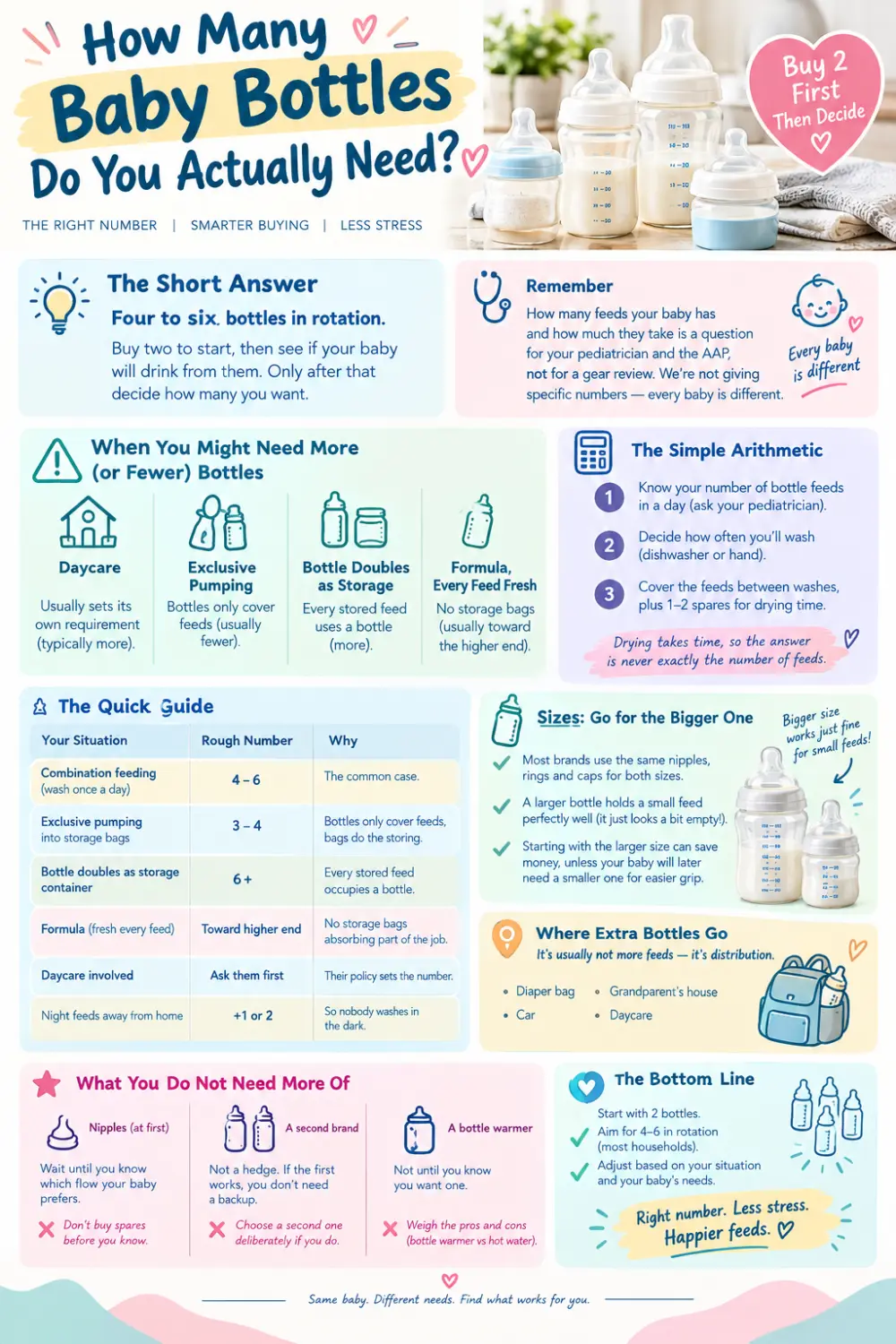
How many baby bottles do you actually need? Four to six in rotation, if you want one number and no arithmetic. That is what covered a day of feeds in our house without anyone standing at the sink at midnight, and it is the number we give people who ask. The more useful answer is that you should buy two, find out whether your baby will drink from them, and only then decide how many you want. Almost everyone we know bought a set of six first, and a good number of them own six bottles their baby never liked.
One honest note before the numbers. How many times a day your baby feeds, and how much, is a question for your pediatrician and for the AAP, not for a gear review. We are not going to put a feeds per day figure in this article, because it is not ours to give and it varies more between babies than any blog average suggests. What we can do is show you the arithmetic, so that once you know your own number you can work out how many bottles it implies.
The short answer, and who it is wrong for
Four to six bottles covers most households. Buy two to start.
It is wrong for you if your baby is going to daycare, which usually sets its own requirement and raises the number. It is wrong if you are exclusively pumping into storage bags, which usually lowers it. And it is wrong if you have chosen a bottle system where the bottle doubles as the storage container, which raises it again for a different reason.
Those three cases are most of the variation, and each one is covered below.
The arithmetic, since the real answer is yours
The number of bottles you need is not really about bottles. It is about how long you are willing to go between washes.
Work it out like this. Take the number of bottle feeds in a day, whatever yours turns out to be. Decide honestly how often you will run the dishwasher or wash by hand, which for most people is once a day rather than the twice they imagine. Then you need roughly enough bottles to cover the feeds between washes, plus one or two spare for the feed that happens while the others are still wet.
That last part is the bit people leave out, and it is why the answer is never exactly the number of feeds. A bottle that is clean but still drying is not a bottle you can use, and the CDC’s guidance is to air dry rather than towel dry, which we cover in how to clean baby bottles properly. Drying time is a real constraint on a rack full of wide-neck bottles, and it is the reason a household that technically owns enough bottles still runs out at the wrong moment.
| Your situation | Rough number | Why |
|---|---|---|
| Combination feeding, washing once a day | Four to six | The common case, and where our number comes from |
| Exclusively pumping into storage bags | Fewer, often three or four | Bottles only cover feeds, bags do the storing |
| Bottle doubles as the storage container | More, six or more | Every stored feed occupies a bottle in the fridge |
| Formula, every feed made fresh | Toward the upper end | No storage bags absorbing part of the job |
| Daycare involved | Ask them first | Their written policy sets the number, not you |
| Night feeds away from the kitchen | Add one or two | So nobody is washing a bottle in the dark |
Buy two first. This is the part that saves money
Every bottle ships a different nipple shape, and the nipple is the only part of a bottle your baby has an opinion about. It is also the part you cannot return once the packet is open.
So a set of six is a bet placed before you have any information. If she takes to it, you saved a few pounds against buying singles. If she does not, you own six bottles and a decision about whether to keep trying. We have watched this go wrong for enough people that we would say it plainly: buy one or two of a bottle, feed with them for a few days, then buy the rest of the set.
There is a second reason, which is that you will almost certainly end up with more than one kind of bottle anyway. Ours split between glass on the counter and plastic in the diaper bag, and that was not indecision, it was the two jobs being genuinely different. We made that case in glass vs plastic baby bottles.
Count the bottles, not the pieces
A trap worth knowing about before you shop, because it is the most common way people end up with a third of what they thought they bought.
Bottle sets are frequently listed by piece count rather than bottle count. A listing that says nine items can be three bottles, three storage lids and three cup rings. That is a perfectly honest description of what is in the box and a very easy thing to misread at speed when six listings look alike.
Read the breakdown, find the number of bottle bodies, and ignore the headline number. If you have worked out that you want six bottles, two of those sets is what you are buying, not one.
What changes if the bottle is also the storage container
Most bottle sets assume milk lives in a bag or a separate container and moves into the bottle at feeding time. A few do not.
If your bottle takes a sealed storage lid, as the Tommee Tippee Natural Start does, the workflow changes: milk goes into the bottle, the storage lid goes on, the bottle goes in the fridge, and at feeding time the lid swaps for the nipple and ring. Nothing gets poured from one vessel to another, which is genuinely better.
The cost of that is arithmetic. Every stored feed is now occupying a bottle rather than a bag, so the fridge is holding bottles you cannot also be feeding from. Households using that system want more bottles than the four to six baseline, and they want fewer storage bags. It is a straight trade, and worth making deliberately rather than discovering after you have bought.
Sizes: you probably only need the bigger one
Bottles come in a smaller newborn size and a larger one. Most lines use the same nipples, rings and caps across both, so the choice is about capacity rather than about how the bottle feeds. The small newborn sizes we rate are in the best baby bottles for newborns.
A larger bottle holds a smaller feed perfectly well. It looks slightly absurd with two ounces in the bottom of it and that is the entire drawback. Ours are 8 and 9 oz bodies, and we have used them from about three months, after small newborn bottles. If you are trying to avoid buying two sets across the first year, going straight to the larger size is the cheaper path. The argument for the small ones is mostly that they are easier for a small hand to hold later, which is a real but minor thing.
Where the extra ones actually go
If you land above the baseline, it is usually not because feeds went up. It is because bottles scattered.
One lives in the diaper bag. One ends up at whichever grandparent does regular childcare. One is in the car from a trip three weeks ago. Daycare takes several and keeps them for the day. None of that is waste exactly, but it is worth naming, because a household that owns six bottles and can only find two has a distribution problem rather than a quantity problem.
The practical fix is not more bottles. It is deciding which bottles belong to which place and not raiding the kitchen set for the bag.
What you do not need more of
Nipples, at first. They wear out and you will replace them eventually, and how often to replace baby bottles covers the signs, but buying spares before you know which flow your baby settles on is the same mistake as buying six bottles.
Bottle sets in a second brand, bought as a hedge. If the first nipple works, you do not need the hedge. If it does not, you want to choose the second one deliberately rather than have it already sitting in a cupboard.
A bottle warmer, until you know you want one. It is the gadget people register for and then argue about, and we made the honest case both ways in bottle warmer vs hot water. If you do decide you want one, the ones we use are in the bottle warmers we have tested.
Where we landed
Four to six bottles, bought two at a time rather than in a set, split between glass at home and something plastic in the bag. That covered a day without a midnight wash and without a cupboard full of bottles nobody liked.
If you have not chosen which bottles yet, the glass ones we feed with are ranked in best glass bottles for breastfed babies, and the lineup we use for formula is in best baby bottles for formula feeding. For where bottles sit against everything else you are being told to register for, our realistic baby registry checklist has the short list of what earns its place.
Frequently asked questions
How many baby bottles do you actually need?
Four to six in rotation covered a day of feeds for us without anyone running the dishwasher at midnight, and that is the number we give people who want one number. It is not a fixed rule, because it depends on how many bottle feeds happen in your day and how often you are willing to wash. The honest advice is to buy two first, find out whether your baby takes to that nipple, and then fill out the set once you know.
How many bottles do you need if you are exclusively pumping?
Usually fewer than you would expect, because pumped milk often goes into storage bags rather than sitting in bottles, so the bottles only have to cover feeds rather than storage too. The exception is a set like the Tommee Tippee Natural Start, where the bottle takes a sealed storage lid and becomes the storage container, in which case you want more bottles and fewer bags.
How many bottles do you need for formula feeding?
Slightly more than for pumping, in our experience, because there are no storage bags absorbing part of the job. Every feed is a bottle that gets made, used and washed. If you are formula feeding and want to stay at the low end anyway, the thing to optimise is not the number of bottles but the number of parts on each one, since that is what actually decides how long the sink takes.
Should you buy a set of six bottles at once?
We would not, and this is the mistake we see most often. The nipple is the part your baby has an opinion about and it is the part you cannot return once the packet is open, so committing to six before she has fed from one is a gamble with no upside. Buy one or two, find out, then buy the rest. The bottle you buy second is usually the one she picked.
How many bottles do you need for daycare?
That is set by the daycare rather than by you, and most have a written policy about how many prepared bottles to send and how they must be labelled. Ask them before you buy anything, because a daycare requirement is usually the single biggest jump in how many bottles a household needs, and it is the one people discover late.
What size baby bottles should you buy?
Bottles generally come in a smaller newborn size and a larger one, and most lines use the same nipples and rings across both, so the size is about how much fits rather than about the feed. Ours are 8 and 9 oz bodies, which is the larger end, and we have used them from about three months, after small newborn bottles, because a bigger bottle holds a smaller feed perfectly well. Going straight to the larger size is the cheaper path if you do not mind the look of it.
How many bottles do you need at night?
Enough that you are not washing one in the dark, which for us meant keeping two made or ready near where the night feeds happen. This is the single place where owning a couple of extra bottles pays for itself, and it is worth counting separately from your daytime rotation when you work out your number.