How to sterilize baby bottles
This post contains affiliate links. If you buy through them, we may earn a small commission at no extra cost to you.Learn more.
How to sterilize baby bottles has a short factual answer and a longer question sitting behind it, which is whether you need to be doing it at all. We will take both, and we will be clear about which parts are ours and which are not. The methods and the times below come from the CDC, and whether they apply to your baby is a conversation with your pediatrician, not with a gear review.
First, terms, because they get used interchangeably and mean different things. Cleaning is washing the bottle, which happens after every feed. Sanitizing, which most people call sterilizing, is an extra step on top of that. You do not sanitize instead of cleaning. We cover the washing part in how to clean baby bottles properly.
Do you actually need to sterilize?
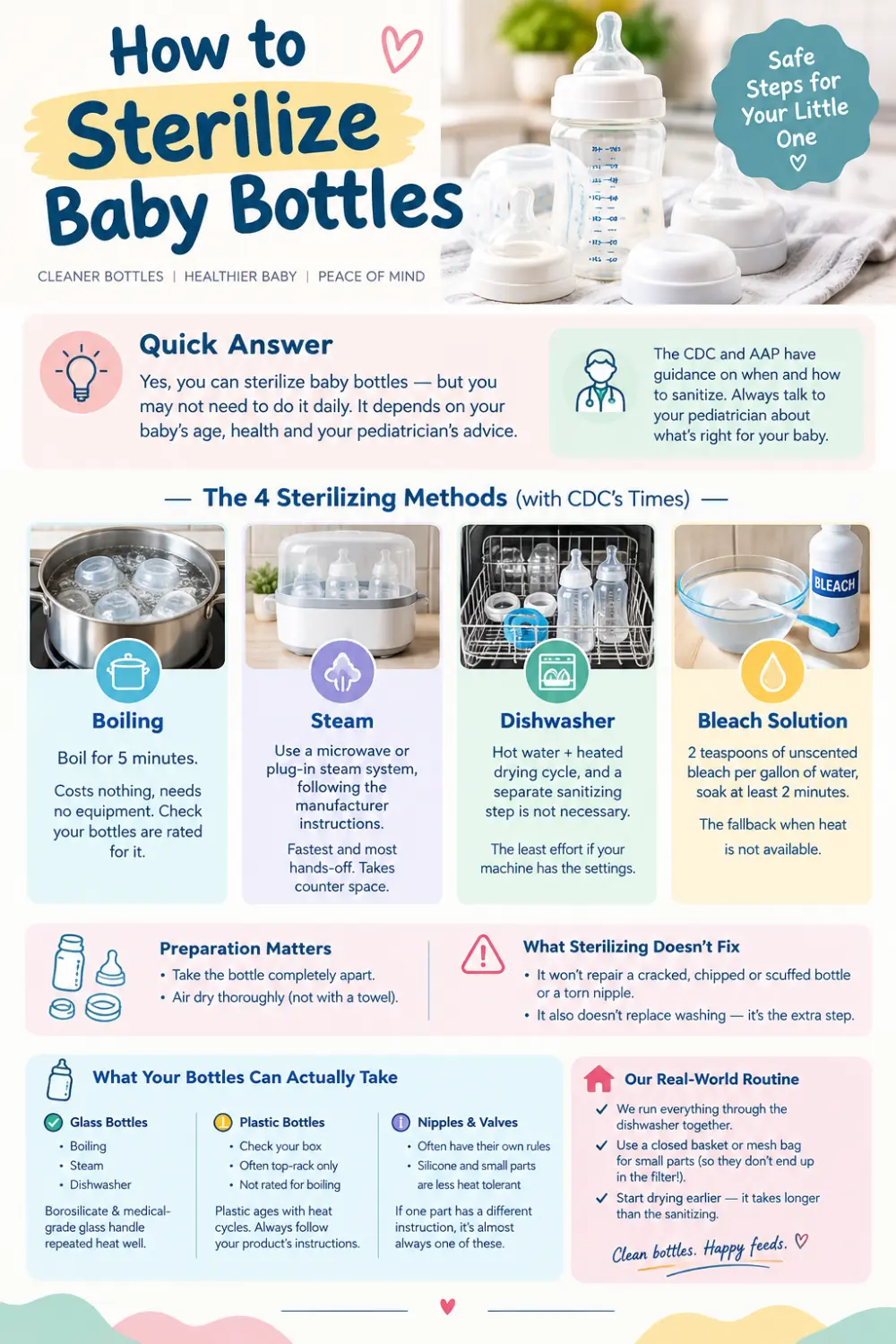
The CDC’s position is specific. Sanitizing is for extra germ removal, and they say to do it daily if your baby is less than 2 months old, was born prematurely, or has a weakened immune system due to illness or medical treatment. Outside those cases they present it as an additional measure rather than a daily requirement.
The AAP, writing about bottles, notes that parents and pediatricians today are not as concerned with sterilizing bottles as they were a generation ago, and that washing in a dishwasher using heated water and a hot drying cycle, or by hand in hot soapy water with a thorough rinse, should kill most germs.
We are repeating both of those because they are what the two relevant bodies say. Which applies to your baby, and for how long, is genuinely a question for your pediatrician, and we are not going to turn their guidance into a rule of our own.
The four methods, with the CDC’s own times
| Method | What the CDC specifies | Practical notes |
|---|---|---|
| Boiling | Boil for 5 minutes | Costs nothing, needs no equipment. Check your bottles are rated for it |
| Steam | Microwave or plug-in steam system, following the manufacturer instructions | Fastest and most hands-off. Takes counter space |
| Dishwasher | Hot water plus a heated drying cycle, and then a separate sanitizing step is not necessary | The least effort if your machine has the settings |
| Bleach solution | 2 teaspoons of unscented bleach per gallon of water, soak at least 2 minutes | The fallback when heat is not available |
Whichever you use, the preparation is the same and it matters. Take the bottle completely apart first, every piece, because a sealed or assembled bottle does not get sanitized on the inside of its own joints. And afterwards, air dry thoroughly rather than towel drying, which the CDC is explicit about because a dish towel can transfer germs back onto the item you just treated.
What your bottles can actually take
This is our half of the article, and it is the part the guidance does not cover, because it depends on what you own.
Glass bottles are generally rated for boiling, for steam and for the dishwasher. Borosilicate and medical-grade glass are made to take sudden temperature change, which is precisely why they tolerate being boiled and steamed repeatedly without clouding or degrading. If you are sanitizing daily because your baby is under two months or was born early, that is one of the stronger practical arguments for glass bottles, and it is the argument we found most convincing ourselves. The full comparison is in glass vs plastic baby bottles.
Plastic is where you read the box. Plenty of plastic bottle parts are top-rack only, some are not rated for boiling at all, and plastic ages through repeated heat cycles in a way glass does not. None of that makes plastic unsuitable. It means the instructions in your own box are the ones that govern, not a general article, and that includes this one.
Nipples and valves are the parts most likely to have their own separate rule, because silicone and the small moving parts in vented bottles are the least tolerant pieces on the bottle. If one part of your bottle has a different instruction, it is almost always one of those.
What sterilizing does not fix
Two things worth being plain about, because they come up in the same conversation.
Sanitizing does not rescue a bottle that is past it. A cracked, chipped or deeply scuffed bottle, or a nipple with a tear in it, has places that cleaning and sanitizing do not reach. The CDC makes this point about items with tiny cuts or breaks in them: germs get in and cannot be removed by cleaning. That is a replacement question, and we go through the signs in how often should you replace baby bottles.
Sanitizing also does not substitute for washing. It is the step after, not the step instead of.
The practical version, in our kitchen
We run everything through the dishwasher together, which is the least effortful of the four methods and the one the CDC says removes the need for a separate step when the machine runs hot with a heated dry cycle. The whole set goes in at once rather than bottle by bottle, which is easier when your bottles are all one neck width and mostly the same system.
Two things we would tell someone starting out. Small parts go in a closed basket or mesh bag or they end up in the filter, which we learned the way everyone learns it. And whatever method you pick, drying is the part that takes the time, not the sanitizing, so start earlier in the evening than feels necessary. That drying constraint is also part of why our answer on how many baby bottles you need has a buffer built into it.
Where we landed
Use one of the CDC’s four methods, prepare and dry the way they describe, and ask your pediatrician whether daily sanitizing applies to your baby rather than deciding it from an article. If you are buying bottles and expect to sterilize daily, glass takes that treatment better than plastic does, and the bottles we feed with are ranked in best glass bottles for breastfed babies.
Follow the care instructions that shipped in your own box over anything written here.
Frequently asked questions
How do you sterilize baby bottles?
The CDC lists four methods: boiling for 5 minutes, steam in a microwave or plug-in steam system following the manufacturer's instructions, a dishwasher run with hot water and a heated drying cycle, or soaking for at least 2 minutes in a solution of 2 teaspoons of unscented bleach per gallon of water. Take every part off the bottle first and let everything air dry thoroughly afterwards. Those are their methods and their times, not ours.
Do you have to sterilize baby bottles?
Not necessarily every day, and this is a question for your pediatrician rather than for us. The CDC says to sanitize daily if your baby is less than 2 months old, was born prematurely, or has a weakened immune system, and otherwise describes sanitizing as extra germ removal on top of normal cleaning. The AAP notes that parents and pediatricians are not as concerned with sterilizing as they were a generation ago. Ask yours what applies to your baby.
How long do you boil baby bottles to sterilize them?
The CDC says 5 minutes. Take the bottle fully apart first, make sure the parts are submerged, and check that your bottles are rated for boiling, which glass bottles generally are and some plastic parts are not. Let everything air dry rather than towel drying it. Always follow the care instructions that came in your own box as well, since makers do differ.
Does a dishwasher sterilize baby bottles?
The CDC's position is that if you run the dishwasher using hot water and a heated drying cycle, a separate sanitizing step is not necessary. That makes a dishwasher with those settings the least effortful option of the four. Put small parts such as nipples, rings and valves in a closed-top basket or mesh bag so they do not end up in the filter.
Can you sterilize glass and plastic bottles the same way?
Not always, and the difference is heat. Glass bottles are generally rated for boiling, steam and dishwasher cleaning, and borosilicate takes repeated heat cycles without degrading. Plastic is where you need to read the box, since parts are often top-rack only and repeated heat ages plastic faster than glass. If you sterilize daily, that difference is one of the stronger practical arguments for glass.
Do bottle sterilizers actually work, or is boiling enough?
Both are on the CDC's list, so this is a convenience question rather than an effectiveness one. A plug-in or microwave steam sterilizer is faster and more hands-off than watching a pan, and it is one less hot pan in a kitchen with a baby in it. Boiling costs nothing and needs no counter space. Follow the manufacturer's instructions for whichever you use.