Philips Avent bottle warmer review: how to use it, and is it worth it
This post contains affiliate links. If you buy through them, we may earn a small commission at no extra cost to you.Learn more.
Our verdict, if you don’t read another word: the Philips Avent fast bottle warmer earns 5 out of 5 from us and it is the one that lives on the dresser and gets used every day. It is a water-bath warmer with a single dial, no app and no presets, and it warms a fridge-cold 5 oz bottle in about 3 to 4 minutes in our own timing. We bought it after living with a gentler, slower warmer and deciding speed mattered more, and it has been the one we reach for first ever since.
One honest note before anything else. We cover the gear here. How to store, thaw and warm your baby’s milk, what temperature it should reach and how long it can stand, are questions for the manual that ships with your unit, the CDC and your pediatrician, not a blog. What we can tell you is what this machine is like to own and operate.
What the Philips Avent warmer actually is
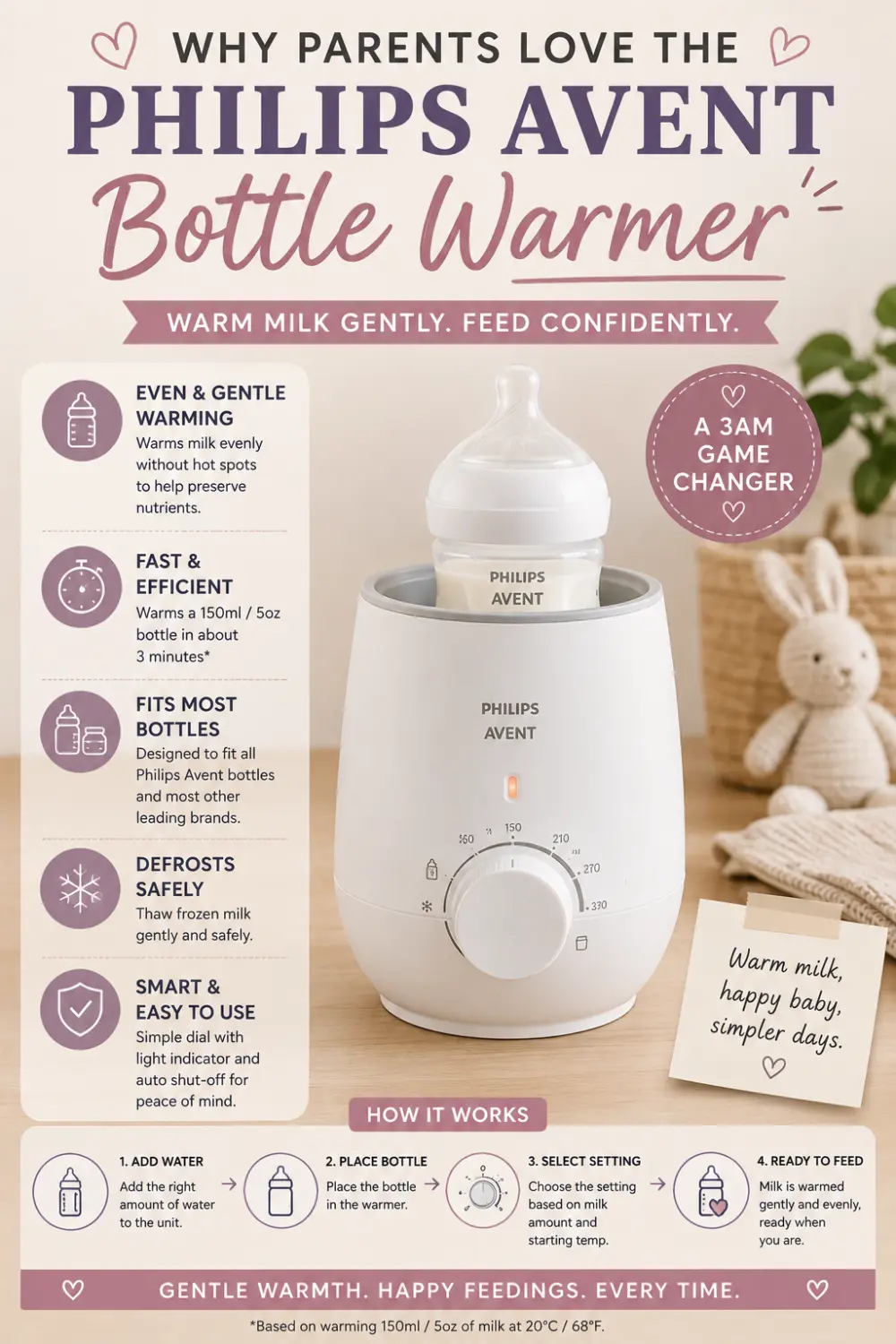
A corded countertop water-bath warmer with one dial and three modes. There is no app, no presets and nothing to pair, which is exactly the right amount of technology for something you operate half-asleep.
It is a circulating warm-water bath, so it heats evenly rather than blasting one side of the bottle. The three modes are warm milk, gentle keep-warm and defrost, and warm baby food. It takes narrow bottles, wide bottles and food jars without adapters. What it is not built for is milk storage bags, which matters if that is how you store breast milk.
How to use the Philips Avent bottle warmer
This is the part people search for, so here is the mechanical version. Where it touches milk safety rather than machine operation, we point you at the manual and your pediatrician instead of answering, and we mean that literally rather than as a disclaimer.
The three modes, and what each one is for
The mode selector decides what kind of job the warmer is doing. Warm milk is the everyday setting. Gentle keep-warm and defrost runs cooler and slower, and is the one for bringing something up from frozen or holding it. Warm baby food is for jars and pots rather than bottles.
Picking the wrong mode is the most common way to get a result you did not expect, because the defrost setting is deliberately slow and will feel broken if you were expecting the everyday warm.
The routine, step by step
Fill the chamber with water, stand the bottle in it, select your mode, and turn the dial to the setting that matches your bottle size. Ours reduces to three movements in practice: fill it, turn the dial, drop the bottle in.
Then stay nearby. On older units there is no auto shut-off, so switching it off is your job rather than the machine’s, and that is the single thing to build into the habit.
For the water level, the exact dial position for your bottle, and anything about what temperature the milk should reach or how to check it before feeding, follow the manual that came with your unit alongside CDC guidance and your pediatrician. That is genuinely not something a review should be telling you.
What the dial does not tell you
The dial gives you settings, not temperatures. There is no number telling you what you are getting, which is why it takes about a week to get a feel for.
What actually happens is you find the mark that suits your usual bottle size, and after that you stop thinking about it entirely. It is a real learning curve and it is short, and it is the trade-off for controls simple enough to work one-handed in the dark. A warmer with a screen and presets solves this differently and gives you more to read at 3 a.m., which is not obviously better.
Speed, measured rather than claimed
Philips Avent quotes about 3 minutes for a 5 oz bottle. We timed a fridge-cold 5 oz bottle with a phone stopwatch across a few real sessions and averaged about 3 to 4 minutes, close enough to their figure that we would call the claim fair.
For a water-bath design that is genuinely fast, and it is the entire reason this warmer is on our dresser. We owned a slower, gentler water-bath warmer first, and eight to ten minutes with a baby getting fussier the whole time is what sent us looking for this one. We put the two head to head in Philips Avent vs Kiinde Kozii, which is the page to read if gentleness matters more to you than minutes. Every warmer we have timed, including the cordless ones, sits in one table in how long a bottle warmer takes.
Bottle fit, the check people skip
It takes narrow bottles, wide bottles and food jars with no adapters, which covers most of what a house accumulates. If your bottles came from three different brands over eighteen months, this is the warmer that will not care.
The exception is milk storage bags. This is built around bottles and jars and warms bags poorly, so if you freeze breast milk in bags, that single fact should decide your purchase before any question of speed. We go through fit and the rest of the buying checks in how to choose a baby bottle warmer.
The auto shut-off catch
This is the honest drawback and we would rather state it plainly than bury it in a pros list. Older units have no automatic shut-off. The machine will not stop on its own, so you do.
In practice we got used to it and it stopped being a thought, but “you get used to it” is not the same as “it is fine,” and if the idea of a warmer running while you are half asleep bothers you, believe that instinct. It is the one feature where the slower warmer we replaced is genuinely better, because it has a timer with a true auto shut-off.
The cheaper Tommee Tippee Easiwarm we own sits in between. Its timer shuts off on its own, but the water keeps heating until you turn the dial off, which we explain in our Tommee Tippee bottle warmer review. We rank all three side by side in the best mid-range bottle warmer, and put the Easiwarm directly against this one in Tommee Tippee vs Philips Avent.
Keeping it working
Anything that heats water builds up limescale, and a warmer caked in scale heats slower and less evenly, which quietly undoes the speed you bought it for. The routine is a wipe after use and a descale every week or two.
We wrote the full method, including what never to put in one, in how to clean a bottle warmer. If you are in a hard water area, expect to descale more often than the manual suggests.
What we like
- Genuinely fast for a water-bath design, about 3 to 4 minutes on our own stopwatch
- Dead-simple dial, operable half-asleep and one-handed
- Circulating water bath heats evenly rather than hot-spotting one side
- Fits narrow bottles, wide bottles and food jars without adapters
- Three modes cover everyday warming, defrost and keep-warm, and baby food
What we don't
- No auto shut-off on older units, so remembering it is your job
- The dial gives settings rather than temperatures, so expect a learning week
- Warms milk storage bags poorly, since it is built for bottles and jars
- Corded countertop unit, so it is a home warmer and not a travel one
Who it is for, and who should skip it
Buy this one if speed is what you actually care about, if you want controls you can work without reading anything, or if your house has drifted into a mix of narrow and wide bottles. It suits formula and mixed feeding particularly well.
Skip it if you store breast milk in bags, if a true auto shut-off is non-negotiable for you, or if gentleness for breast milk matters more than minutes, in which case the Kozii is the one built around that. If you want a machine that also sterilizes and thaws, that is a different tool again, which we compare against this one in Momcozy vs Philips Avent, and we cover the whole lineup in the bottle warmers we have used. And if you are still deciding whether you need one at all, we answered that honestly in bottle warmer vs microwave.
The bottom line
The Philips Avent takes 5 out of 5 from us because it does the everyday job faster than anything else we have used and asks almost nothing of you to do it. Fill it, turn the dial, drop the bottle in. The missing auto shut-off on older units is a real gap and the dial takes a week to learn, and neither has stopped it being the warmer on our dresser that gets used every single day.
Frequently asked questions
How do you use the Philips Avent bottle warmer?
Fill the chamber with water, stand the bottle in it, choose the mode, and turn the dial to the setting that matches your bottle size. There are three modes: warm milk, gentle keep-warm and defrost, and warm baby food. Our routine is fill it, turn the dial, drop the bottle in. Older units have no auto shut-off, so you switch it off yourself. Follow the manual that ships with your unit for water levels and settings rather than any blog, including this one.
How long does the Philips Avent bottle warmer take?
Philips Avent quotes about 3 minutes for a 5 oz bottle. We timed a fridge-cold 5 oz bottle with a phone stopwatch across a few real sessions and averaged about 3 to 4 minutes, close to their own estimate. That is genuinely fast for a water-bath design, which is the main reason it replaced the gentler warmer we owned first.
Does the Philips Avent bottle warmer have auto shut-off?
Older units do not, so you turn it off yourself. That is the one real drawback and it is worth knowing before you buy, because a warmer you have to remember is a warmer you can forget at 3 a.m. If a hands-off timer matters more to you than speed, the Kiinde Kozii has a true auto shut-off and we compare the two directly.
What do the dial settings on the Philips Avent mean?
The dial gives you settings rather than exact temperatures, which takes about a week to get a feel for. You learn which mark suits your usual bottle size and then stop thinking about it. Anything to do with what temperature milk should actually reach is a question for the manual, the CDC and your pediatrician rather than a product review.
Does the Philips Avent warmer fit all bottles?
It fits narrow bottles, wide bottles and food jars without needing adapters, which covers most of what people own. What it does not do well is milk storage bags, since it is built around bottles and jars. If you store breast milk in bags rather than bottles, that is the single check to make before buying.
Is the Philips Avent bottle warmer worth it?
In our use, yes, and we rate it 5 out of 5. It is fast for a water-bath warmer, the dial is simple enough to work half-asleep and one-handed, and it fits our bottles without adapters. We bought it after living with a gentler, slower warmer and it became the one on the dresser that gets used every day.