How often should you replace baby bottles?
This post contains affiliate links. If you buy through them, we may earn a small commission at no extra cost to you.Learn more.
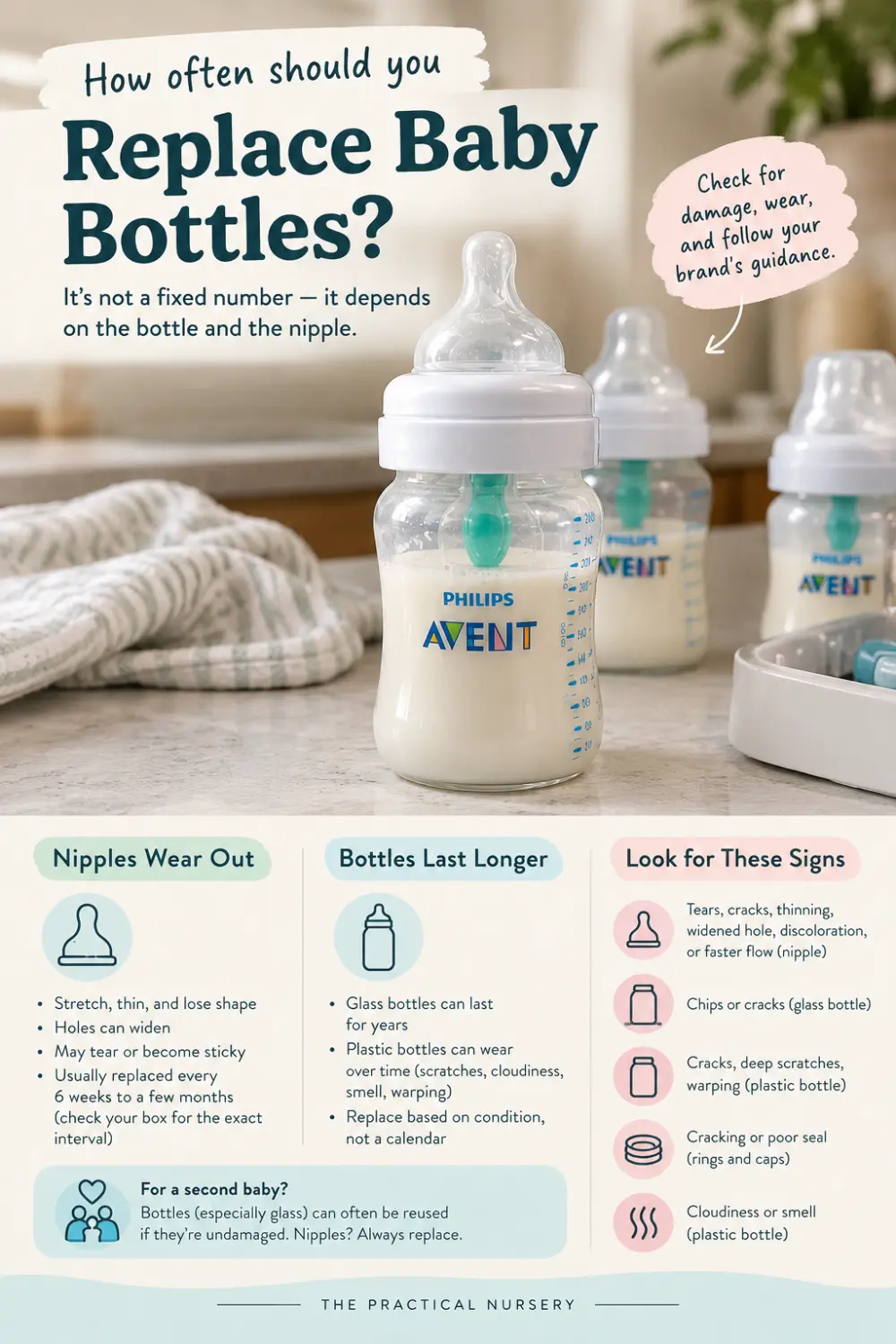
How often should you replace baby bottles is really two questions wearing one coat, because the bottle and the nipple wear out on completely different schedules. The nipple is the part that goes, and it goes repeatedly. The bottle body, particularly a glass one, may well outlast the baby.
The short version: replace on condition, not on a calendar. Inspect before use, throw away anything cracked, torn, chipped or deeply scuffed, and check the replacement interval printed in your own box rather than trusting a number from an article. Anything touching whether a worn item is safe for your baby is a question for your pediatrician, and we are not going to answer it here.
Nipples wear out. Bottles mostly do not
A silicone nipple is doing mechanical work every single feed, and it is being heated, washed and often sterilized between each one. It stretches. It thins. The hole widens. Eventually it tears, usually somewhere you would not look.
Manufacturers commonly suggest replacing nipples somewhere in the range of every six weeks to every few months, and the specific figure varies enough between brands that the only number worth acting on is the one in your own packaging. We are deliberately not giving you a single figure, because there is not one, and a made-up average would be exactly the kind of number that reads as a fact.
Bottle bodies are a different story. They are not doing mechanical work, only holding milk and taking heat. A glass body in good condition can go on for years and through more than one child.
What to actually look for
This is the part that matters more than any interval, because a nipple can fail well before its window is up and a bottle can be perfectly fine long after.
| Part | Replace when you see | How urgent |
|---|---|---|
| Nipple | Tears, cracks, thinning, stickiness, a widened hole, discoloration, faster flow than before | Immediately, bin it |
| Nipple | Reached the interval in your box with no visible damage | Replace at your convenience |
| Glass bottle | Any chip or crack, however small | Immediately, no judgment call |
| Plastic bottle | Cracks, deep internal scratches, warping that stops it sealing | Immediately |
| Plastic bottle | Cloudiness or a smell that a proper wash does not fix | Soon, it is near the end |
| Rings and caps | Cracking, or a thread that no longer seals and leaks under shaking | Soon, and often replaceable alone |
The principle underneath all of it is the CDC’s point about items with tiny cuts or breaks: germs get into them and cannot be removed by cleaning. That is why damage is a replacement question rather than a cleaning question, and why no amount of sterilizing rescues a torn nipple. We go through the sterilizing side of that in how to sterilize baby bottles.
Flow rate is the sign people miss. If a feed has started going faster than it used to on the same nipple level, the hole may have worn rather than your baby having changed. That is worth noticing, and what to do about it is a pediatrician question rather than ours.
Glass and plastic fail differently, and that changes how you inspect
This is the part we would want to know as a buyer, and it is not really about durability numbers. It is about the failure mode.
Plastic fails gradually and visibly. It scuffs, then clouds, then sometimes holds a smell that survives the dishwasher. None of it happens in month one, all of it has happened by the time you are thinking about a second baby, and every scuff is somewhere residue can sit that a brush passes over rather than into. The upside is that plastic warns you. You can watch it aging and plan.
Glass fails suddenly and completely. It stays exactly as it was on day one, with no smell, no stain, no cloudiness and no scuffing, right up until it chips, and then that bottle is finished. A chipped glass bottle is an immediate bin and there is no judgment involved.
So you inspect them differently. Plastic you assess on gradual condition, and the question is whether it is still properly cleanable. Glass you check for chips, especially around the rim and the base, and otherwise leave alone. We set out the whole trade, including weight and cost, in glass vs plastic baby bottles.
The second baby question
The honest split is bodies yes, nipples no.
A glass bottle body that is undamaged, unclouded and still seals is a perfectly good bottle for a second child, and this is most of the reason a glass set works out cheaper across two babies despite costing more on the day. Check every one for chips, check that the rings still seal, and be willing to lose one or two.
Nipples we would replace without thinking about it. They are the wearing part, damage on them is the hardest to see, they have been through a year or more of heat cycles, and they are the cheapest component of the whole system. Buying fresh nipples for a set of bottles you already own is a small cost against the alternative.
Plastic bodies are the judgment call. If they are still clear, smell-free and unscratched inside, they are fine. If they have started to cloud or hold a smell, they have already told you the answer.
What this means when you are buying
Two practical consequences, and they both argue for the same thing.
Buy into a bottle line that sells replacement nipples on their own, easily, years from now. You will buy more nipples than bottles over the life of a baby, and a line that has quietly discontinued the part you need turns a working set of bottles into scrap. This is a real risk with smaller brands and it is worth weighing before you commit to six of anything.
And do not over-buy at the start, because the nipple is the part your baby has an opinion about and it is the part you cannot return once opened. Two first, then the rest. We work that arithmetic through in how many baby bottles do you actually need.
Where we landed
Inspect before use, replace on condition, and check the nipple interval printed in your own box rather than any figure from an article. Nipples are consumables and should be treated as such. Bottles, particularly glass ones, are not.
For the washing routine that keeps them going in the meantime, the CDC’s protocol and our notes on which parts cause trouble are in how to clean baby bottles properly.
Frequently asked questions
How often should you replace baby bottles?
There is no single interval, and the honest answer is that you replace on condition rather than on a calendar. Nipples go first and go often, and manufacturers commonly suggest replacing them somewhere between every six weeks and every few months, so check the interval in your own box. Bottle bodies last far longer, and glass ones can outlast more than one baby. What matters more than any interval is inspecting before use and throwing away anything cracked, torn, chipped or deeply scuffed.
How often should you replace bottle nipples?
More often than the bottles, and this is the part people forget. Silicone nipples are doing the mechanical work of every feed, so they stretch, thin and tear. Manufacturers commonly give a replacement window in the range of six weeks to a few months, but the window in your own box is the one that applies. Inspect before each use and replace at the first sign of damage rather than waiting for the interval to come around.
What are the signs a baby bottle needs replacing?
On a nipple: tears, cracks, thinning or stickiness, a hole that has widened, discoloration, or milk coming out faster than it used to. On a bottle: any crack or chip, cloudiness that washing does not fix, deep scratches inside, a smell that survives a proper wash, or warping that stops the ring sealing. On a glass bottle, a chip is an immediate bin, no judgment call.
Do glass baby bottles last longer than plastic?
Comfortably, yes. Glass does not stain, scuff or go cloudy, and it takes repeated sterilizing for years without degrading, so a glass set can outlast more than one baby. Plastic scuffs, clouds and can hold a smell, and every scuff is somewhere residue sits that a brush does not properly reach. The catch is that glass fails suddenly and completely rather than gradually: one chip and the bottle is done.
Can you keep using a cracked or scratched baby bottle?
No, and this is the clearest line in the whole subject. The CDC's point about items with tiny cuts or breaks is that germs get into them and cannot be removed by cleaning, so no amount of washing or sterilizing rescues a damaged item. A cracked or chipped bottle and a torn nipple both go in the bin rather than back in the rotation.
Can you reuse baby bottles for a second baby?
Bottle bodies, often yes, particularly glass ones, provided they are undamaged, not clouded or scuffed and still seal properly. Nipples, no, and we would not: they are the wearing part, they are cheap, and they are the item where damage is hardest to see. Buying fresh nipples and reusing good glass bodies is the sensible split, and it is most of the reason a glass set works out cheaper over two children.