How to clean a diaper caddy
This post contains affiliate links. If you buy through them, we may earn a small commission at no extra cost to you.Learn more.
Cleaning a diaper caddy is a ten-minute job if you do it often and a much bigger one if you do not. Empty it completely, tip out the crumbs, wipe a plastic caddy or spot clean a fabric one, lint-roll the outside, and let it dry fully before anything goes back in. That is the whole routine, and the drying is the part people skip.
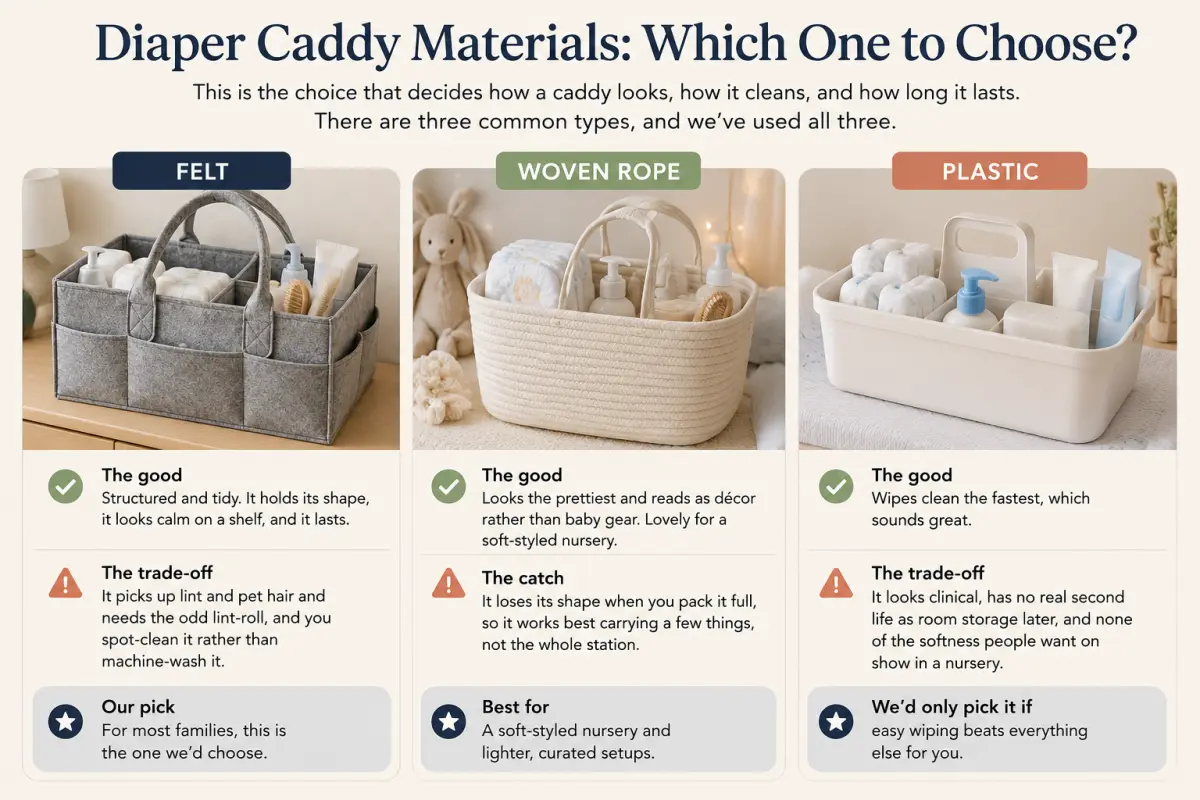
The one thing worth knowing before you start: what your caddy is made of decides how you clean it. We own a structured felt one, a woven rope one and a hard plastic one, all covered in the best diaper caddies we’ve used, and they are three different jobs. The plastic wipes. The felt gets spot cleaned. The rope gets handled gently and never soaked.
What you need
Nothing you would have to buy specially.
- A damp cloth, and baby wipes if you have them open anyway
- A little mild soap or dish soap, used sparingly
- A lint roller, which is the tool that makes a felt caddy look new again
- Baking soda, for any smell that lingers after cleaning
- An old toothbrush for seams and stitching
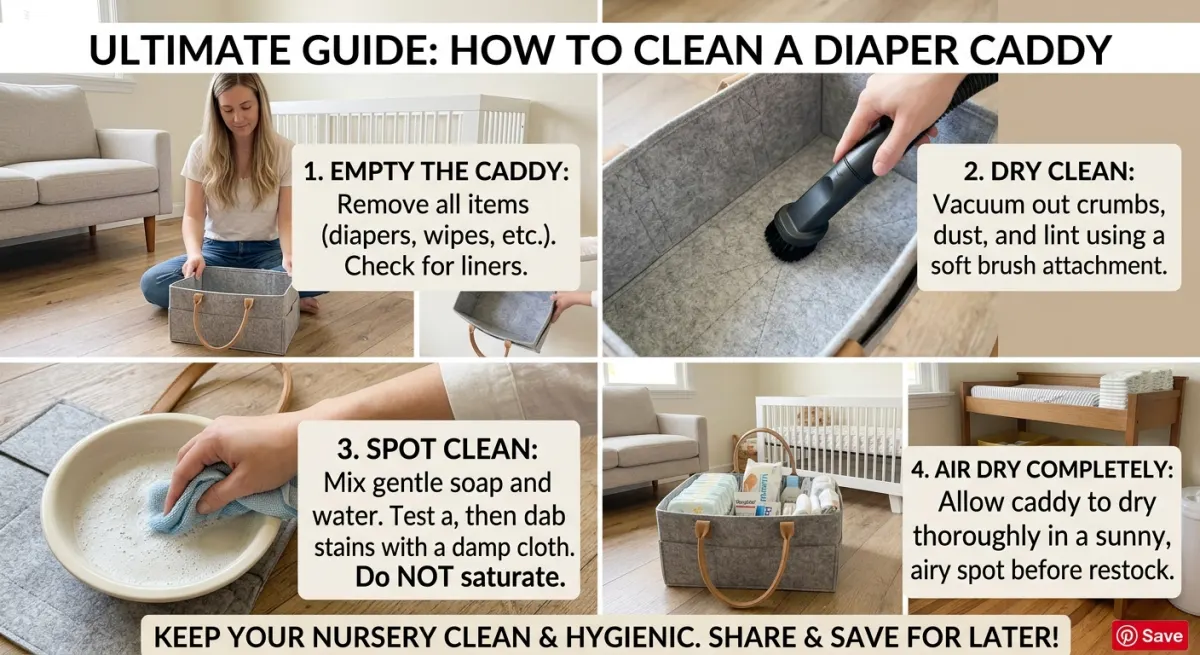
Empty it completely, including the divider
Take everything out. Not most things, everything, including the divider and whatever has migrated into the outside pockets, because a caddy always has one tube of something wedged in a corner that is the actual source of the mess.
Then turn it upside down over a bin and shake. What comes out is usually a surprising amount of dried wipe crumb, bits of cotton, a dried leaf of something unidentifiable, and the sand that appears in any container a baby has been near. This step alone does half the job, and it is the one you can do in thirty seconds on a weekday.
If the crumbs are stuck into the seams rather than loose, a vacuum with a soft brush attachment lifts them out without the scrubbing, and it is gentler on felt than working at it with a cloth. The brush head matters here, since a bare nozzle will pull at the fibre.
If your divider is removable, this is the moment to appreciate that. Pulling it out gets you to the bottom corners, which is where everything collects and where a fixed divider means you are cleaning around an obstacle forever.
Plastic: wipe it and you are finished
If you have a hard plastic caddy, the cleaning section of this article is one sentence long. Wipe it with a baby wipe, or a damp cloth for anything sticky, and it is done.
There is no fibre for anything to soak into, so spills sit on the surface waiting to be removed rather than absorbing while you are not looking. Ours is the one we reach for when something has genuinely leaked, because a cream lid that came off in a fabric caddy is a problem and in a plastic one it is a wipe. If yours has a drawer or a mat, pull the drawer right out and wipe inside the runner, since that is the one spot the cloth otherwise skates over.
Felt and fabric: spot clean, and work the cloth
Felt is the most common caddy material and the one people get wrong, usually by being too enthusiastic with water.
Put a small amount of mild soap on a damp cloth, not on the caddy, and work at the mark rather than the panel. The goal is to lift the stain with the cloth, so keep turning the cloth to a clean section as you go, and finish by going over the same spot with a cloth wrung out in plain water so you are not leaving soap in the fibre. Soap left behind attracts dirt and the mark comes back darker a fortnight later.
Do not soak a felt caddy, and do not hold it under a tap. Structured felt gets its shape from stiffened fibre, and saturating it is what turns a caddy that stands up into a bag that flops.
The machine is not worth the risk
Every few weeks someone asks whether a caddy can go in the washing machine. Ours have not, and we would not try it.
A cycle does to a structured caddy exactly what soaking does, only faster and with agitation on top. Even the fabric ones that survive the water come out of the drum a different shape, and a caddy that will not stand up on its own is one where everything inside tips over the first time you carry it. Spot cleaning takes less time than a wash cycle. If the caddy is beyond spot cleaning, it is usually beyond the machine too.
Woven rope needs a gentler hand
A cotton rope basket is the prettiest kind of caddy and the most fragile to clean. The rope is wound and stitched rather than woven into a solid panel, so anything abrasive frays it and anything wet makes it sag.
Work along the direction of the rope with a barely damp cloth, blot rather than rub, and let it dry slowly and away from direct heat. If the stitching has picked up crumbs, that is what the toothbrush is for: a light brush along the seam lifts more than a cloth ever will.
Lint is the other half of the job
Nothing makes a felt caddy look tired faster than lint, and nothing makes it look new again faster than a lint roller. Felt collects lint and pet hair the way a magnet collects paperclips, and ours needs a roll every few weeks alongside the actual cleaning.
It takes a minute and it is the difference between a caddy that looks cared for on the changing table and one that looks like it has been under the bed. The outside faces the room, so it is the part anyone else sees.
Pockets, seams and the places a cloth slides over
Outside pockets are where the small greasy things live, so they are where the residue is. Turn each pocket inside out if it will go, or push the cloth into the corners with one finger if it will not, and give the seam along the bottom of the pocket a pass with the toothbrush.
The other spot worth a look is wherever the handles join the body. Stitching there collects grime and it is the part that takes the weight, so a clean seam is also a chance to notice a thread going before it becomes a handle coming off mid-carry.
Getting a smell out
Most caddy smells are one specific thing rather than the caddy in general: a leaking cream tube, a wipe packet that dried out, or a dirty burp cloth that got put back in. Find the item, clean the patch underneath it, and the smell usually goes with it.
For a smell that lingers in fabric after cleaning, sprinkle a little baking soda in the empty caddy, leave it a few hours, then shake or vacuum it out. Airing does the rest, and airing in a room with moving air beats an airing cupboard every time.
Drying is most of the job
This is the step that decides whether the clean worked. Stand the caddy open, ideally somewhere with a bit of air moving, and leave it until it is dry all the way through rather than dry to the touch. Felt in particular holds damp in the middle of the panel long after the surface feels fine.
Keep it away from a radiator or direct sun, both of which dry the outside fast and can stiffen or fade the fabric while the inside stays wet. If you are in a hurry, put the contents back in a second caddy or leave them on the shelf for the evening. Repacking damp is how a clean caddy ends up smelling worse than it did before.
How often, in short
Tip it out and wipe it once a week, at the same moment you restock it, since the caddy is empty then anyway. Spot clean whenever something leaks rather than waiting for the weekly pass. Lint roll a felt one every few weeks. That rhythm keeps the job at ten minutes and means you never have to do the version of this that involves scrubbing.
The restock and the clean fitting together is not a coincidence, and we go through the packing order that makes both quick in how to organize a diaper caddy.
The bottom line
Empty it fully, shake out the crumbs, wipe plastic or spot clean fabric with a damp cloth and a little soap, get into the pockets and seams, deal with any smell using baking soda and air, then dry it completely before it goes back into service. Skip the washing machine. Lint roll the felt.
If the caddy itself is the problem rather than the routine, the materials and what each one is like to live with are covered in how to choose a diaper caddy and the ones we own are in the best diaper caddies we’ve used. The bag you carry out of the house cleans differently, and that one is how to clean a diaper bag.
Frequently asked questions
How do you clean a diaper caddy?
Empty it completely, pull the divider out, and tip the crumbs into a bin. Wipe a plastic caddy with a baby wipe or damp cloth and it is done. For felt or fabric, spot clean the marks with a little mild soap on a damp cloth, working the cloth rather than soaking the panel, lint-roll the outside, then stand it open to dry fully before you repack it. The whole job is ten minutes and most of that is drying.
Can you put a diaper caddy in the washing machine?
We would not, and we do not. A structured felt caddy gets its shape from stiffened fibre, and a machine cycle is what turns it into a floppy fabric bag that never stands up again. Rope and cotton baskets lose their shape the same way. Spot cleaning takes less time than a wash cycle anyway, and it keeps the thing looking like a caddy rather than a slumped liner.
How do you get a smell out of a diaper caddy?
Empty it, spot clean whatever caused it, then let it air properly, ideally somewhere with moving air rather than a closed cupboard. For a lingering smell in fabric, a light sprinkle of baking soda left in the empty caddy for a few hours and then vacuumed or shaken out does most of the work. Repacking a caddy that is still damp is the single most common way a smell comes back.
How often should you clean a diaper caddy?
A quick tip-out and wipe once a week, at the same time as the restock, and a proper spot clean whenever something leaks. Cream is the usual culprit, since a tube with a loose lid quietly greases the bottom of the caddy for days before anyone notices. Little and often keeps it a ten-minute job rather than a rescue mission.
Is a plastic diaper caddy easier to clean than a fabric one?
Much easier, and that is its main advantage. A plastic shell has no fibre to absorb anything, so a baby wipe handles nearly everything and a damp cloth handles the rest. Felt and fabric caddies stain, hold smells, and cannot really be cleaned once something has soaked into the material. We own both and the plastic one is the one we never worry about.