Do you need a baby monitor? An honest answer from parents who own six
This post contains affiliate links. If you buy through them, we may earn a small commission at no extra cost to you.Learn more.
Our answer, if you don’t read another word: you don’t strictly need a baby monitor, but most homes are better with one. It earns its place the first time the baby naps somewhere you cannot hear clearly and you want to know whether a noise means getting up. We own six video monitors and use them every day, and we would still tell you to skip buying one in a small flat where you would hear a cry from every room. A monitor saves you trips to the door. It does not keep a baby safe, and nothing on this page should suggest otherwise.
That last point first, because it shapes everything else. A baby monitor is a convenience device. None of the ones we own is a medical product, and none claims to be. The AAP’s 2022 safe sleep recommendations advise against using home cardiorespiratory monitors as a way to reduce the risk of SIDS, and against relying on commercial devices marketed to do the same. Where a baby sleeps, and anything else about safe sleep, is a question for the AAP, the CPSC and your pediatrician. What we can tell you is when a monitor is worth having as a piece of gear.
What a baby monitor does
Strip the features away and a monitor answers one question: is the baby still asleep?
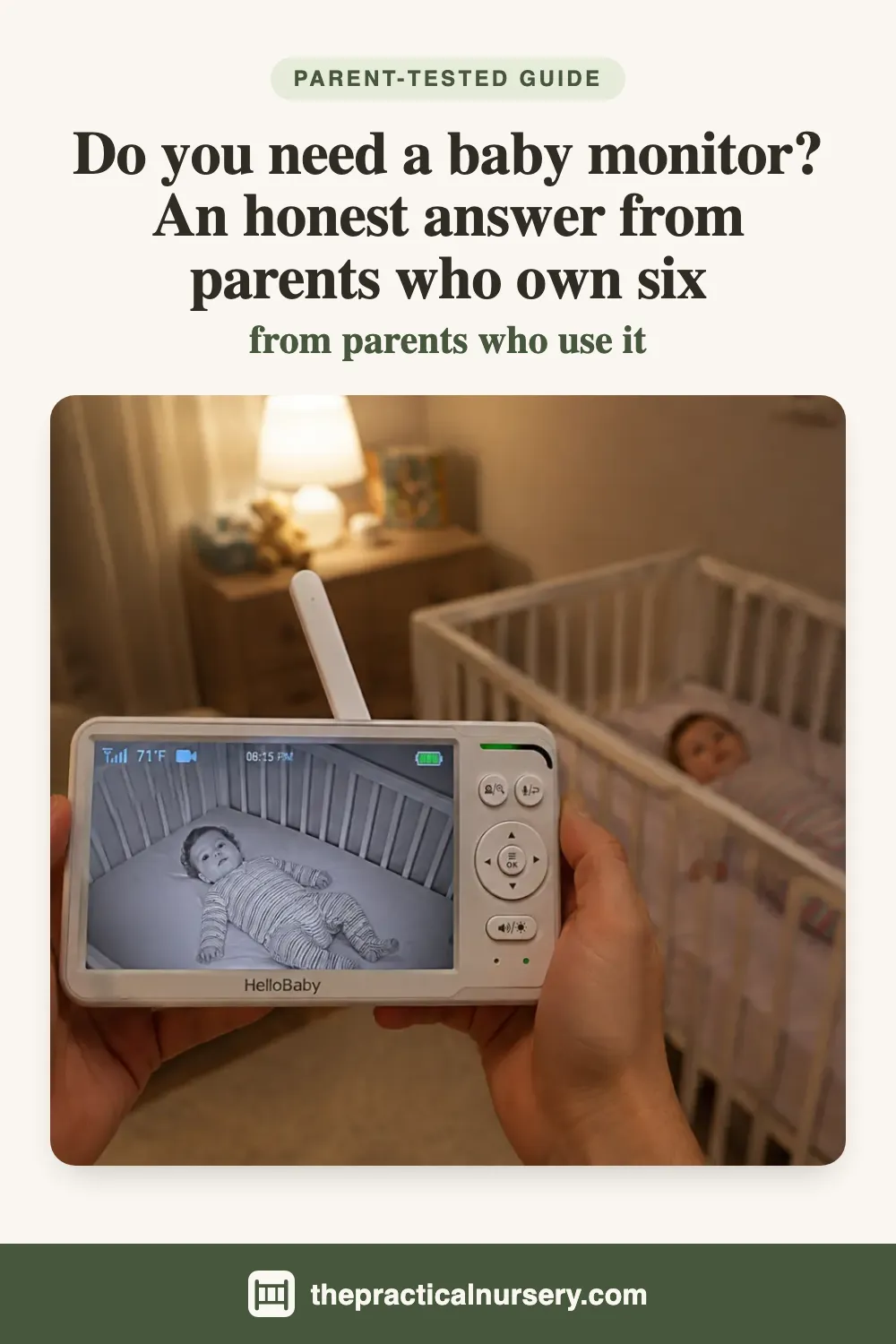
An audio monitor answers it with sound. If the room is quiet, they probably are. A video monitor answers it with a picture, which goes further. It tells you whether that noise was a cry or a sleepy grumble, whether they have rolled to the corner, and whether a toddler is standing up in the cot or lying down.
The value is in the trips you no longer make. Without a monitor, every sound from the nursery is a decision: go and check, or wait and hope. Opening the door to look is often what wakes a baby who was about to settle. With a monitor you look at a screen instead, and most of the time you sit back down.
When a monitor earns its place
These are the situations where we would not want to be without one.
The baby sleeps out of earshot
This is the main one. If the nursery is upstairs and you spend the evening downstairs, or there are a couple of closed doors and a running dishwasher between you, a cry can go unheard or arrive muffled enough that you are never sure. Range is the reason the monitor exists.
Naps while you get on with the day
Night time gets all the attention, but in our house naps are when the monitors work hardest. A nap is when you are cooking, working, hanging washing or sitting in the garden. A handset you can carry from room to room turns the nap into usable time instead of tiptoeing time, as long as its battery covers the nap. Ours range from about 5 hours on the VAVA to a rated 8 to 16 on the Jeeber, and our guide to baby monitor battery life compares all six.
Two children in one room
Both of ours share a room, and here a camera stops being a nice extra. When you hear crying from a shared room, the first question is which one. Without a camera, the only way to find out is to go in, and going in can wake the other. With a camera over each cot you know before you stand up. Our two-camera VAVA baby monitor puts both cots on one screen for exactly this, after a single wide camera turned out not to be enough.
A loud house, or a loud nursery
If you run a fan, white noise or air conditioning in the nursery, it can cover small sounds before they reach you through the door. A monitor puts the microphone in the room, next to the cot. The better ones go further: our Infant Optics filters out steady background noise like a fan, so what reaches the handset is the baby rather than the hum.
A toddler who has started climbing
A monitor does not stop at the baby stage. Once a toddler is standing and climbing, a picture tells you whether that noise was a toddler chatting to themselves or one trying to get out.
When you can probably skip it
We would not tell everyone to buy one. Here is when we think you can do without.
A small home where you hear everything
In a one-bedroom flat, or a small house where the nursery shares a wall with the room you live in, you may simply hear the baby without help. If you can hear a cry from every room you spend time in, a monitor is adding a screen to information you already have. Try a few weeks without one before you decide.
The baby sleeps in the room with you
Where your baby sleeps, and for how long, is safe sleep guidance we leave to the AAP. While the baby sleeps in the same room as you at night, a monitor has little to do at night. It may still be useful for daytime naps elsewhere, which is how a lot of families start using one.
You go in every time anyway
Some parents check in person whatever the monitor shows, and that is a reasonable way to parent. If that is you, a camera will not change your nights much. A basic audio monitor, or none at all, may suit you better.
What a monitor can’t do
This is worth being plain about, because baby monitor marketing sometimes is not.
A monitor does not prevent anything. It relays a picture and sound from one room to another. Breathing sensors, wearable socks and movement pads are a different category of product, and the AAP’s position on them for reducing SIDS risk is linked above. We do not own any and do not review them.
A monitor also does not replace following the manual. Cords on a monitor need to be kept away from the cot, and the CPSC has a specific warning about baby monitor cords that every parent setting one up should read. Our where to put a baby monitor camera guide points to it before anything else.
And a monitor will not work if you do not trust it. One that is too quiet, too hissy or flat by bedtime ends up ignored. Buy one you will rely on, which mostly means a readable screen, loud clean sound and a battery that fits your day.
If you do get one, how much do you need to spend?
Less than you might think. We own monitors across the price range, and the most expensive is not the one that surprised us most.
The cheap end works. The Jeeber VB619 has a 5 inch 1080p screen, needs no WiFi or app, and we rate it 5 out of 5 against other budget monitors. The VTimes VT31 is the cheapest we own, with a 2.4 inch screen that tells you whether the baby is asleep and not a lot more. Both are in our best baby monitor under $100 roundup.
Spending more buys durability and comfort rather than the basic job. Our top pick, the Infant Optics DXR-8 PRO, earns its rating with swappable lenses, noise filtering and a battery you can replace, and two years in it still runs as long as it did new. The full ranking of the four main monitors in our house is in the best baby monitor roundup.
If you want a monitor that never touches your WiFi, which also happens to be the simpler setup, our best non-WiFi baby monitors page ranks the four we own.
Audio, video, or no monitor at all
If you have decided you want something, the next fork is sound only or sound with a picture.
Audio monitors are simpler and usually cheaper. They tell you something is happening. Video monitors tell you what is happening, which is the difference between going in and staying put. Most of the night a video monitor is working as an audio monitor anyway, because the screen stays dark until the baby makes a sound. We go through the trade in our audio vs video baby monitor guide.
If you go with video, decide one thing before anything else: whether you need to watch from outside the house. That is the WiFi question, and it splits the market in two. Our how to choose a baby monitor guide takes it from there, feature by feature.
Should a baby monitor go on the registry?
For most families, yes. It is one of the few items on our own realistic registry checklist that gets used every single day. One monitor is enough to start with. Monitors that take extra cameras, like the Jeeber, mean a second child later is a camera to add rather than a monitor to replace.
What does not need to go on the registry is the most expensive model in the shop because the box has the longest feature list. Our baby items you don’t need list covers the popular things that end up unused, and the extras on monitor boxes are a smaller version of the same story.
The bottom line
Do you need a baby monitor? If your baby sleeps where you cannot hear them clearly, or naps while you get on with the day, then yes, you will use it every day. If your home is small enough to hear every sound, you can skip it, or start with a cheap one and see.
Either way, buy it as a convenience. It saves trips to the door and the occasional woken baby. Safe sleep is a separate subject with its own experts, and the AAP and CPSC are where to read about it.
Frequently asked questions
Do I really need a baby monitor?
Not strictly, but most families end up glad they have one. It earns its place once the baby sleeps somewhere you cannot hear clearly from where you spend your evenings, or naps while you cook, work or sit in the garden. If your home is small enough that you would hear a cry from every room, you can manage without one. A monitor is a convenience device that saves you trips to the door, not a safety device.
Can a baby monitor prevent SIDS?
No, and no monitor we own claims to. The AAP's 2022 safe sleep recommendations advise against using home cardiorespiratory monitors as a strategy to reduce the risk of SIDS, and against relying on commercial devices marketed to reduce that risk. Read the guidance at the source, and talk to your pediatrician about anything to do with safe sleep.
When do you need a baby monitor?
Whenever the baby is asleep somewhere you cannot hear well. Where a baby should sleep, and for how long, is safe sleep guidance from the AAP rather than something a gear blog should advise on. Practically, a monitor starts earning its keep at the first nap you spend in another room, and keeps doing so well beyond the baby stage.
Is an audio monitor enough, or do you need video?
Audio tells you that the baby is making noise. Video tells you whether you need to go in. If you are happy to go in every time you hear something, audio can be enough. A camera earns its place when you want to check without opening the door, or when two children share a room and you need to see which one is awake. We compare the two in our audio vs video baby monitor guide.
Do you need an expensive baby monitor?
No. The Jeeber VB619 we rate 5 out of 5 for the budget category costs a fraction of our top pick and has a sharper picture than monitors we paid more for. What a low price usually takes away is screen size, a second camera or battery life. What it does not have to take away is the basics: a clear picture and sound you can hear.