Best baby bottles: the eight we own, ranked
This post contains affiliate links. If you buy through them, we may earn a small commission at no extra cost to you.Learn more.
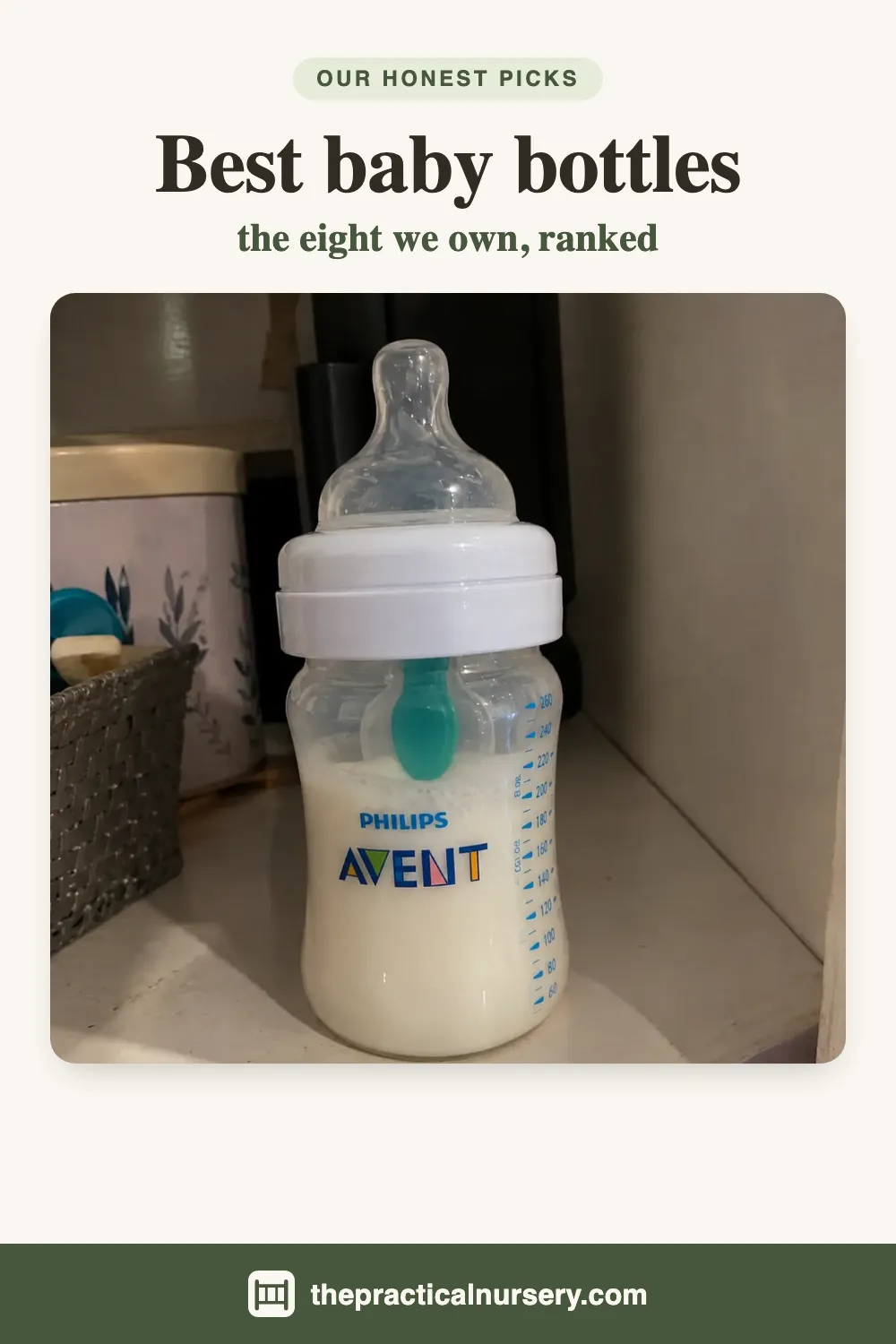
Our pick, if you don’t read another word: the best baby bottle in our house is the Philips Avent Anti-Colic with the AirFree vent, the only one of our eight we rate a 5. It washes up quickly, its vent is a single piece, and it is the bottle we pick up first. The Philips Avent Natural Response glass bottle is our 4.8 and the one we own the most of, and the list runs down to the two Dr. Brown’s bottles at 4. This page ranks every bottle we feed with against the others. If you are shopping for one particular job, the box below sends you to the page that ranks bottles for it.
One honest note before the rest. We review gear. How much and how often your baby should feed, whether and when to introduce a bottle to a breastfed baby, preparing formula, and anything touching colic, reflux or latch are questions for your pediatrician or an IBCLC lactation consultant, and the CDC and AAP publish the current guidance. What we can tell you is what these eight bottles are like to fill, feed with and wash several times a day.
What separates one bottle from another
Most bottles on the shelf hold milk well enough. The differences you feel every day come down to four things, roughly in this order, and our guide to how to choose a baby bottle turns them into a checklist.
The nipple matters most. Two questions decide it: how fast it flows, and whether it drips when the baby pauses. A nipple that keeps delivering milk while she stops to breathe makes for a gulpier feed. The Philips Avent Natural Response nipple is built not to do that, which is a large part of why two of our top three use it.
Parts come second, because you will wash every one of them several times a day for a year. Our bottles run from three parts on the Thyseed to five on the vented Dr. Brown’s glass bottle. We go through which parts cause the most trouble in how to clean baby bottles properly.
Neck width is third. A wide neck fills, takes a formula scoop flat and brushes out easily, and it is also what decides whether a bottle fits your warmer. Seven of our eight are wide, and we compare the two in wide-neck vs narrow-neck baby bottles.
Material comes last, and it matters less than people expect. Glass stays clear and smell-free for years but is heavier and can break. Plastic is light and bounces. Our list mixes both, and we set out where each one wins in glass vs plastic baby bottles.
The eight, side by side
| Bottle | Our rating | Material | Neck | Air handling | Parts to wash | Best for |
|---|---|---|---|---|---|---|
| Philips Avent Anti-Colic with AirFree | 5 / 5 | Plastic | Wide | One-piece AirFree vent in the neck | 4 with the vent | Everyday feeds with the least fuss |
| Philips Avent Natural Response glass | 4.8 / 5 | Borosilicate glass | Wide | Valve in the nipple | 4 | Feeds at the baby's pace |
| Philips Avent Natural Response 4 oz | 4.8 / 5 | Plastic | Wide | Valve in the nipple | 4 | The newborn weeks |
| Tommee Tippee Natural Start glass | 4.5 / 5 | Medical-grade glass | Wide | Vented nipple | 4 | Storing milk in the bottle you feed from |
| Thyseed anti-colic glass | 4.5 / 5 | Borosilicate glass | Wide | Pressure-sensing valve in the base | 3 | The softest nipple and the shortest wash-up |
| PopYum formula making bottle | 4.5 / 5 | Polypropylene and silicone | Wide | Vent that sends air back into the bottle | 5 | Making formula away from the kitchen |
| Dr. Brown's Options+ wide-neck glass | 4 / 5 | Glass | Wide | Removable internal vent | 5 with the vent, 4 without | Swallowed air, if you accept the extra work |
| Dr. Brown's Options+ narrow 2 oz | 4 / 5 | Plastic | Narrow | Removable internal vent | The vent insert adds parts | The very smallest feeds |
Our ratings are our overall judgment of each bottle, not a score worked out from this table. Where two bottles share a rating, the one that covers more of an ordinary day ranks higher, which is why the newborn sizes sit below their full-size versions.
1. Philips Avent Anti-Colic with the AirFree vent: the one we reach for first
A wide-neck, BPA-free plastic bottle with Philips Avent’s anti-colic nipple and a separate one-piece AirFree vent that sits in the neck. Our set is four 9 oz bottles with Flow 2 nipples. The vent is designed to keep the nipple full of milk rather than air, even with the bottle held level, and the bottle works with or without it, so you can take the vent out later and carry on with the same set. The wide neck takes a formula scoop flat and cleans with a sponge.
Who should buy it
Buy it if
- You want one everyday bottle that is quick to wash
- You want venting without a fiddly insert
- You want a light bottle that will not break if it hits the floor
Skip it if
- You are buying for a newborn, since our set came with Flow 2 nipples
- You want glass that will not scuff or cloud with age
How its venting compares with the Thyseed and the Dr. Brown’s is in anti-colic baby bottles, where it also ranks first.
2. Philips Avent Natural Response glass: the one we own the most of
A wide-neck borosilicate bottle with the Natural Response nipple, which has a slit that opens when the baby actively sucks and closes when she pauses. Milk arrives when she draws it out, not because gravity is pushing it. The anti-colic valve sits in the nipple, so it is four parts: bottle, nipple, screw ring and cap. It is BPA-free and safe for the dishwasher, steam and UV sterilizers, and boiling water. It is heavier than plastic, and a chipped bottle goes in the bin.
Who should buy it
Buy it if
- Your baby moves between the breast and a bottle
- You want glass that stays clear and smell-free
- You sterilize often
Skip it if
- Your baby has started holding the bottle and dropping it
- You want the lightest bottle for days out
It tops our ranking of glass bottles for breastfed babies, and the full write-up is our Philips Avent Natural Response glass bottle review.
3. Philips Avent Natural Response 4 oz: the same nipple in a newborn size
The same Natural Response nipple on a 4 oz plastic bottle, fitted with the slow flow and sold as a 2-pack. It is BPA-free, light, four parts, and it was the bottle we used most before our baby was 3 months old.
Who should buy it
Buy it if
- You are buying for the first months
- You want a slow flow nipple fitted from the first feed
- You want something light
Skip it if
- Your baby is already past the newborn stage
- You would rather start with glass
It is our first pick for the first months in the best baby bottles for newborns, alongside the smallest bottles we own.
4. Tommee Tippee Natural Start glass: the most useful set
A wide-neck 9 oz bottle in medical-grade glass with a vented silicone nipple, screw ring and cap. The set also includes travel food jar lids and cup rings, so the same glass body is a bottle, then a sealed storage jar, then part of a cup. The assembled bottle is leakproof upside down, and the glass is heat and thermal shock resistant and self-sterilizes in about three minutes. Listings count pieces, so a nine-item set is three bottles.
Who should buy it
Buy it if
- You want glass without paying the usual glass price
- You pump and want to store milk in the bottle you feed from
- You feed formula and shake bottles several times a day
Skip it if
- The pace of the feed is the thing you most want to get right
- You want a light bottle for the diaper bag
It ranks first in the best baby bottles for formula feeding, and the full write-up is our Tommee Tippee Natural Start glass bottle review.
5. Thyseed anti-colic glass: the softest nipple
A wide-neck borosilicate bottle that handles air in the base: a valve there senses the pressure change as the baby drinks and lets air in from below. That leaves three parts, the fewest of anything we own. The nipple is the softest silicone on this list, wide and breast-shaped, with three holes at the tip instead of one. Thyseed makes six flow rates, and the listing we bought pairs an 8 oz body with a slow flow nipple rated 3m+. The parts go on the top rack of the dishwasher.
Reflux and gas are questions for your pediatrician, and a bottle is not a treatment. What we can say is that this nipple suited our baby when others had not.
Who should buy it
Buy it if
- Other anti-colic bottles have not suited your baby
- You want a very soft, wide, breast-shaped nipple
- You want the fewest parts to wash
Skip it if
- You want an established brand for replacement nipples
- You want a light bottle, since this one is glass
The 5 oz newborn version, with an extra slow 0m+ nipple, is in the best baby bottles for newborns.
6. PopYum formula making bottle: the one for the diaper bag
The only bottle here built for one job. PopYum holds formula powder in a sealed chamber and the water in the bottle until you press two buttons on the side and shake, so you can make a fresh bottle one handed wherever you are. Our set is three 9 oz bottles with number 2 medium flow anti-colic nipples and a funnel for loading the powder. It is polypropylene and silicone, free from BPA, BPS, latex, lead, PVC and phthalates, five parts in all, and top-rack dishwasher safe.
Who should buy it
Buy it if
- You feed formula and are often out of the house
- You want to make up a bottle one handed
Skip it if
- You rarely make formula away from home
- You are feeding a newborn, since our set came with a medium flow nipple
7. Dr. Brown’s Options+ wide-neck glass: the most venting, and the most fuss
A 9 oz wide-neck glass bottle with Dr. Brown’s internal vent, which carries air past the milk to the top of the bottle so it goes into the bottle rather than into the baby. The vent lifts out once your baby no longer needs it, and the bottles carry on working. It comes with a Level 1 slow flow nipple, with faster levels sold separately, and it is safe for the top rack of the dishwasher, electric and microwave sterilizers, and boiling water.
Who should buy it
Buy it if
- Swallowed air is the specific problem you are trying to solve
- You want a vent you can take out later and keep the bottles
Skip it if
- You mix formula by shaking the bottle
- You want the shortest wash-up
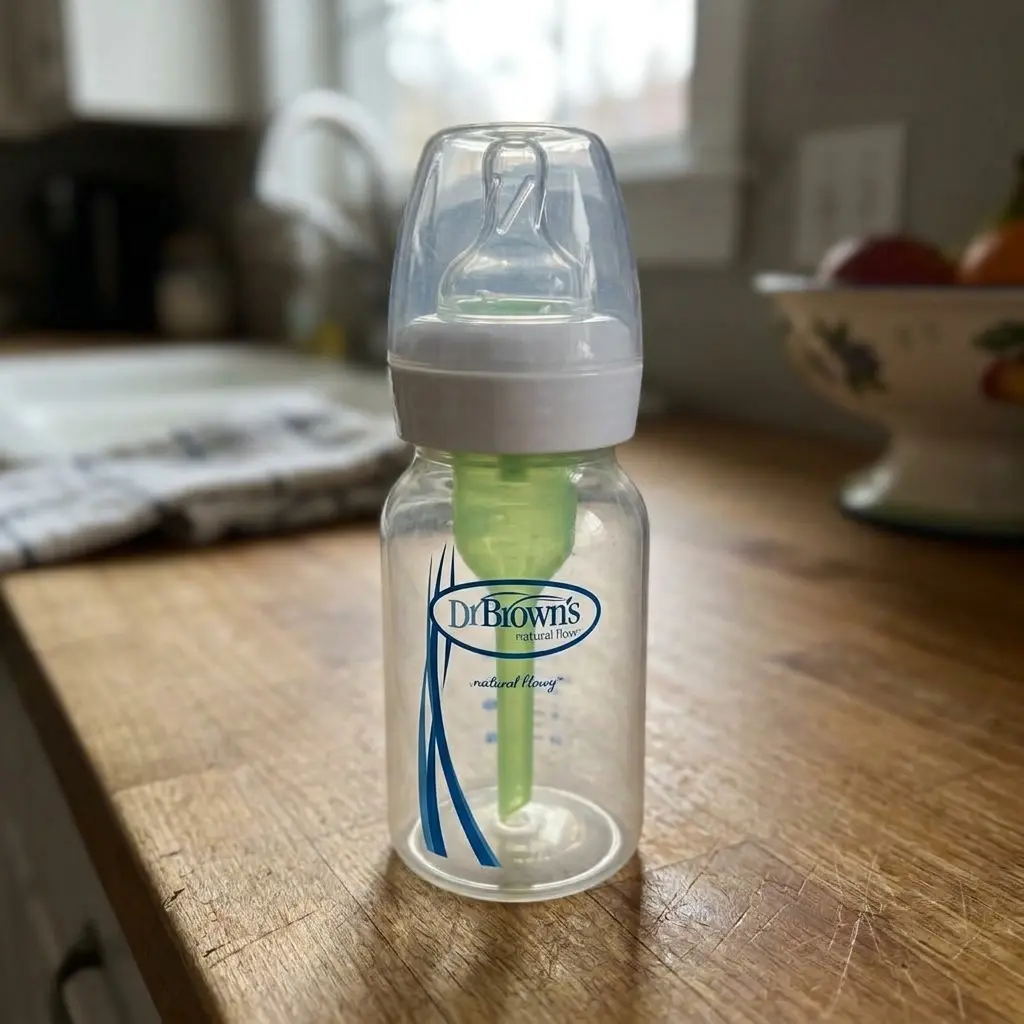
8. Dr. Brown’s Options+ narrow 2 oz: the smallest bottle we own
A 2 oz narrow plastic bottle with preemie flow nipples, rated 0m+, sold as a 4-pack. It uses the same removable internal vent as the glass version, and it is BPA-free.
Who should buy it
Buy it if
- You want the smallest bottle and the slowest flow for very small feeds
Skip it if
- You want a wide neck that is quick to fill and clean
- You want a bottle that lasts past the first weeks
What we would skip
A set of six before your baby has fed from one. The nipple is the part she has an opinion about, and it is the part you cannot return once the packet is open. We work out the right number in how many baby bottles do you actually need.
Any bottle sold on the promise that it cures colic. Venting reduces how much air a baby swallows, and that is as far as a bottle can honestly go.
Matching nipple level numbers across brands. A Level 2 on one bottle is not a Level 2 on another, so go by how your baby copes with the flow.
The rest of our bottle pages
Each of our other bottle pages answers one narrower question, so you only need the one that matches yours. Philips Avent vs Tommee Tippee glass bottles puts our two most-used glass bottles head to head. If you are still choosing a material, glass vs plastic baby bottles settles it. And once the bottles are home, how to sterilize baby bottles and how often to replace baby bottles cover looking after them, and the machines we sterilize ours in are ranked in the best bottle sterilizer and dryer.
Where we landed
Buy the Philips Avent AirFree if you want one everyday bottle and the least washing for a vented one. Buy the Philips Avent Natural Response glass bottle if you want glass and a feed that runs at your baby’s pace. Start a newborn on its 4 oz version. Buy the Tommee Tippee if you want glass that doubles as fridge storage at a fair price, the Thyseed if other bottles have not suited your baby, and PopYum for formula on the go. We would only reach for the Dr. Brown’s bottles if swallowed air is the problem and you accept the extra parts.
Whatever you choose, buy one or two first. For where bottles sit against everything else you are being told to buy, our realistic baby registry checklist has the short list of what earns its place.
Frequently asked questions
What is the best baby bottle?
Of the eight we feed with, the Philips Avent Anti-Colic with the AirFree vent, the only one we rate 5 out of 5. It is quick to wash for a vented bottle, the vent is a single piece, and it is the bottle we pick up first. The Philips Avent Natural Response glass bottle is our 4.8 and the one we own the most of. If you are shopping for one job, such as a newborn, formula or a breastfed baby, we rank bottles for each of those on its own page.
Which baby bottle is the easiest to clean?
The Thyseed, at three parts, because its anti-colic valve is built into the base rather than added as an insert. The Philips Avent bottles come next at four parts, and the AirFree vent is one piece that needs no special brush. The Dr. Brown's Options+ bottles are the most work, because the vent insert comes out, gets washed and has to dry at every feed.
Are Philips Avent bottles worth it?
For us, yes. Our top three are all Philips Avent: the AirFree anti-colic bottle at 5 out of 5, and the Natural Response glass bottle and its 4 oz newborn version at 4.8 each. The Natural Response nipple only lets milk out while the baby is actively drinking, which is the feature we would pay for. Prices move on Amazon, so check the current price before you buy.
Do nipple flow levels match between bottle brands?
No, and we learned that the messy way. Our baby was on Level 2 with the Avent bottles, so we ordered Level 2 for the Dr. Brown's, and the same number ran noticeably faster. Go by how your baby copes with the flow rather than the number or the age on the packet, and ask your pediatrician if feeding is a struggle.
Should you stick to one brand of bottle?
You do not have to, and most families we know end up with more than one. Babies have opinions about nipples, and the bottle you buy second is often the one your baby picked. Buy one or two of a bottle first, see how the feeds go, then build a rotation around the one that works.