Newborn vs regular size baby bottles: do you need the small ones?
This post contains affiliate links. If you buy through them, we may earn a small commission at no extra cost to you.Learn more.
Our answer, if you don’t read another word: in the newborn vs regular size baby bottles question, you do not strictly need the small ones. The nipple sets the flow, not the bottle, and in most lines the same nipples, rings and caps fit both sizes. A larger bottle with a newborn nipple holds a small feed perfectly well. What the small bottles give you is convenience in the first months: they are lighter, easier to read at low volumes, and one of ours comes in a size the larger line does not offer. We used small bottles until about three months and 8 and 9 oz bottles after that.
One note on scope. This is a page about bottles as gear. How much and how often a newborn should feed, and which nipple flow suits your baby, are questions for your pediatrician or a lactation consultant. The AAP publishes the current guidance.
What actually changes between the two sizes
The difference is smaller than the shelf suggests.
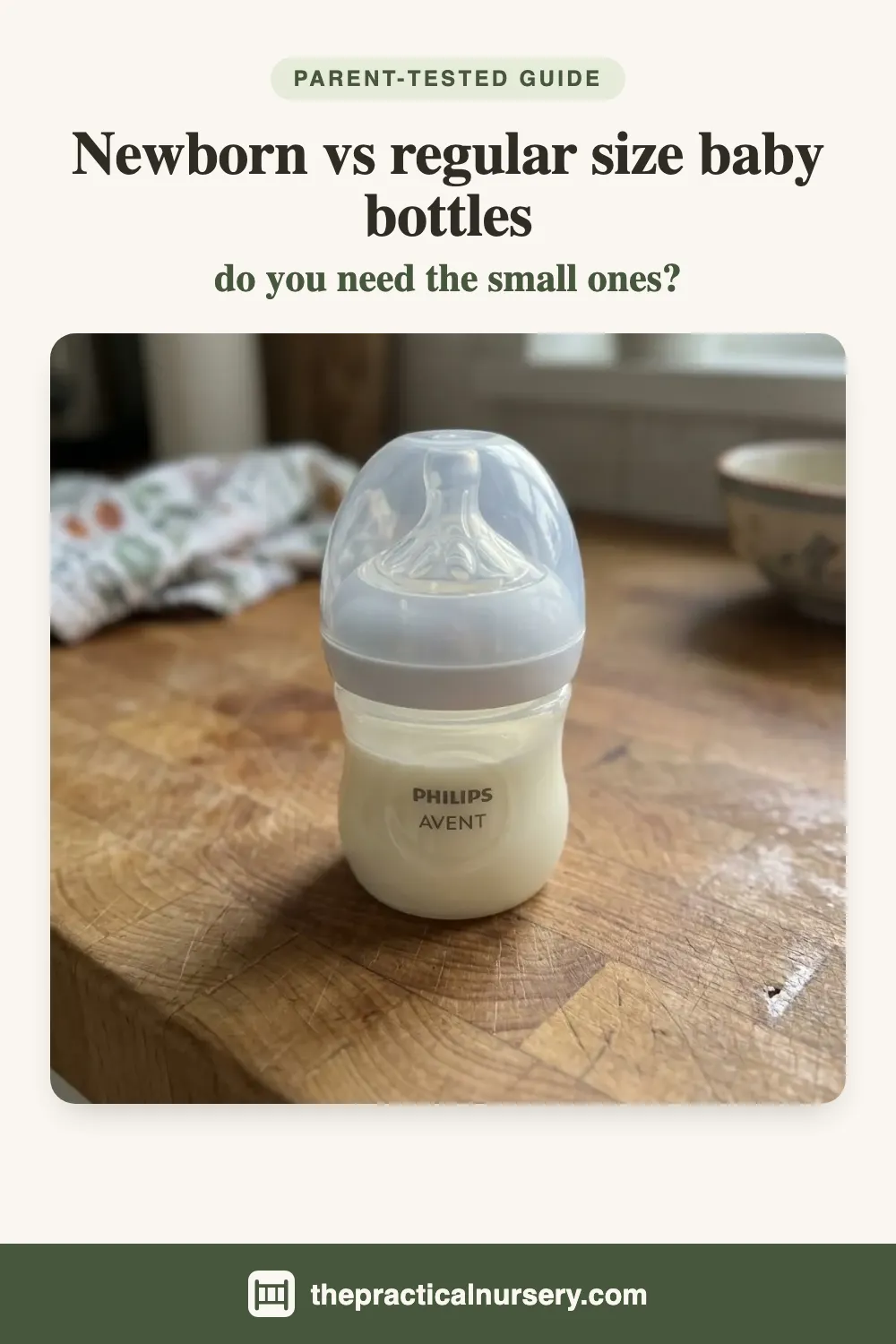
Capacity. Our newborn bottles hold 2 to 5 oz: the Dr. Brown’s Options+ is 2 oz, the Philips Avent Natural Response 4 oz and the Thyseed newborn bottle 5 oz. Our regular bottles hold 8 or 9 oz.
Weight in the hand. A small bottle is lighter, which you notice at 3 a.m. with a baby in the other arm.
Readability. A small amount is easier to read on a small bottle than at the very bottom of a large one.
What does not usually change is the feed. The nipple decides the flow, not the bottle size. A newborn nipple on a 9 oz bottle feeds the same as on a 4 oz one. Within one line, the nipples, rings and caps are usually shared across both sizes, so you can move up without changing how the bottle feeds.
The case for buying the small ones
They are easier to handle in the first weeks. A light bottle with a small amount in it is simpler to hold, tip and read than a large bottle that is mostly empty.
They come with the slowest nipples fitted. Each of our newborn bottles arrived with its brand’s newborn flow already on: extra slow on the Thyseed, preemie flow on the Dr. Brown’s and slow flow on the Avent. You can buy those nipples for a larger bottle too, but with a small bottle you are not relying on yourself to swap them.
Some sizes only exist small. Our Dr. Brown’s Options+ 2 oz with preemie flow nipples is the smallest bottle we own, and its larger relatives are a different shape, which matters below.
The case for skipping them
You will outgrow them quickly. Newborn bottles are a short stage. In our house they covered roughly the first three months.
A larger bottle does the job from day one. It holds a small feed perfectly well. It looks slightly absurd with two ounces in the bottom, and that is the entire drawback.
You avoid buying two sets. If you go straight to the larger size, the bottles you buy in the first week are the bottles you use for the rest of the bottle years. That is the cheaper path, and it is what our how many baby bottles do you need guide recommends if you are trying to keep the number of bottles down.
Check that the line carries over
This is the detail that decides whether small bottles are a sensible start or a dead end. If you buy newborn bottles, check that the larger bottle in the same line takes the same nipple, so the nipple your baby has accepted moves up with you.
| Newborn bottle | Neck | Larger bottle we use | Same nipple fits? |
|---|---|---|---|
| Philips Avent Natural Response 4 oz | Wide | Philips Avent Natural Response glass | Yes, the same Natural Response nipple |
| Thyseed 5 oz newborn glass | Wide | Thyseed anti-colic glass | Yes, the line runs through six flow rates |
| Dr. Brown's Options+ 2 oz | Narrow | Dr. Brown's Options+ wide-neck glass | No, narrow and wide nipples are different sizes |
The Dr. Brown’s is the one to watch. Its 2 oz newborn bottle is narrow-neck, and its larger glass bottle in our house is wide-neck. Nipples and rings are made for one neck width only, so moving up means a new nipple as well as a new bottle. That is not a reason to avoid it, only a reason to know before you buy. We explain the difference between the two widths in wide-neck vs narrow-neck baby bottles.
How many small bottles to buy
Fewer than you think. Because the stage is short, the small bottles do not need to cover a full day of feeds for a year. Buy one or two, see whether your baby takes to the nipple, and add more only if the stage turns out to need them.
That also protects you from the bigger risk with bottles, which is that the nipple is the part your baby has an opinion about. A packet of nipples cannot be returned once opened.
Which way to go
Buy a couple of newborn bottles if you want something light and easy to handle in the first weeks, if you want the slowest nipple fitted from the start, or if you want the very smallest bottle a line makes. Pick a line whose larger bottle takes the same nipple.
Skip them and start with the larger size if you would rather buy one set and keep it, and you are happy to fit a newborn nipple yourself. A larger bottle is not a worse bottle for a newborn, just a bigger one.
Either way, the more important choice is the nipple, then the parts and the neck, which we go through in order in how to choose a baby bottle. The three newborn bottles we used are compared in the best baby bottles for newborns.
The bottom line
The newborn vs regular size baby bottles choice is about convenience, not feeding. The nipple sets the flow, and in most lines it fits both sizes. Small bottles are lighter and easier in the first weeks, and a larger bottle with the right nipple does the same job and lasts longer. If you buy the small ones, buy one or two, and make sure the line you choose carries the same nipple up.
Frequently asked questions
Do you need newborn size bottles?
Not strictly. In most bottle lines the nipple, not the bottle, sets the flow, and the same nipples fit both sizes. A larger bottle with a newborn nipple holds a small feed perfectly well. The small bottles are a convenience in the first months: lighter, easier to read at low volumes, and in a few lines the only way to get the very smallest bottle.
What is the difference between newborn and regular baby bottles?
Mostly capacity. Our newborn bottles hold 2 to 5 oz and our regular ones 8 or 9 oz. Within one line they usually share nipples, rings and caps, so the feed itself depends on which nipple you fit, not on the size of the bottle.
Can you use a big bottle for a newborn?
Yes, as long as it has the right nipple on it. A larger bottle holds a small feed fine and looks a little silly with two ounces in the bottom, which is the whole drawback. How much your newborn should drink, and which flow suits them, are questions for your pediatrician.
When do babies move up from newborn bottles?
In our house the small bottles covered roughly the first three months, and we used 8 and 9 oz bottles from then on. When to change the nipple flow is a separate question, and the answer comes from how your baby copes and from your pediatrician, not from the bottle size.