Wide-neck vs narrow-neck baby bottles: which is easier to live with
This post contains affiliate links. If you buy through them, we may earn a small commission at no extra cost to you.Learn more.
Our answer, if you don’t read another word: in the wide-neck vs narrow-neck baby bottles choice, wide is easier to live with for almost everything. It fills faster, takes a formula scoop flat, cleans with a sponge and is the shape most of today’s bottles use. Narrow still has a place for the smallest bottles and very small feeds. Seven of the eight bottles we feed with are wide-neck, and the one narrow bottle we own is a 2 oz newborn bottle, the one you outgrow first.
One note on scope. We compare bottles as gear: how they fill, clean and fit with other things. Which nipple suits your baby, and anything to do with feeding itself, is a question for your pediatrician.
What neck width changes
Neck width sounds like a detail. In practice it decides four things you do several times a day.
How fast the bottle fills. A wide mouth takes milk from a jug or a pump bottle without a funnel.
How formula goes in. A scoop goes into a wide neck flat. Into a narrow neck it goes at an angle, powder lands on the rim, and the ring picks it up and cements it into the thread.
How you clean it. A wide neck lets a hand and a sponge reach the bottom of the bottle. A narrow neck needs a bottle brush for the body.
What it fits. Neck width is the dimension that decides whether a bottle goes into your warmer, and nipples and rings are made for one width or the other.
Our bottles, by neck width
| Bottle | Neck | Material |
|---|---|---|
| Philips Avent Anti-Colic with AirFree vent | Wide | Plastic |
| Philips Avent Natural Response glass | Wide | Glass |
| Philips Avent Natural Response 4 oz | Wide | Plastic |
| Tommee Tippee Natural Start glass | Wide | Glass |
| Thyseed anti-colic glass | Wide | Glass |
| PopYum formula bottle | Wide | Plastic |
| Dr. Brown's Options+ glass | Wide | Glass |
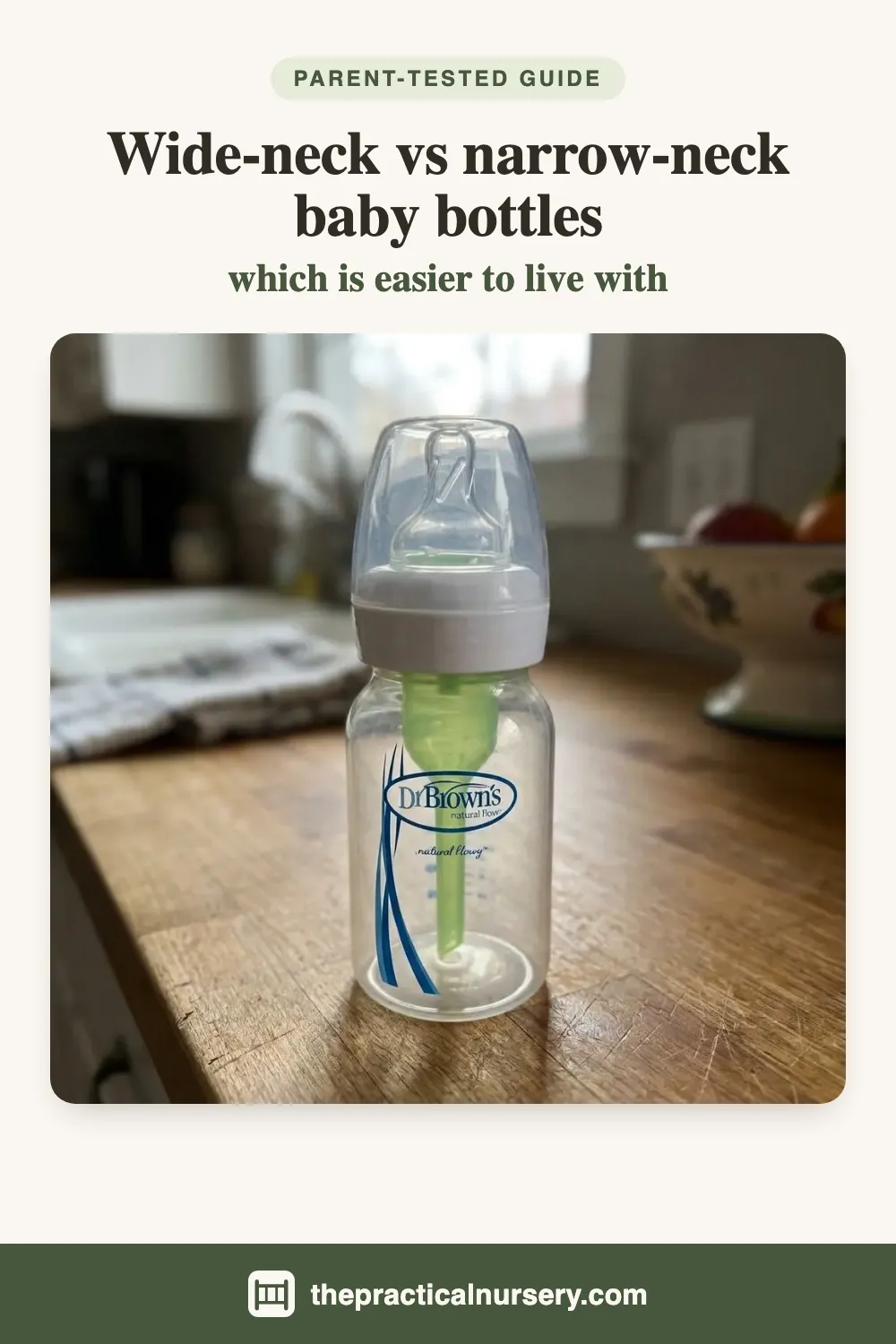
| Dr. Brown's Options+ 2 oz | Narrow | Plastic |
The one narrow bottle is also the smallest we own, and it covers the shortest stretch of a baby’s life. How each bottle feeds, which matters more than its neck, is in the best baby bottles.
Filling and formula
This is where the difference is most obvious, and it is daily.
Pouring milk into a wide neck is easy to do half asleep. A narrow neck asks for a steady hand or a funnel.
Formula is the bigger gap. Every bottle in our ranking for formula feeding is wide-neck, and we would not put a narrow one on that list. The scoop and the rim will annoy you every day for a year. They are fine bottles, and plenty of babies feed happily from them, but mixing in them is fiddly.
Cleaning
A wide neck is faster to wash, and this is the reason most people give for choosing one. It is true, with one honest limit.
Some makers say their wide-neck bottles need no bottle brush, only a sponge. That is fair for the body of the bottle. It is not fair for the nipple, which still needs something that gets inside it, or for any vent part, which needs its own attention. So a wide neck removes the brush from the largest part, not from every part.
A narrow neck needs a brush for the body every time. Our 2 oz Dr. Brown’s is slower to brush out than our wide bottles, and its internal vent adds another part to take out, wash and dry. Our how to clean baby bottles guide goes through the CDC’s steps with real bottles.
Wide necks do have one small cost at the sink: they hold water, and a wide bottle on a rack takes a while to dry. Stand them upside down or at an angle and give them space.
Warmers and sterilizers
Neck width is the measurement that most often decides whether a bottle fits a warmer.
This matters most with wide-neck glass bottles. All four glass bottles we feed with are wide-neck, and fit comes first when we look at any warmer for them. Our best bottle warmer for glass bottles ranks three warmers on exactly that basis.
Some warmers handle both widths. Our Philips Avent warmer is a circulating water bath that fits narrow bottles, wide bottles and food jars without adapters. If you have a mix of bottles, that kind of warmer saves you a decision.
Sterilizers are less fussy about neck width, but bottles always take more room than the box suggests. Our Momcozy sterilizer is sold for 8 bottles and fits 6 of ours, 7 at most, once real bottles with nipples and rings go in. Count with your own bottles in mind.
Nipples and rings do not swap between widths
Nipples and rings are made for one neck size. A wide-neck nipple will not go on a narrow-neck bottle, and the reverse is true as well.
Within one line, though, bottles of the same width usually share nipples, rings and caps across sizes. That is useful: you can start with a small bottle and move to a larger one without changing nipples, as long as you stay with the same width and brand. Our guide to how many baby bottles you need explains why you probably only need the larger size anyway.
If you mix brands or widths, keep each set’s nipples and rings together. Otherwise you will be sorting parts at 3 a.m.
When a narrow neck makes sense
There is a place for narrow bottles, and it is at the small end.
Our narrow bottle is the Dr. Brown’s Options+ 2 oz with preemie flow nipples, rated 0m+. It is the smallest bottle we own, built for very small feeds, and it uses Dr. Brown’s internal vent, which carries air past the milk. It rates a 4 for design reasons, not because anything went wrong: the narrow neck is slower to fill and brush, the vent adds parts, and at 2 oz it is the first bottle you outgrow. Our best baby bottles for newborns covers it alongside two wide-neck newborn bottles.
Which neck suits you
Wide-neck, for most families. If you formula feed, wide-neck without question. If you want the easiest bottle to clean, wide-neck with as few parts as possible.
Narrow-neck, if you want the smallest bottle for very small feeds in the first weeks, knowing you will move on from it.
Neck width is one factor among several. For how the eight we use compare on the nipple, the vent and the number of parts, see the best baby bottles.
The bottom line
The wide-neck vs narrow-neck baby bottles question is mostly settled by what you do with them every day. Wide fills, mixes and cleans more easily, and seven of our eight bottles are wide for that reason. Narrow is for the smallest feeds and the shortest stretch of a baby’s life. Whatever you choose, check that it fits your warmer before you buy both.
Frequently asked questions
Are wide-neck baby bottles better than narrow ones?
For everyday use, we think so. A wide neck is quicker to fill, takes a formula scoop flat and lets a sponge clean the body of the bottle. Seven of the eight bottles we feed with are wide. A narrow neck still makes sense for the smallest bottles, such as our 2 oz Dr. Brown's for very small feeds.
Do wide-neck bottles fit in all bottle warmers?
No. Neck width is the dimension that most often rules a warmer out, especially with wide-neck glass bottles. Our Philips Avent warmer fits narrow and wide bottles without adapters, but check the warmer's chamber before you buy, and our page on the best bottle warmer for glass bottles covers which ones fit.
Can you use wide-neck nipples on narrow-neck bottles?
Generally not. Nipples and rings are sized to the neck they are made for, so a wide-neck nipple will not fit a narrow-neck bottle. Within one brand's line, bottles of the same neck width usually share nipples and rings across sizes.
Are narrow-neck bottles harder to clean?
The body is, because you cannot get a hand and a sponge inside, so you need a bottle brush. The nipple and any vent parts need the same attention on both kinds. A wide neck removes the brush from the largest part, not from every part.