How to choose a baby bottle: what to check, in the order it matters
This post contains affiliate links. If you buy through them, we may earn a small commission at no extra cost to you.Learn more.
Our answer, if you don’t read another word: to choose a baby bottle, start with the nipple, because it is the only part your baby has an opinion about. Then count the parts you will wash, check the neck width, and only after that decide between glass and plastic. Size matters least. And buy one or two before you buy a set, because you will not know which nipple works until your baby has tried it. We feed with eight different bottles between us, and this is the order we would check them in if we were starting again.
One note on scope. This page is about bottles as gear. How much and how often to feed, introducing a bottle to a breastfed baby, preparing formula, and anything to do with colic, reflux or latch are questions for your pediatrician or a lactation consultant. The CDC and the AAP publish the current guidance.
Start with how the bottle will be used
Before comparing bottles, it helps to know what job they are doing, because the job changes what matters.
If you are mixing formula, a wide neck and a bottle that seals properly for shaking move to the top of the list. A scoop goes into a wide neck flat, and a bottle that leaks when shaken is a daily annoyance. Our best baby bottles for formula feeding compares the three we mix in.
If the bottles are mostly for expressed milk, the nipple and how it behaves during pauses matter most. We cover which nipples we found suited that in the best glass bottles for breastfed babies.
If the bottles are leaving the house, weight and leaks matter more than anything about how they feed. That is usually where plastic earns its place.
Most families end up doing more than one of these, which is why most families end up with more than one kind of bottle.
1. The nipple
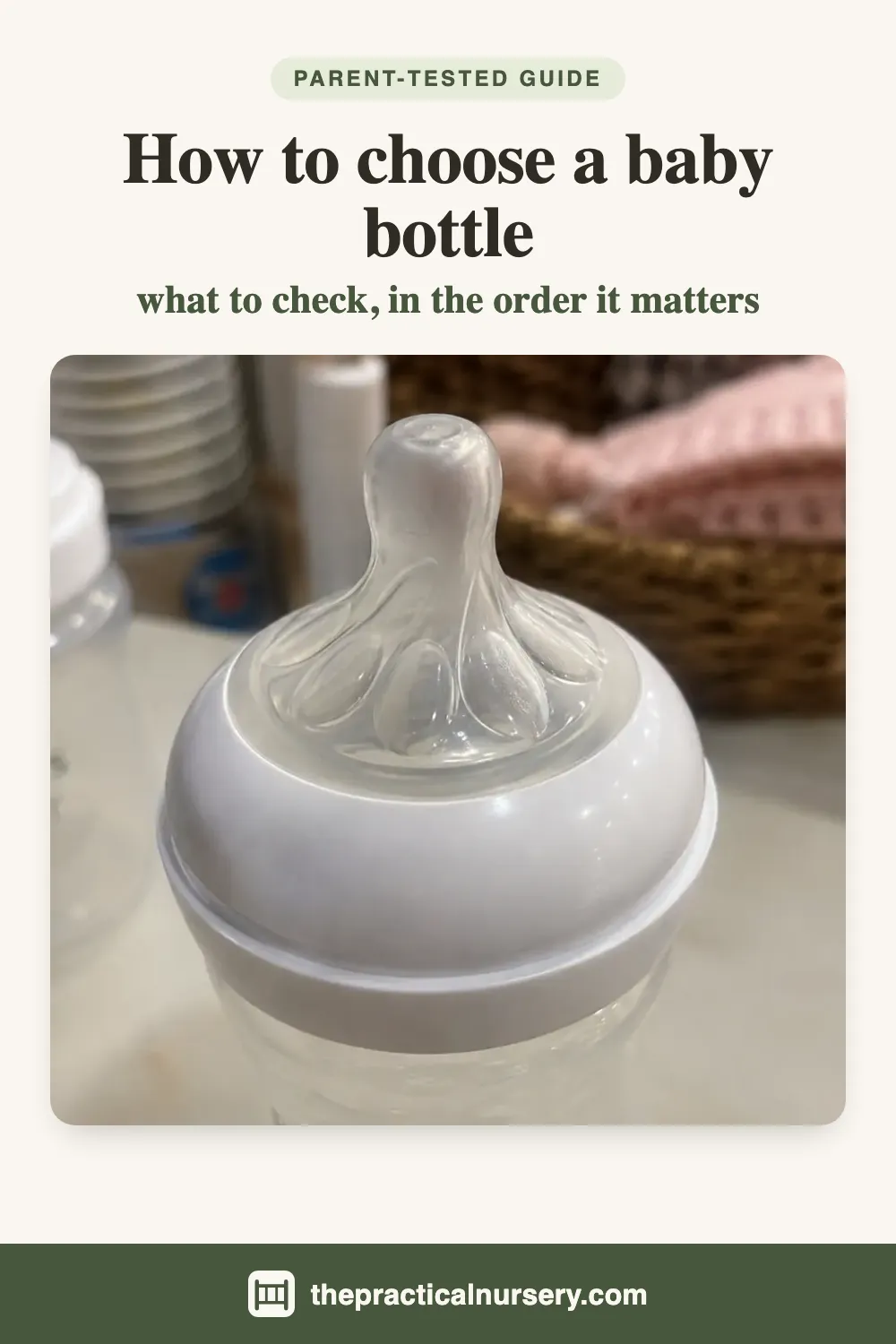
The nipple is the part that decides whether a bottle works. Everything else is about convenience. Three things separate one nipple from another.
Flow rate. Most bottles ship with a slow flow nipple and sell faster ones separately. A flow that is too fast turns a calm feed into a gulping one. Check which level comes in the box, because it varies by set.
Whether it drips. Some nipples keep delivering milk while the baby pauses to breathe. Others only release milk while she is actively drinking. The Philips Avent Natural Response nipple is built to work the second way.
Shape. Many nipples are wide and shaped like a breast, and most brands make similar claims about the latch. Shape is the part where your baby’s preference decides, not the packaging.
The level numbers on nipples are the trap. They are not a shared scale.
Because the nipple is the part your baby has an opinion about, it is also the reason to buy one or two bottles before a set. You cannot return a nipple once the pack is open.
2. How many parts you will wash
You will wash every part of every bottle several times a day for a year. That makes the part count one of the most practical numbers on the box.
Our bottles run from three parts to five. The Thyseed glass bottle has three. The Philips Avent Anti-Colic has four with its one-piece vent. The vented Dr. Brown’s glass bottle has five with its vent and four without it. Each extra part is another thing to take apart, wash, dry and put back together, and small parts are the ones that hold water and get lost.
It is worth separating the number of parts from how fiddly they are. The Avent’s vent is a single piece, so it adds a part without adding a mechanism, and it turned out to be our quickest bottle to wash. Our how to clean baby bottles properly guide goes through which parts cause the most trouble.
3. Venting
Many bottles vent air in some way, and the useful question is where the air goes. Across our bottles there are three approaches.
Through the nipple, with a vent piece in the neck, as on the Philips Avent Anti-Colic.
Through the base, with a valve that lets air in from below, as on the Thyseed.
Through an internal tube that carries air past the milk to the top of the bottle, as on the Dr. Brown’s Options+.
Venting does what it says mechanically: it reduces how much air the baby swallows during a feed. Whether that changes anything about colic is a medical question, not one for a gear site. The practical trade you can judge is that more venting usually means more parts. We compare the three in anti-colic baby bottles.
4. Neck width
A wide neck is easier to live with for almost everything. It fills without a funnel, takes a formula scoop flat, and lets a sponge clean the body of the bottle. Seven of our eight bottles are wide.
Neck width also decides what the bottle fits. It is the dimension that most often rules a bottle warmer out, especially with wide-neck glass bottles, and nipples and rings are made for one width only. Our wide-neck vs narrow-neck baby bottles guide goes through each difference.
5. Glass or plastic
Material matters less than people expect, and it is the one decision you do not have to make once.
Glass stays clear and smell-free for years and suits bottles that live in the kitchen and get sterilized often. It is heavier and can break.
Plastic is light, bounces when dropped and suits the diaper bag. It scuffs and clouds over time.
Most people who try both end up owning both. Ours split between glass on the counter and plastic in the bag, because those are two different jobs. The full comparison is in glass vs plastic baby bottles.
6. Size
Bottles usually come in a small newborn size and a larger one. Within one line, the nipples, rings and caps are usually shared across both, so the choice is about capacity, not how the bottle feeds.
A larger bottle holds a small feed perfectly well. Ours are 8 and 9 oz bodies, used from about three months after small newborn bottles. If you want to avoid buying two sets in the first year, going straight to the larger size is the cheaper path. The newborn sizes we have used are compared in the best baby bottles for newborns.
7. Leaks, lids and the extras
The details on the box that matter in daily use are mostly about leaks.
A bottle that is leakproof upside down saves a lot of mess when you shake formula or carry a made-up bottle. Our Tommee Tippee glass bottle is, and its set includes storage lids and cup rings, so the same glass body works as a bottle, a sealed jar and later part of a cup. At the other end, our Dr. Brown’s glass bottle leaks if you shake it or tip it upside down, and its cap is a struggle.
Some bottles do one job unusually well. The PopYum keeps formula powder in a sealed chamber until you press two buttons and shake, so you can make a fresh bottle one handed away from home. It is a narrow tool, but a useful one in the diaper bag.
8. Fit with the rest of your gear
A bottle has to work with the other things on your counter.
Check that it fits your bottle warmer, if you have one. Neck width is the usual problem.
Check how many fit your sterilizer. Machines hold fewer real bottles than the box suggests. Our Momcozy sterilizer is sold for 8 and fits 6 of ours, 7 at most, once nipples and rings go in.
Check the dishwasher instructions. Many plastic bottles, and some glass ones, are rated for the top rack only.
The checklist
| Check | What to look for | Where we go deeper |
|---|---|---|
| Nipple | Flow level in the box, whether it drips, a shape your baby accepts | Best glass bottles for breastfed babies |
| Parts | Fewer is easier, and one-piece vents beat fiddly ones | How to clean baby bottles |
| Venting | Where the air goes, and how many parts that adds | Anti-colic baby bottles |
| Neck width | Wide for filling, formula and cleaning | Wide-neck vs narrow-neck baby bottles |
| Material | Glass for the kitchen, plastic for the bag | Glass vs plastic baby bottles |
| Size | The larger size usually covers both stages | Best baby bottles for newborns |
| Leaks and lids | Leakproof upside down if you shake or carry it | Best baby bottles for formula feeding |
| Fit | Your warmer, your sterilizer, your dishwasher | Best bottle warmer for glass bottles |
Buy one or two first
This is the step that saves the most money. Pick the bottle that passes the checks above, buy one or two, and feed with them for a few days before buying the rest. If your baby takes to it, finish the set. If not, you have lost a bottle rather than a box of them.
Four to six bottles in rotation is the number most households land on. Our how many baby bottles do you need guide does the arithmetic, including how daycare and pumping change it.
The bottom line
How to choose a baby bottle comes down to the order you check things in. Nipple first, because that is where your baby decides. Then parts, venting and neck width, because those decide your sink. Then glass or plastic, and size last. Buy one or two, let your baby vote, and only then buy the set. When you are ready to compare specific bottles, the eight we feed with are side by side in the best baby bottles.
Frequently asked questions
What should I look for when choosing a baby bottle?
The nipple first, because it is the only part your baby has an opinion about. Then the number of parts, since you will wash every one several times a day. Then the neck width, which decides how easily it fills and whether it fits your warmer, and only then glass or plastic. Size matters least: a bigger bottle holds a small feed perfectly well.
How many baby bottles should I buy to start?
One or two. The nipple is the part your baby decides about, and you cannot return an opened pack, so a full set before you have tried it is a bet. Feed with one or two for a few days, then buy the rest. Four to six in rotation covered a day of feeds for us.
Are nipple flow levels the same across brands?
No. A level number only means something within one brand. Our Level 2 on a Dr. Brown's flowed noticeably faster than the Level 2 we had been using on an Avent. Check which level comes in the box, and if your baby struggles with flow, take it to your pediatrician.
Should I choose glass or plastic baby bottles?
Glass if the bottles will mostly stay in the kitchen and you want a set that stays clear and smell-free for years. Plastic if they are going in a diaper bag or onto a hard floor. Most families who try both end up owning both, which is what happened in our house.