Best baby bottles for newborns: the three we used in the first months
This post contains affiliate links. If you buy through them, we may earn a small commission at no extra cost to you.Learn more.
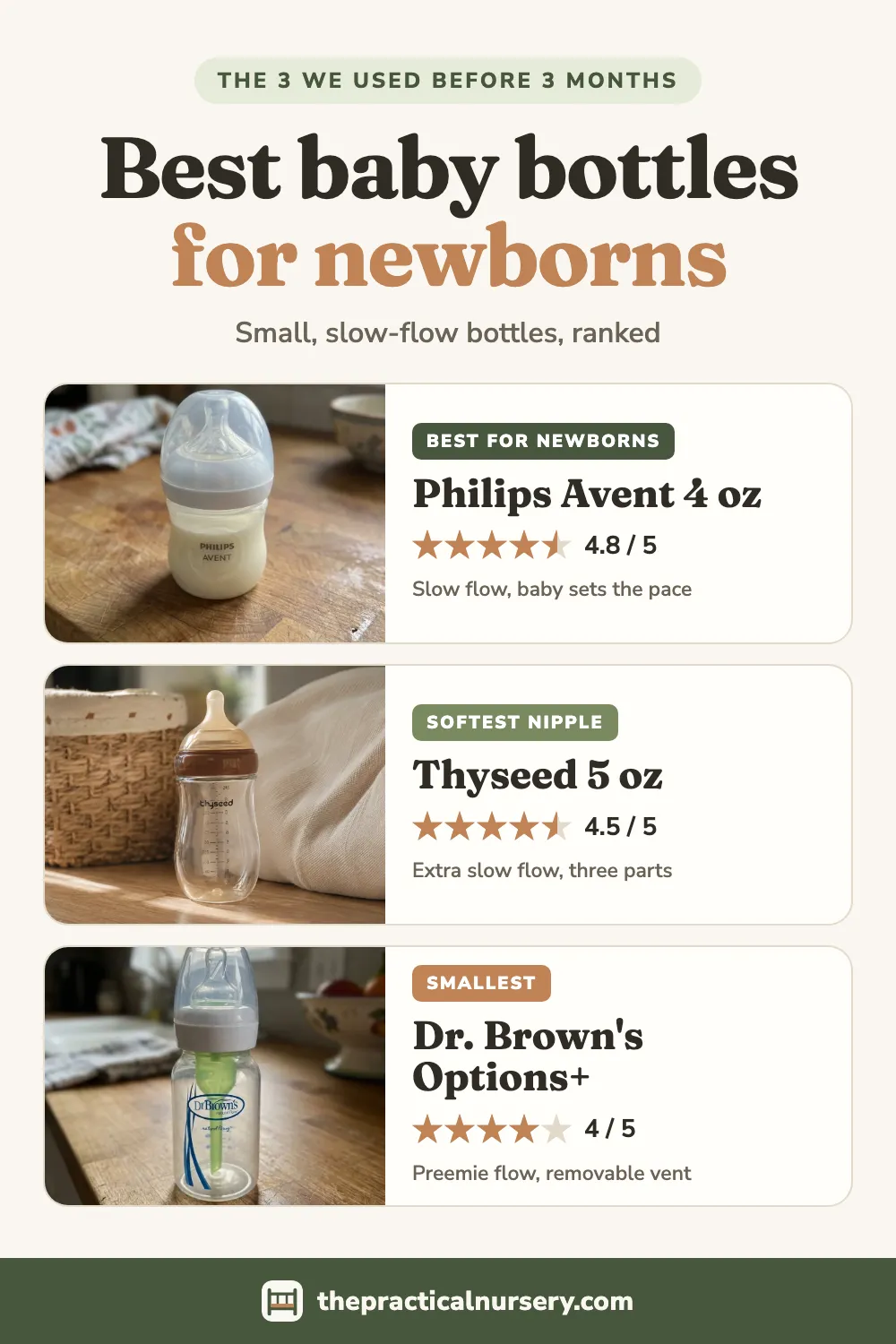
Our pick, if you don’t read another word: the best baby bottle for newborns we used is the Philips Avent Natural Response 4 oz slow flow bottle. These are the newborn versions we fed with before our baby was 3 months old, ranked by our ratings. The Avent rates 4.8, the Thyseed 5 oz newborn bottle 4.5 for its very soft nipple, and the Dr. Brown’s Options+ 2 oz 4.
One honest note before anything else. We review gear. How much and how often a newborn should feed, when to introduce a bottle to a breastfed baby, and anything touching colic, reflux or latch are questions for your pediatrician or an IBCLC lactation consultant, not a blog. What we can tell you is what these three bottles were like to use in the first months.
What makes a bottle right for a newborn
Three things matter more in the first weeks than they will later.
The flow comes first. A newborn needs the slowest nipple a brand makes. Each of these comes with its newborn flow fitted: extra slow on the Thyseed, preemie flow on the Dr. Brown’s and slow flow on the Avent. Faster nipples come later, when your baby shows you they are ready, not when the packet says so.
Size comes second. A newborn drinks small amounts, so a 2 to 5 oz bottle is easier to handle and to read than an 8 or 9 oz one. You will size up in a few months, and the larger glass bottles from all three brands are in our best glass bottles for breastfed babies.
The nipple shape comes third. All three are breast-shaped, and two of them are built to stop milk arriving faster than the baby wants it. Babies still have preferences, so buy one or two of a bottle before you commit to a set.
The three, side by side
| Bottle | Our rating | Size | Newborn flow | Neck | Air handling | Best for |
|---|---|---|---|---|---|---|
| Philips Avent Natural Response | 4.8 / 5 | 4 oz plastic, 4-pack | Slow flow, no-drip | Wide | Valve in the nipple | Baby-paced feeds |
| Thyseed anti-colic | 4.5 / 5 | 5 oz glass, single bottle | Extra slow, 0m+ | Wide | Valve in the base | The softest nipple, fewest parts |
| Dr. Brown's Options+ narrow | 4 / 5 | 2 oz plastic, 4-pack | Preemie flow, 0m+ | Narrow | Removable internal vent | The very smallest feeds |
The Avent and Dr. Brown’s are plastic, and the Thyseed is glass. We set out what each material is good at in glass vs plastic baby bottles. Our ratings are our overall judgment of each bottle, not a score worked out from this table.
1. Philips Avent Natural Response 4 oz: the one we used most
The newborn size of the bottle line we own the most of: a 4 oz plastic bottle with Philips Avent’s Natural Response slow flow nipple, sold as a 4-pack. The nipple is soft and breast-shaped, and it does not drip. It has a slit that opens when the baby actively sucks and closes when they pause, so milk arrives when the baby draws it out and not before. The anti-colic valve is built into the nipple, which keeps the bottle to four parts: bottle, nipple, screw ring and cap.
The bottle is BPA-free, light in the hand, and easy to clean.
Two things to know. Some newborns take to a nipple that does not drip straight away, and some need a few feeds to learn that they have to do the work, so give it more than one try. And keep to the slow flow until your baby is clearly ready, because a faster nipple undoes the point of this one. The same nipple comes on Avent’s glass bottle, which we review in full in our Philips Avent glass bottle review.
What we like
- The nipple only releases milk while the baby drinks, so the feed goes at their pace
- Slow flow fitted, the right start for a newborn
- BPA-free plastic, light and easy to clean
- Only four parts, and a wide neck that fills and brushes easily
What we don't
- Some babies need a few feeds to adjust to a nipple that does not drip
- At 4 oz, you will size up within a few months
2. Thyseed 5 oz newborn: the softest nipple
The 5 oz glass bottle with Thyseed’s extra slow flow newborn nipple, rated 0m+. Thyseed handles air in the base rather than the nipple: a valve there senses the pressure change as the baby drinks and lets air in from below. That leaves almost nothing to wash: a wide-neck borosilicate body, a nipple and a ring. Three parts in all.
The nipple is the softest silicone of the three here, wide and breast-shaped, with three small holes at the tip instead of one. The milk spreads out as the baby latches rather than arriving in a single stream. The glass is food-grade borosilicate, the nipple is Wacker silicone, the ring is TotalEnergies polypropylene, and the parts go on the top rack of the dishwasher. Thyseed makes six flow rates, so the same bottle line follows your baby up.
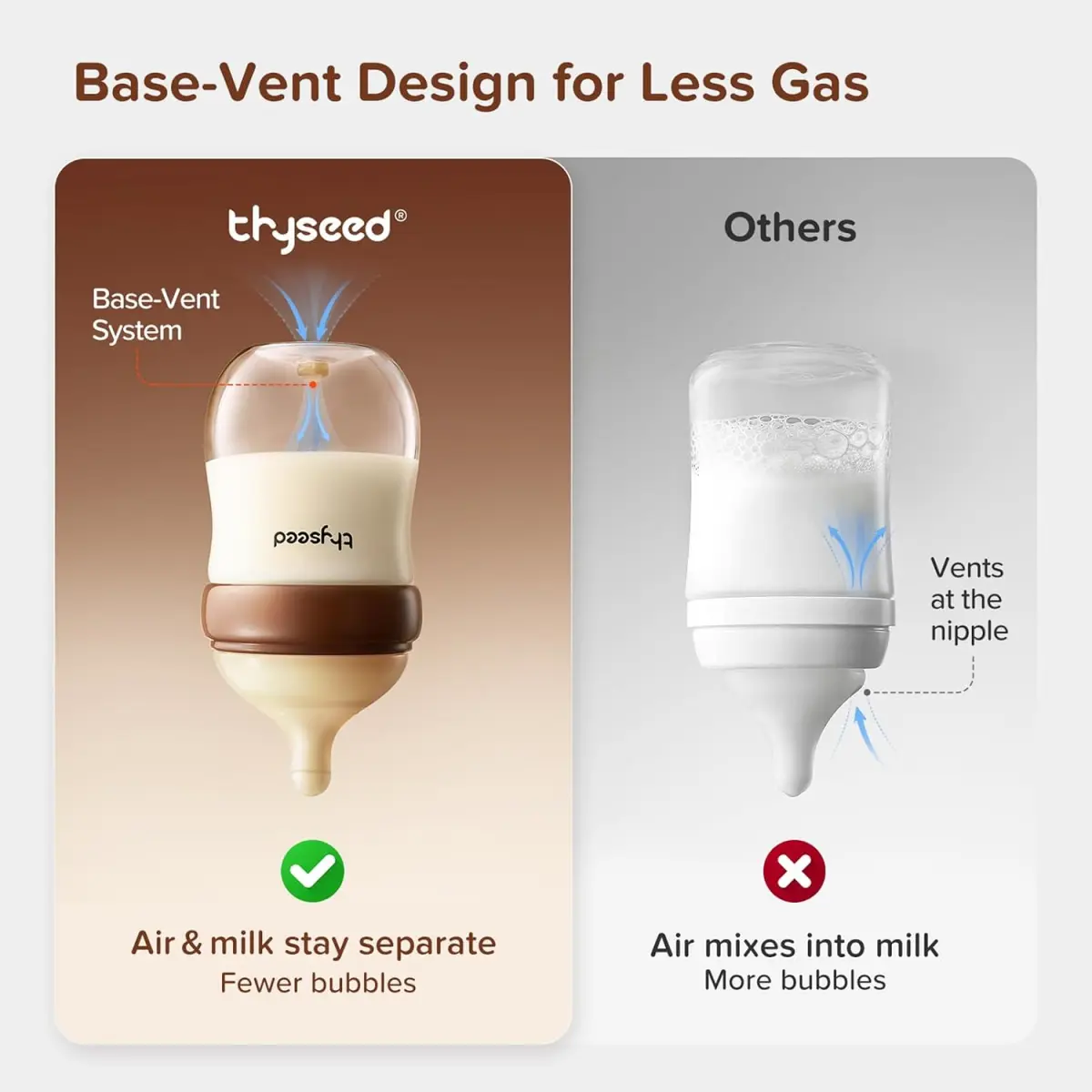
Reflux and gas are questions for your pediatrician, and a bottle is not a treatment. What we can say is that this nipple suited our baby when others had not. It sits below the Avent because Thyseed is a smaller brand, which matters when you are buying replacement nipples for two years, and because the valve lives in the base, the end that takes the knocks.
What we like
- Extra slow flow newborn nipple, rated 0m+
- The softest nipple here, with three holes at the tip
- Three parts in all, the shortest wash-up
- Six flow rates, so the bottle line grows with your baby
What we don't
- Sold as a single bottle, so a rotation means buying several
- A smaller brand, so long-term nipple availability is less certain
- The valve sits in the base, the end most exposed to knocks
3. Dr. Brown’s Options+ 2 oz: the smallest and slowest
The smallest bottle here: a 2 oz narrow plastic Options+ bottle with preemie flow nipples, rated 0m+, sold as a 4-pack. Dr. Brown’s runs an internal vent through the middle of the bottle that carries air past the milk, so air goes into the bottle rather than into the baby. The Options+ part means the vent comes out once your baby no longer needs it, and you keep using the same bottles.
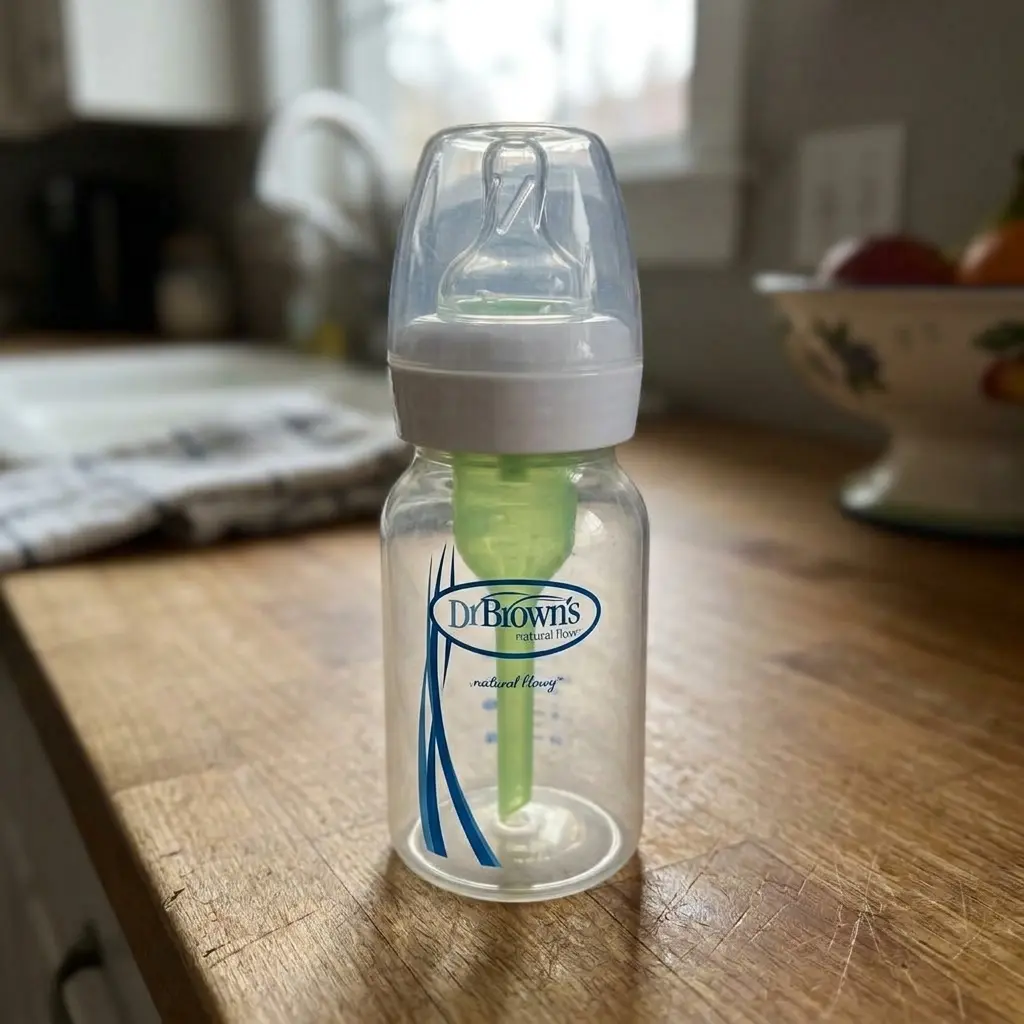
It rates 4 rather than higher for design reasons, not because anything went wrong. The vent insert is an extra part to take out, wash, dry and put back at every feed, so it has the most pieces of the three. The neck is narrow, which is slower to fill and to brush out than the wide necks on the other two. And at 2 oz it is the bottle you outgrow first.
One lesson from our bigger wide-neck Dr. Brown’s bottle carries over. Flow levels do not match across brands, and the same level number ran noticeably faster for us on Dr. Brown’s than on our Avent. Stay on the preemie or Level 1 nipple until your baby shows you they need more, rather than matching the number from another brand.
What we like
- The smallest bottle here at 2 oz, with preemie flow nipples
- An internal vent that moves air past the milk instead of into the baby
- The vent comes out later, so the bottles keep working
- BPA-free
What we don't
- The most parts to wash, because of the vent insert
- A narrow neck, slower to fill and clean than a wide one
- At 2 oz, the first bottle you outgrow
Which newborn bottle fits your baby
If your baby moves between the breast and the bottle, start with the Avent. A nipple that only flows while the baby sucks keeps the feed at their pace, and it was the bottle we used most. Any question about breastfeeding itself belongs with your pediatrician or a lactation consultant.
If you want the softest nipple and the least washing, try the Thyseed. Three parts and a very soft, three-hole nipple made it the one that suited our fussy feeder.
If you want the smallest possible bottle and the slowest flow, the Dr. Brown’s 2 oz with preemie nipples is the one, as long as you do not mind the vent insert at the sink.
When to move up a size
Newborn bottles are a short stage. As feeds get bigger, you move to a larger bottle and a faster nipple from the same brand, and the nipple you liked usually carries over. We cover the larger glass versions of all three in the best glass bottles for breastfed babies, and how many you need in how many baby bottles do you actually need. Cleaning and sterilizing are in how to sterilize baby bottles, and if air is the thing you are trying to solve, we rank vented bottles in anti-colic baby bottles.
The bottom line
For a newborn, start small and slow. The Philips Avent Natural Response 4 oz slow flow bottle is our 4.8 and the one we used most, because its nipple lets the baby set the pace. The Thyseed 5 oz newborn bottle is our 4.5, with the softest nipple and the fewest parts. The Dr. Brown’s Options+ 2 oz is our 4, the smallest and slowest of the three, with a vent that adds parts at the sink. Buy one or two first, see which nipple your baby likes, then build your rotation around it.
Frequently asked questions
What is the best baby bottle for a newborn?
Of the newborn bottles we used before our baby was 3 months old, the Philips Avent Natural Response 4 oz slow flow bottle, which we rate 4.8 out of 5. Its nipple only lets milk out while the baby is actively sucking, so the feed goes at the baby's pace. The Thyseed 5 oz newborn bottle is second at 4.5 for its very soft three-hole nipple, and the Dr. Brown's Options+ 2 oz is third at 4.
What size bottle does a newborn need?
Small. The newborn versions we used hold 2 to 5 oz: the Dr. Brown's is 2 oz, the Avent 4 oz and the Thyseed 5 oz. A smaller bottle is lighter to hold and easier to read at low volumes. How much your newborn should drink, and how often, is a question for your pediatrician.
What nipple flow should a newborn use?
The slowest one each brand makes for newborns. The bottles here come with an extra slow flow (Thyseed, 0m+), a preemie flow (Dr. Brown's, 0m+) and a slow flow (Avent). Flow numbers are not the same across brands, so the same level can run faster on one bottle than another. Watch how your baby copes rather than going by the age on the packet, and ask your pediatrician if feeding is a struggle.
Glass or plastic bottles for a newborn?
We used both. Our newborn Philips Avent and Dr. Brown's bottles were plastic, and the Thyseed was glass. Glass does not stain, hold milk smells or go cloudy, and it takes repeated sterilizing, but it is heavier and can break if dropped. Plastic is lighter and does not break. At newborn sizes either works, and the nipple matters far more than the material.
How many newborn bottles do you need?
We found four to six in rotation covered a day of feeds. Buy one or two of a bottle first and see whether your baby takes to the nipple before buying a full set, because the nipple is the part a baby has an opinion about.