Tommee Tippee Natural Start glass bottle review
This post contains affiliate links. If you buy through them, we may earn a small commission at no extra cost to you.Learn more.
Our verdict, if you don’t read another word: the Tommee Tippee Natural Start glass bottle earns 4.5 out of 5 from us. What makes it worth writing about is not the bottle itself, which is a good, plain, wide-neck glass bottle. It is what comes with it. The same glass body takes a sealed storage lid, a nipple and ring, or a cup ring, so it is a bottle, a fridge container and later an open cup, and you stop owning three sets of things. It is also priced like a normal purchase rather than a luxury one, which is the single most common reason people who wanted glass ended up with plastic.
One note before anything else. We review gear here. How long milk or a made-up feed keeps, how to prepare formula, and anything touching latch, colic or feeding at the breast are questions for your pediatrician, an IBCLC lactation consultant or the CDC rather than for us. What follows is what this bottle is like to fill, feed with, store and wash.
What the Tommee Tippee Natural Start glass bottle actually is
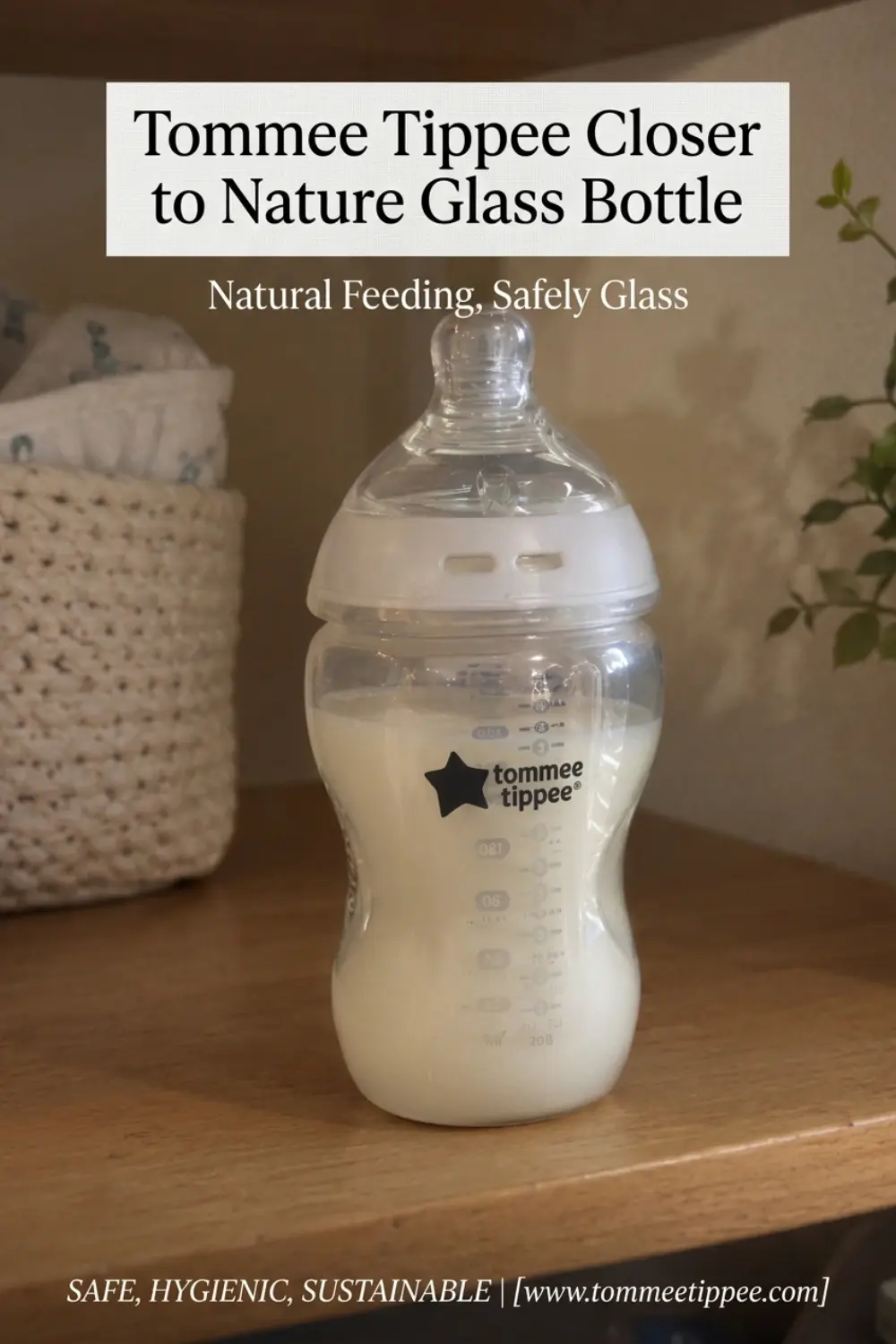
A wide-neck 9 oz bottle in what Tommee Tippee calls medical-grade glass, with a vented silicone nipple, a screw ring and a cap. Made by the Mayborn Group, sold as part of the Natural Start line.
Tommee Tippee specifies the glass as durable, stain resistant and free from BPA, phthalates and toxins. They rate it as heat and thermal shock resistant and as self-sterilizing in about three minutes, and they rate the assembled bottle as 100 percent leakproof with the ring, nipple and cap secured, including upside down. Every one of those is their specification rather than something we measured, and we say so because a spec you can check on a box is not the same kind of claim as something we lived with.
The part we can speak to is the living with it.
The lids are the actual product
Most glass bottle sets give you bottles. This one gives you a glass body and three different things to put on top of it.
With the nipple and screw ring it is a bottle. With the travel food jar lid it is a sealed container, which is what makes the fridge workflow above possible, and later the same jar holds whatever a weaning baby is eating. With the cup ring it becomes an open cup for a baby learning to drink from one.
That matters for a reason that is easy to miss in a product listing. The stage where you need bottles and the stage where you need small sealed containers and the stage where you need a first cup are three different shopping trips, and this set collapses them into one. We have not got as far as the cup ring stage yet, so we are not going to tell you how well it works. We can tell you the bottle and the storage lid are the two we use daily, and that pairing alone has been worth it.
Medical-grade glass, and what glass buys you generally
The case for glass does not really change between brands, and we set it out fully in glass vs plastic baby bottles. The short version: it does not pick up a milk smell, it does not stain, it does not go cloudy and it does not scuff, and that last one matters most because every scuff inside a plastic bottle is somewhere residue can sit that a brush does not properly reach. A glass bottle that looks clean is clean.
What is specific to this one is the price. Glass bottles are usually the expensive shelf, and the reason plenty of people buy plastic is not that they prefer it. Tommee Tippee pricing this set like an ordinary purchase is the reason it is in our house at all, and we would rather say that plainly than pretend the decision was made on materials science.
The costs are the ones glass always carries. It is heavier, which becomes a live question once your baby holds her own bottle. It breaks, and a bottle with a chip or a crack goes in the bin rather than back in the rotation. Silicone sleeves are worth having for grip and for containing a break.
The nipple, and what Tommee Tippee claims for it
The nipple is vented silicone, shaped, in Tommee Tippee’s description, to encourage a natural latch, reduce air intake and help a baby switch between breast and bottle without nipple confusion.
We will repeat that claim and we will not endorse it. Latch and nipple confusion are not things a gear review gets to adjudicate, and if bottle feeding is changing how feeding at the breast goes, that is a conversation for an IBCLC lactation consultant or your pediatrician. What we can say mechanically is that it is a conventional nipple in the sense that the milk flow is driven by gravity and suction together, rather than the Philips Avent approach of a valve that holds milk back until the baby actively draws on it. Whether that difference matters to you depends entirely on whether you have fed with the Avent, because it is not something you miss if you have never had it.
The leakproof claim is the one that matters for formula
A leakproof rating sounds like packaging copy until you are making up formula. Mixing means putting the cap on, holding the bottle upside down and shaking it hard, several times a day, and a vented bottle that leaks under that shakes formula onto you.
Tommee Tippee rating the assembled bottle as leakproof upside down is therefore a genuinely useful specification rather than a throwaway one, and it is part of why this bottle placed where it did in our best baby bottles for formula feeding roundup. The wide neck helps for the same reason, since a scoop goes in flat instead of leaving powder on the rim to cement itself into the thread.
Count the pieces, not the bottles
One practical warning that costs people money. Listings for this set are counted in pieces. A listing that says nine items is three 9 oz bottles, three travel food jar lids and three cup rings.
It is three bottles. Read the breakdown before you buy, and if you are planning on a full rotation, four to six bottles is what got us through a day without running the dishwasher at midnight, so one set is a starting point rather than a complete answer. Storing milk in the bottles pushes that number up, which we explain in how many baby bottles do you actually need.
Against the Philips Avent glass bottle
These are the two glass bottles we use most, and they are good at different things.
| Tommee Tippee Natural Start | Philips Avent Natural Response | |
|---|---|---|
| Glass | Medical-grade | Borosilicate |
| Neck | Wide | Wide |
| Nipple | Vented silicone, natural latch claim | Releases milk only while she actively sucks |
| Storage lids | Included, and the reason to buy it | Not part of the set |
| Later stages | Cup rings included for open-cup drinking | Bottle only |
| Price bracket | The more affordable of the two | The pricier of the two |
| Our rating | 4.5 | 4.8 |
The honest split is this. The Avent wins on how it feeds, because the nipple hands the pace of the feed to the baby and nothing else here does that. The Tommee Tippee wins on everything around the feed: what it costs, what else the glass body does, and how many other containers you do not have to buy. We own both and we would buy both again, and the full head to head is in Philips Avent vs Tommee Tippee glass bottles.
What we like
- The same glass body works as a bottle, a sealed fridge container and later an open cup
- Among the more affordable glass bottles, which is the usual barrier to buying glass at all
- Rated by Tommee Tippee as leakproof upside down, which matters when mixing formula
- Wide neck fills, takes a scoop flat, and brushes out properly
- Rated as self-sterilizing in about three minutes and thermal shock resistant
What we don't
- No equivalent to the Avent nipple that only releases milk while she is actively drinking
- Heavier than plastic, and a chipped bottle has to be thrown away
- Listings count pieces rather than bottles, so a nine-item set is three bottles
- One set is a starting point, not a full day of feeds
Who it is for
Buy it if you want glass and have been put off by what glass usually costs. Buy it if the idea of storing milk in the same vessel you feed from appeals to you, which it will more than you expect once you have done it a few times. Buy it if you would rather not shop again for weaning jars and a first cup.
Look at the Philips Avent Natural Response instead if the pace of the feed is the thing you are trying to solve, particularly if your baby is moving between the breast and bottles. And if you have not settled the material question at all, we made the case both ways in glass vs plastic baby bottles.
The bottom line
4.5 out of 5. A plain, well-made, sensibly priced glass bottle that happens to come with the accessories that make it three products. It is not the best-feeding bottle we own, and it is probably the most useful one.
Frequently asked questions
Is the Tommee Tippee Natural Start glass bottle any good?
In our use, yes, and we rate it 4.5 out of 5. The thing that sets it apart is not the bottle, it is the lids: the same glass body is a bottle, then a sealed storage jar, then part of an open cup, so one purchase covers three stages. It is also among the more sensibly priced glass bottles, which is the usual reason people give up on glass entirely. The trade-offs are the ones glass always brings, weight, cost and breakage.
Can you use Tommee Tippee glass bottles for storing milk?
That is the point of the set. It ships with travel food jar lids as well as the bottle tops, so you can seal a bottle with the storage lid and put it in the fridge, then swap the lid for the nipple and ring when it is time to feed. Nothing gets decanted from one container to another. It works the same way whether you are storing expressed milk or a made-up feed, though how long anything keeps is a question for your pediatrician and the CDC rather than for us.
How many bottles are in a Tommee Tippee Natural Start glass set?
Read the count carefully, because listings number the pieces rather than the bottles. The set we have is described as nine items, and that is three 9 oz glass bottles, three travel food jar lids and three cup rings. So it is three bottles, not nine. This trips people up often enough that it is worth saying plainly before you buy.
Are Tommee Tippee glass bottles self-sterilizing?
Tommee Tippee rates them as self-sterilizing in about three minutes, and as heat and thermal shock resistant. That is their specification rather than our measurement, and the method is described in the instructions that ship with the bottles. Follow those rather than any blog, including this one, and check the current version in your own box since manufacturers do update them.
Are Tommee Tippee glass bottles leakproof?
Tommee Tippee rates the assembled bottle as 100 percent leakproof with the screw ring, nipple and cap all secured, including turned upside down. That claim matters more than it sounds if you are feeding formula, because mixing means shaking the bottle hard several times a day, and a vented bottle that leaks under shaking puts milk where you did not want it.
Will the Tommee Tippee nipple work for a breastfed baby?
Tommee Tippee shapes the silicone nipple to encourage a natural latch and says it reduces air intake and helps when switching between breast and bottle. That is their claim about the nipple, not a promise about your baby. Whether and when to introduce a bottle to a breastfed baby, and what to do if feeding at the breast changes afterwards, is a conversation for your pediatrician or an IBCLC lactation consultant rather than a review site.
Is glass or plastic better for baby bottles?
They are better at different things, and we own both. Glass does not stain, hold milk smells or go cloudy, and it takes repeated sterilizing for years. Plastic is lighter, cheaper to replace and does not break on a hard floor. We keep glass at home and plastic in the diaper bag, and we set out the full comparison in our glass vs plastic guide.