Best baby bottles for formula feeding, ranked by two parents
This post contains affiliate links. If you buy through them, we may earn a small commission at no extra cost to you.Learn more.
Our pick, if you don’t read another word: of the baby bottles for formula feeding we actually mix in, the Philips Avent Natural Response glass bottle is the one we reach for, and it gets 4.8 out of 5 from us. The Tommee Tippee Natural Start glass bottle ties on 4.5 and earns its place because the same bottles work as fridge storage, and PopYum takes third, also on 4.5, and is the one we pack when a bottle has to be made somewhere that is not a kitchen. Two of the three are glass, which is what we use at home, and the third is the one that solves the out of the house problem that glass cannot.
One honest note first. We review gear here. How to prepare formula, what water to use, how long a made bottle keeps, how much your baby should be taking and anything touching colic, reflux or weight gain are questions for your pediatrician, and the CDC and AAP publish the current guidance. What follows is only what these three bottles are like to live with.
What actually changes when the bottle is full of formula
A bottle that suits formula is not a different species of bottle. It is the same bottle judged on three things that barely matter when you are pouring in expressed milk.
The first is neck width. Formula arrives as powder in a scoop, and a narrow neck means the scoop goes in at an angle, powder lands on the rim, and the ring picks it up and cements itself on. Every bottle here is wide neck, and once you have used one you will not go back.
The second is whether it seals when you shake it. Mixing formula means turning the bottle upside down and shaking hard, over and over, several times a day. A bottle that leaks under that is a bottle that leaks on you. This is the single place a vented bottle can let you down, because a vent is a hole by design, and it is why the vented glass bottle we like elsewhere is not on this list.
The third is parts. Formula feeding means more bottles through the sink than we ever ran while pumping, because there are no storage bags absorbing some of the volume. Four parts versus six, per bottle, per feed, adds up into a real amount of your evening.
Everything else, the glass, the nipple shape, the anti-colic plumbing, matters exactly as much as it does for any other feed, which is to say quite a lot. We covered the nipple side of it properly in our glass bottles for breastfed babies roundup.
The three, side by side
| Bottle | Material | Neck | Parts to wash | Mixing | Our verdict |
|---|---|---|---|---|---|
| Philips Avent Natural Response | Borosilicate glass | Wide | 4 | Scoop straight in, seals for shaking | Buy: our everyday bottle |
| Tommee Tippee Natural Start glass | Medical-grade glass | Wide | 4 | Scoop straight in, maker rates it leakproof | Buy if you want bottles that double as storage |
| PopYum anti-colic | Polypropylene and silicone | Wide | 5 | Powder and water stored apart, press to mix | Buy for making bottles away from the kitchen |
1. Philips Avent Natural Response glass bottle
A wide-neck borosilicate bottle with Philips Avent’s Natural Response nipple and the anti-colic valve built into the nipple itself. Four parts total: bottle, nipple, screw ring, cap. That count is most of why it wins a formula article.
The mouth is wide enough that a scoop goes in flat, so nothing lands on the rim and nothing dries into the thread. Cap on, ring tight, shake as hard as you like, and it stays where you put it. Then at the sink there is no vent tube to pull out, rinse, and stand somewhere to dry before the bottle is usable again. On a formula day, which is every day if you are not also pumping, that is the difference between a drying rack and an installation.
The nipple is the other half of it. Most bottle nipples drip, so a baby who has paused to breathe is still getting milk arriving in her mouth. The Natural Response nipple has a slit that opens under active sucking and closes when she stops. Philips Avent rates the borosilicate body as BPA-free and safe for the dishwasher, steam and UV sterilizers, and boiling water. Those are their specifications, not our measurements. What we can speak to is that ours has not clouded, stained or scratched.
What we like
- Wide mouth takes a scoop flat, so powder does not end up cemented into the ring
- Seals properly, so you can shake it hard without wearing the feed
- Four parts and no vent tube, which is the shortest wash-up of the three
- Glass has stayed clear and unscratched, with no milk smell and nothing stained in
What we don't
- Heavier than plastic, which matters once she holds the bottle herself
- It is glass, so a chipped bottle has to be thrown out
- Some babies need a few feeds to adjust to a nipple that does not drip on its own
This is the pick for most people feeding formula at home. The full write-up is in our Philips Avent Natural Response glass bottle review.
2. Tommee Tippee Natural Start glass bottle
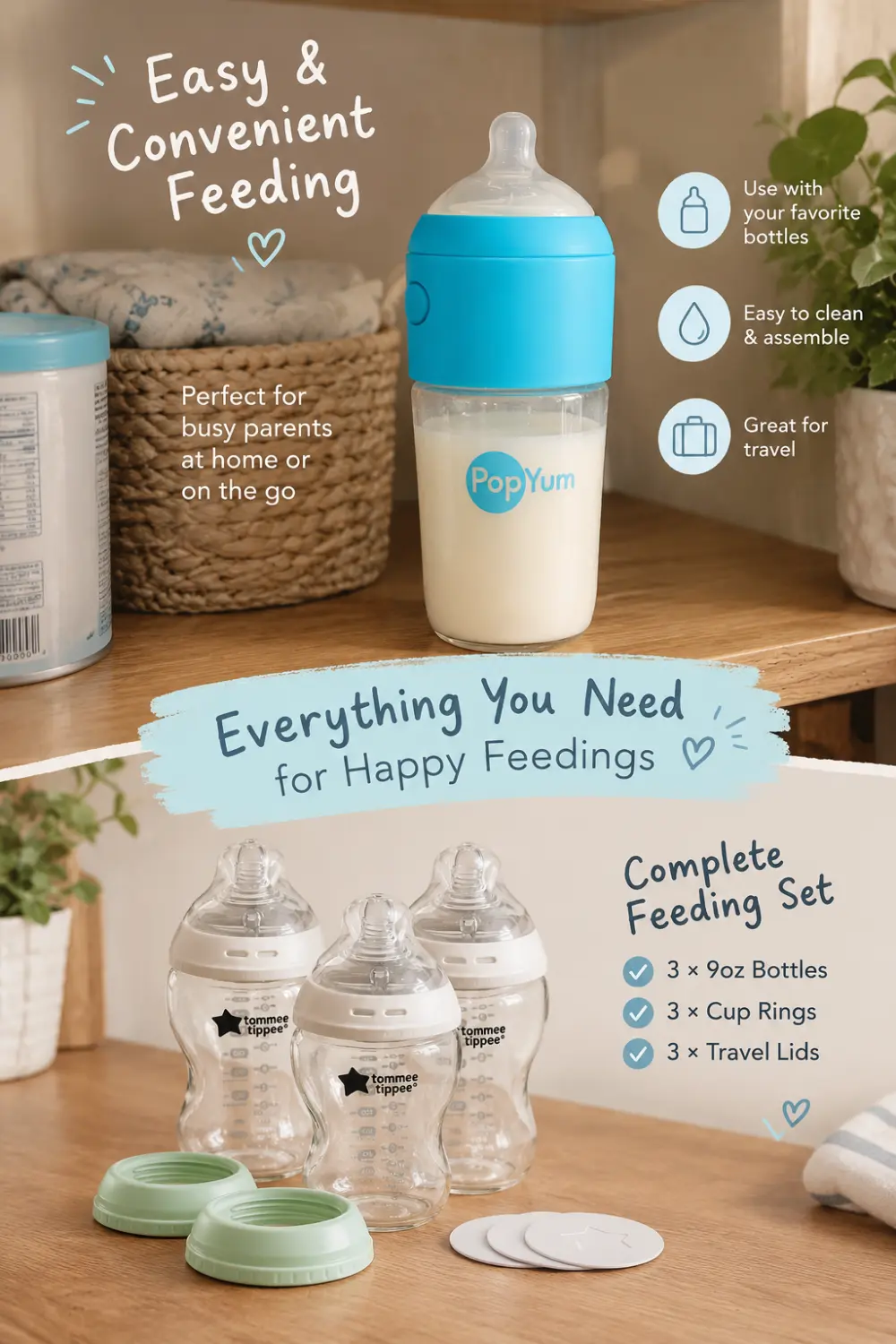
The reason this one is here is not the bottle, it is the lids. The Natural Start glass set comes as three 9 oz bottles with three travel food jar lids and three cup rings, so the same glass body is a bottle, then a sealed storage jar, then part of an open cup later on. One purchase covering three stages is unusual, and it changes how many other containers you end up owning.
As a bottle it does the formula job cleanly. Wide neck, so a scoop goes straight in. Tommee Tippee specifies medical-grade glass that is free from BPA and phthalates, stain resistant, heat and thermal shock resistant, and self-sterilizing in about three minutes. They also rate the assembled bottle as fully leakproof with the ring, nipple and cap secured, including upside down, which is the claim that matters when mixing means shaking. Those are their specifications rather than our measurements. The nipple is vented silicone, shaped to encourage a natural latch and reduce air intake.
What keeps it a hair behind the Avent for us is the nipple rather than the bottle. Tommee Tippee makes the usual claims for it, a natural latch and reduced air intake, but it does not market the flow-stops-when-she-pauses behavior that the Avent Natural Response is built around, and that behavior is the specific reason the Avent sits at number one. Worth knowing too that the set is counted by pieces rather than bottles, so a listing showing nine items is three bottles and six lids.
What we like
- The same glass body works as a bottle, a sealed storage jar and later an open cup
- Wide neck takes a scoop flat, and the maker rates the assembled bottle as fully leakproof
- Among the more reasonably priced glass bottles, which is the usual reason people give up on glass
- Tommee Tippee rates the glass as self-sterilizing in about three minutes and thermal shock resistant
What we don't
- No equivalent to the Avent nipple that only releases milk while she is actively drinking
- Glass, so the same weight and breakage trade-offs apply
- Listings count pieces rather than bottles, so read the number carefully before you buy
This is the pick if you want glass without the usual glass price, and if you would rather store milk in the bottle it will be fed from. It rates 4.5 from us, and the full write-up is in our Tommee Tippee Natural Start glass bottle review.
3. PopYum anti-colic formula making bottle
The odd one out, and the only one here that is not glass. PopYum is polypropylene and silicone, which we would normally count against it, and it earns a place anyway because it solves the problem glass cannot touch. It holds the powder in a sealed chamber and the water in the bottle, separately, until you press two buttons on the side and shake. A made bottle, one handed, wherever you are standing.
That sounds like a gimmick until the first time you do it in a car park with a baby on your other arm. The usual alternative is a formula dispenser, a bottle of water and a free hand you do not have. PopYum replaces all three with one object. The set we bought is three 9 oz bottles with number 2 medium flow anti-colic nipples and a funnel for loading the powder without it falling into the water chamber.
PopYum specifies medical-grade silicone and polypropylene free from BPA, BPS, latex, lead, PVC and phthalates, an anti-colic vent that directs air back into the bottle, five parts total, a wide neck that cleans with a sponge rather than a brush, and top-rack dishwasher safety. Their claim is up to 60 percent fewer parts than other formula making bottles. All of that is their specification rather than our measurement.
Two things to know before you buy. It is plastic, so it will not age the way the glass bottles do, and the chamber mechanism means it is never going to be the four part wash-up the Avent is. And the nipple in our set is a medium flow number 2, not a slow flow, which is fine for the age it is aimed at and is worth checking against your own baby before her first feed from it.
What we like
- Powder and water stored separately, so a fresh bottle is two buttons and a shake
- Genuinely one handed, which is the whole case for it when you are out
- Wide neck cleans with a sponge rather than a bottle brush, and it is top-rack dishwasher safe
- Comes with a funnel, which makes loading the powder chamber a non-event
What we don't
- Plastic rather than glass, with the staining and scuffing that eventually brings
- Five parts including the chamber, so more to wash than either glass bottle
- Ships with a medium flow nipple rather than a slow flow one, so check the level before a newborn feed
This is the pick for the diaper bag rather than the counter. It rates 4.5 from us, level with the Tommee Tippee, and it finishes third only because two thirds of our feeds happen at home where glass wins.
Glass or plastic, if you are only buying one set
We ended up with both, and the split was not a compromise so much as an admission of where bottles actually get used.
Glass at home, because that is where the dishwasher and the sterilizer are, and because the qualities glass has are the ones that show up at month six rather than week one. It does not pick up a milk smell, it does not stain from formula, it does not go cloudy, and it does not scuff. A glass bottle that looks clean is clean, and a set can outlast more than one baby.
Plastic in the bag, because glass is heavy, glass is expensive to replace, and glass breaks on exactly the surfaces you find in public. PopYum being plastic is a reason it works where it works.
If you genuinely want one set only, buy the glass and accept that some feeds happen out of a thermos and a dispenser. If you would rather not do that, the second set is the one to buy, and it does not need to be six of them.
What we would skip
A bottle warmer bought before you know you need one. Formula gets made with water you control the temperature of, which is a different situation from warming a fridge-cold bottle of expressed milk. We made the honest case in bottle warmer vs hot water, and if you do decide you want one, the models we use are in the bottle warmers we have tested.
A set of six before your baby has fed from one. Every one of these ships a different nipple shape, and the nipple is the part she has an opinion about and the part you cannot return once opened. One or two first, then commit, and how many baby bottles do you actually need has the arithmetic for working out your own number.
Narrow neck bottles, for formula specifically. They are fine bottles and plenty of babies feed happily from them, but the scoop and the rim will annoy you daily for a year.
Any bottle sold on the promise that it cures colic. Reducing swallowed air is a mechanical claim we are happy to repeat from a maker. Curing colic is not a claim a bottle gets to make, and we set out where that line falls in anti-colic baby bottles: do they actually work.
Where we landed
Buy the Philips Avent Natural Response glass bottle if you want one recommendation for feeding formula at home. Buy the Tommee Tippee Natural Start glass set if you want glass at a price that does not sting and you like the idea of storing milk in the bottle it gets fed from. Buy PopYum if the bottles you struggle with are the ones you have to make away from the kitchen.
For where bottles sit against everything else you are being told to buy, our realistic baby registry checklist has the short list of what earns its place.
Frequently asked questions
What is the best bottle for formula feeding?
Of the bottles we mix and feed with, the Philips Avent Natural Response glass bottle is the one we hand to a new parent first, and it gets 4.8 out of 5 from us. Its wide neck takes a scoop without a funnel, there are only four parts to wash, and the nipple releases milk only while the baby is actively sucking. The Tommee Tippee Natural Start glass bottle is second at 4.5 because the same bottles double as fridge storage, and PopYum is third at 4.5 and is the one to buy if you are making bottles away from the kitchen.
Are glass bottles good for formula feeding?
They suit it well for reasons that have nothing to do with formula itself. Glass does not stain, does not hold a milk smell, does not go cloudy and does not scratch, and every scuff inside a plastic bottle is somewhere residue can sit that a brush does not properly reach. Glass also takes daily sterilizing for years without degrading. The costs are that it is heavier, it costs more and it breaks, which stops being theoretical the week your baby starts holding her own bottle.
How many bottles do you need for formula feeding?
We ran four to six in rotation, which covered a day of feeds without running the dishwasher at midnight. Formula feeding tends to need slightly more bottles than pumping does, because you are not also filling storage bags. Buy one or two of a bottle first and see whether your baby takes to that nipple before committing to a set of six, since the nipple is the part she has an opinion about and it is the part you cannot return once opened.
Do you need a special bottle for formula?
No. Any bottle takes formula. What changes between them is how easy the bottle is to mix in, which comes down to neck width, how well it seals when you shake it, and how many parts end up on the drying rack. A wide neck takes a scoop without a funnel, a proper seal means you can shake without wearing it, and a bottle like PopYum goes further by holding the powder and the water separately until you press the buttons.
Which nipple flow should a formula-fed baby start on?
The bottles here ship different levels, so check the box rather than assuming. Avent and Tommee Tippee pair a slow flow nipple with the newborn sizes, while the PopYum set we bought comes with a number 2 medium flow nipple, which is worth knowing before a newborn's first feed. Beyond the level in the box, the right flow depends on your baby and how she is coping, which is a judgment for you and your pediatrician rather than a number a blog can give you.
How do you clean and sterilize formula bottles?
All three makers rate their bottles for the dishwasher, PopYum and most wide-neck glass on the top rack, and the two glass bottles for steam or boiling sterilizing as well. Tommee Tippee also sells its Natural Start bottles as self-sterilizing in about three minutes, which is their specification rather than our measurement. Follow the instructions in your own box, since manufacturers do update them, and take the question of how often to sterilize to your pediatrician.
Is formula feeding advice something you give here?
No. We review gear. How to prepare formula, what water to use, how long a made bottle keeps, how much your baby should take and anything touching colic, reflux or weight gain are questions for your pediatrician, and the CDC and AAP publish the current guidance. What we can tell you is what these three bottles are like to fill, mix, feed with and wash several times a day.