Philips Avent Natural Response glass bottle review
This post contains affiliate links. If you buy through them, we may earn a small commission at no extra cost to you.Learn more.
Our verdict, if you don’t read another word: the Philips Avent Natural Response glass bottle earns a 4.8 out of 5 from us. Two things carry it. The glass does not hold milk smells or stains and it still looks like it did on day one, and the Natural Response nipple only lets milk out when the baby is actually drinking, which turns a feed into something she controls instead of something the bottle does to her. Our baby moved between the breast and these bottles without a fight, which is the whole reason you buy this nipple. The trade-offs are the ones glass always brings: it weighs more than plastic and it costs more. Neither has changed anything for us.
One honest note before anything else. We cover the gear here. How to store, thaw and warm your baby’s milk, what temperature it should be, and anything to do with colic, reflux or feeding difficulties are questions for your pediatrician and the CDC, not a blog. What we can tell you is what this bottle is like to own, wash and use every day.
What the Philips Avent glass bottle actually is
It is a wide-neck glass bottle with Philips Avent’s Natural Response nipple and an integrated anti-colic valve. Wide neck is the detail to hold on to, because it is the dimension that decides whether a bottle fits a warmer, and it is the reason the bottle is as easy to clean as it is.
The bottle body is borosilicate glass rather than ordinary soda-lime glass. Philips Avent rates it as BPA-free, dishwasher safe, and safe for steam, UV and boiling sterilizing. Those are the maker’s specifications, not our measurements, and we have flagged them that way throughout. What we can speak to is the washing, which has not clouded, stained or scratched it.
The Natural Response nipple is the reason to buy it
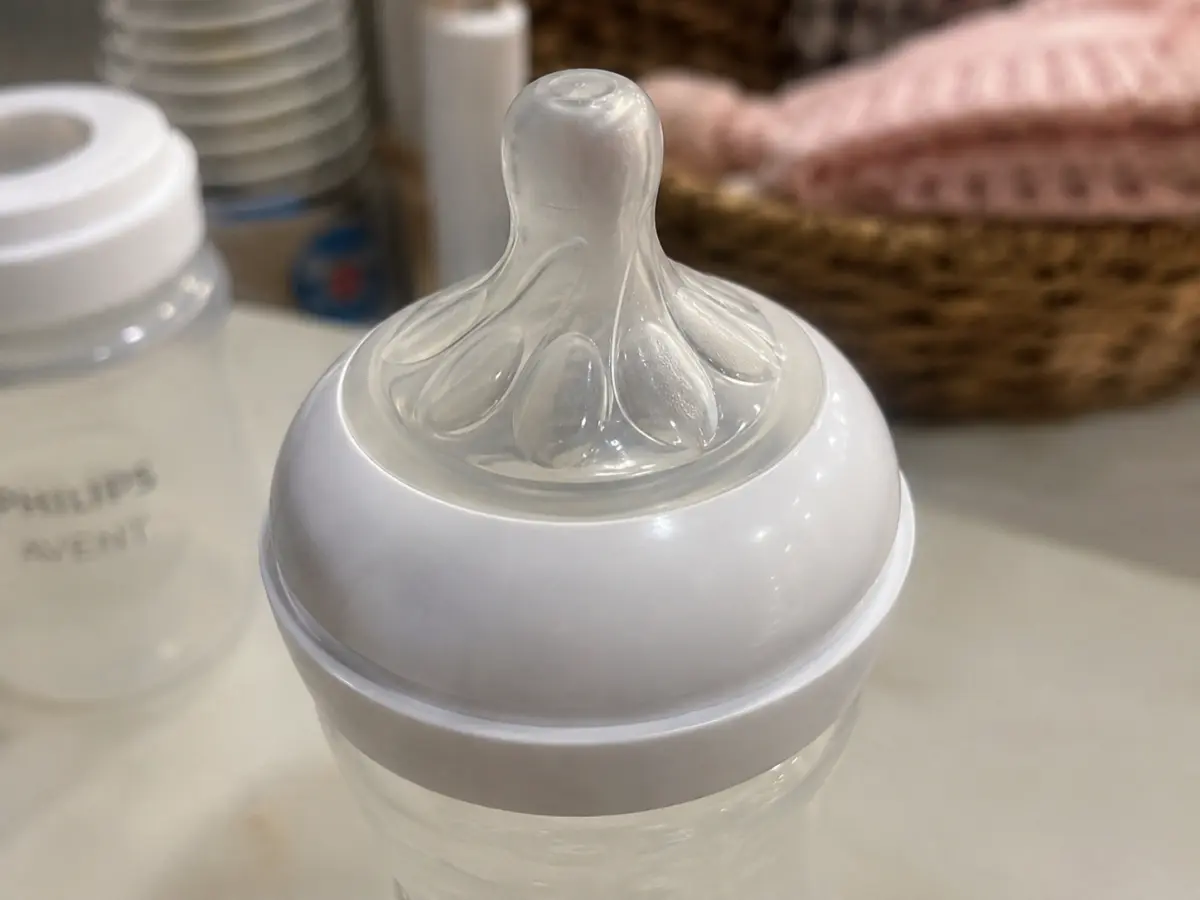
Most bottle nipples drip. Tip one upside down and milk comes out on its own, which means a baby who is pausing to breathe or swallow is still getting milk arriving. The Natural Response nipple is built the other way round. It has a slit that opens under active sucking and closes when the baby stops, so milk comes out when she draws it out and not before.
What that changes in practice is the rhythm of a feed. She sets the pace, she can stop without milk pooling in her mouth, and the sucking, swallowing and breathing stay in her control rather than being driven by gravity. That is also why it is the nipple people reach for when a breastfed baby is starting bottles, since the pattern is closer to what she already knows.
Two honest caveats. Some babies take to it on the first feed and others need a handful of feeds to work out that they have to do the work now, so do not judge it on one attempt. And flow number matters a great deal here. Too slow and she will fight it and tire out, too fast and you have lost the reason you bought it. Go by her age and how she is actually feeding, not by what the box suggests. For the newborn weeks, the 4 oz slow flow version with the same nipple, the one we used before 3 months, is ranked in the best baby bottles for newborns.
What borosilicate glass buys you
Glass gets talked about mainly as a plastic-avoidance thing, and that is a fair reason on its own, but the day-to-day case for it is duller and more convincing. It is about what the bottle looks and smells like six months in.
Plastic bottles pick up a milk smell. They stain, they go cloudy in the dishwasher, and they scuff, and every one of those scuffs is somewhere residue can sit that a brush does not properly reach. Glass has a hard non-porous surface, so there is nothing to absorb into and nothing to scratch, and a bottle that looks clean is actually clean. Ours get washed constantly and still read as new, with no milk smell and nothing stained into them.
The borosilicate part specifically is about heat. It handles sudden temperature change better than ordinary glass does, which is what makes repeated boiling and steam sterilizing a non-event, and the methods and times for that are in how to sterilize baby bottles. It is still glass, so it will still break if you drop it on tile, and a chipped bottle goes in the bin rather than back in the rotation.
The anti-colic valve, and what it does not do
The bottle has an integrated valve in the nipple that lets air into the bottle as milk leaves it, so the air goes into the bottle instead of into your baby. Less swallowed air during a feed is a reasonable thing to want, and it is a mechanical claim we are comfortable repeating.
What we will not tell you is that it fixes colic, and neither should anyone else. Colic has several possible causes, most of which have nothing to do with a bottle, and it is squarely a conversation for your pediatrician. We take that question apart properly, and rank the vented bottles we feed with, in anti-colic baby bottles: do they actually work. If your baby is genuinely struggling with feeding-related discomfort, ask them, and treat any bottle marketing on the subject as marketing.
The wide neck earns its keep at the sink
This is the least exciting feature and the one you will notice most, because you are going to wash this bottle several times a day for a year. A wide opening means a bottle brush gets to the bottom and the shoulders without you fighting it, powder goes in without a funnel, and the whole thing dries properly instead of trapping water in a narrow neck.
It also assembles into very few parts. Bottle, nipple, screw ring, cap. Fewer pieces to lose, fewer seams for milk to hide in, and a faster turnaround at the end of a long day. If you are also choosing a warmer to go with it, the wide-neck shape is worth checking against the warmer’s chamber before you buy, and we go through that fit question in how to choose a baby bottle warmer.
Glass against plastic, plainly
| What you notice | Borosilicate glass | Typical plastic bottle |
|---|---|---|
| Milk smell after months | Does not hold it | Tends to pick it up |
| Staining and cloudiness | Stays clear | Common, especially in the dishwasher |
| Scratches inside | Very resistant | Scuffs over time, and residue sits in the scuffs |
| Repeated sterilizing | Handles it indefinitely | Degrades gradually |
| Weight in the hand | Noticeably heavier | Light |
| If it hits the floor | Can break, chipped bottles get binned | Bounces |
| Life span | Can outlast more than one baby | Usually replaced |
None of that has been a problem for us, and the weight in particular has not been the drawback we expected. These are comfortable to hold and the shape helps. But we would still say the honest split is glass at home and plastic for the days out, where a dropped bottle on a tiled cafe floor is a real possibility. If your baby is at the stage of holding her own bottle and testing what happens when she lets go, that is a reason to keep something plastic in the rotation for a while. The longer version of that argument, and where each material actually wins, is in glass vs plastic baby bottles.
Other glass bottles people ask about
We get asked about Dr. Brown’s, Thyseed, Tommee Tippee, Lansinoh and Evenflo glass bottles in the same breath as this one. We have since fed with the Dr. Brown’s Options+ wide-neck glass bottle and the Thyseed anti-colic glass bottle, and both are ranked against this one in our roundup of the best glass bottles for breastfed babies. We also feed with the Tommee Tippee Natural Start, which is the cheaper glass bottle and the one whose lids turn it into fridge storage and later a cup: our Tommee Tippee Natural Start glass bottle review has the full picture, and we put the two directly head to head in Philips Avent vs Tommee Tippee glass bottles. The short version is that Dr. Brown’s is the one with the internal vent system and Thyseed vents through the base. We have not used Lansinoh or Evenflo, so we will not tell you how they feed. Lansinoh’s pitch is its nipple shape for breastfed babies and Evenflo is the plain, inexpensive glass bottle. If one of those sounds closer to your problem, go and find someone who has actually used it.
What we like
- Natural Response nipple only releases milk when your baby is actively drinking, so she paces the feed
- Glass has stayed clear and unscratched, with no milk smell and nothing stained into it
- Wide neck makes it quick to fill, brush out and dry properly
- Only four parts to assemble, so there is little to lose and little to scrub
- Rated by Philips Avent for dishwasher, steam, UV and boiling sterilizing
What we don't
- Heavier than plastic, which is worth thinking about once your baby holds the bottle herself
- It is glass, so it can break, and a chipped bottle has to be thrown out
- Costs more than a plastic bottle of the same size
- Some babies need a few feeds to adjust to a nipple that does not drip on its own
- Not the bottle you want in a diaper bag for a day out
Who it is for
Buy this one if you want a bottle that stays hygienic and looks it after months of daily use, if you sterilize often and are tired of watching plastic go cloudy, or if you are moving a breastfed baby onto bottles and want the feed to stay at her pace. It is also the sensible buy if you expect to use bottles for a long stretch or for more than one child, because it is the sort of thing that survives that.
Skip it if you want the lightest possible bottle for travel, if your baby has just started holding her own bottle and dropping it, or if a pediatrician has pointed you at a specific vented system for a feeding problem. In that last case follow their recommendation over any review.
For where bottles sit against everything else you are being told to buy, our realistic baby registry checklist has the short list of what earns its place, and the bottle warmers we have used covers what to warm it in. If you are wondering whether you need a warmer at all, we went through that in bottle warmer vs microwave.
The bottom line
The Philips Avent Natural Response glass bottle gets 4.8 out of 5 from us because it does the two things a bottle is judged on over a year, and it does both well. It stays properly clean and looks it, and it feeds at your baby’s pace instead of gravity’s. The weight and the price and the fact that glass breaks are all true, and none of them changed our minds. It is the bottle we reach for at home, and if you are shopping for glass bottles it is an easy one to recommend.
Frequently asked questions
Is the Philips Avent Natural Response glass bottle any good?
In our use, yes. We rate it 4.8 out of 5. The glass has stayed clear and free of milk smells and stains, the wide neck makes it quick to clean properly, and the Natural Response nipple has a natural enough feel that our baby moved between breastfeeding and bottles without a fight. The trade-offs are the ones glass always brings: it weighs more than a plastic bottle, it costs more, and it can break if it lands on tile.
Is borosilicate glass safe for baby bottles?
Borosilicate is the same glass family used in lab and cookware because it tolerates heat and sudden temperature change better than ordinary soda-lime glass. Philips Avent specifies it for this bottle and rates it for steam, boiling and dishwasher cleaning. Follow the care instructions that ship with the bottle rather than any blog, including this one, and stop using any glass bottle that has a chip or a crack in it.
Does the Natural Response nipple actually slow the feed down?
That is what it is built to do. Milk is released when your baby actively sucks and stops when they pause, rather than dripping continuously the way a standard nipple does. In practice that means a feed happens at your baby's pace instead of the bottle's. Some babies take to it on the first feed and some need a few tries, and the right flow number depends on your baby's age and how they feed.
Does the anti-colic valve stop colic?
No bottle can. The integrated valve is designed to let air into the bottle rather than into your baby, which reduces how much air gets swallowed during a feed. That is a mechanical claim about the bottle, not a medical one about your baby. Colic has several possible causes and it is a question for your pediatrician, not a product page.
Is the Philips Avent glass bottle dishwasher safe and sterilizer safe?
Philips Avent rates it for dishwasher cleaning, steam sterilizers, UV sterilizers and boiling water. Borosilicate handles repeated heat cycles without clouding, which is the practical case for glass over plastic if you sterilize often. Always check the current care instructions in the box, since manufacturers do update them.
Is a glass baby bottle better than plastic?
They are better at different things. Glass does not stain, hold milk smells or go cloudy, and it takes repeated sterilizing without degrading. Plastic is much lighter and it does not break when a toddler throws it off the high chair. Most families we know end up with glass at home and plastic in the bag, which is roughly where we landed too.