Small space baby registry: what to register for when there's no room
This post contains affiliate links. If you buy through them, we may earn a small commission at no extra cost to you.Learn more.
Our answer, if you don’t read another word: a small space baby registry follows three rules. Skip the furniture that does one job, pick gear that folds flat or hangs up, and let one item do two jobs wherever you can. In practice that means no changing table, a diaper caddy instead of a changing station, a high chair that folds thin, storage on the back of the door, and fewer appliances on the counter. We set this up in our own small-ish nursery, and these are the choices that held up.
The three rules
Skip single-job furniture. The biggest space savings on a baby registry come from what you leave off, not from clever versions of what you keep. A changing table is the obvious one.
Pick things that fold or hang. Anything that lives on the floor all the time costs you every day. Anything that folds away or hangs on a door only costs you when you are using it.
Let one thing do two jobs. A diaper caddy that moves from room to room is also your changing station. A bottle warmer with a steam function also does occasional sterilizing. A dresser with a changing mat on top is also your changing table.
Skip the changing table
This is the single biggest space decision on the list. A changing table is a large object with exactly one job and a life of two or three years, and in a small nursery it decides where everything else goes. If it means the cot ends up somewhere awkward, that is a high price for a surface.
We skipped it entirely. A changing pad on the bed works fine for us, and at night it is honestly more comfortable. The other route most families take is a dresser you were going to own anyway with a changing mat on top, which gets you the working height and leaves you with a dresser afterwards. We go through the whole question in diaper caddy vs changing table.
Register for a diaper caddy instead
The caddy is the cheap, small half of that decision. It holds about a day of changes in one basket, lives on a shelf, and comes with you to whichever room the baby is in. In a small home that matters, because there is rarely one obvious room for every change.
Ours is the Parker Baby, a structured felt caddy with a divider and outside pockets, and it is the most-used organizer we own. The rest are compared in the best diaper caddy organizers.
A high chair that folds thin
A high chair has two different small-space problems, and it helps to know which one you have.
If the chair has nowhere to go between meals, you want one that folds thin and stands up by itself. Our Primo PopUp folds to about 4 inches thick with one button in around 10 seconds, weighs 10 lb and arrives fully assembled.
If the problem is floor space while the chair is in use, you want one that is small standing up. That is our Graco, which is tiny standing even though it does not fold flat.
The Ingenuity Sun Valley sits between the two: it folds flat and stands on its own, with a 5-point harness, though the build is a step down. All three are compared in the best high chairs for small spaces.
A high chair is not a day-one item, so it can wait until around six months. But if you know your space is tight, it is worth choosing a folding one from the start rather than learning the hard way.
Storage that uses doors and height
A small nursery runs out of floor and shelf long before it runs out of wall and door.
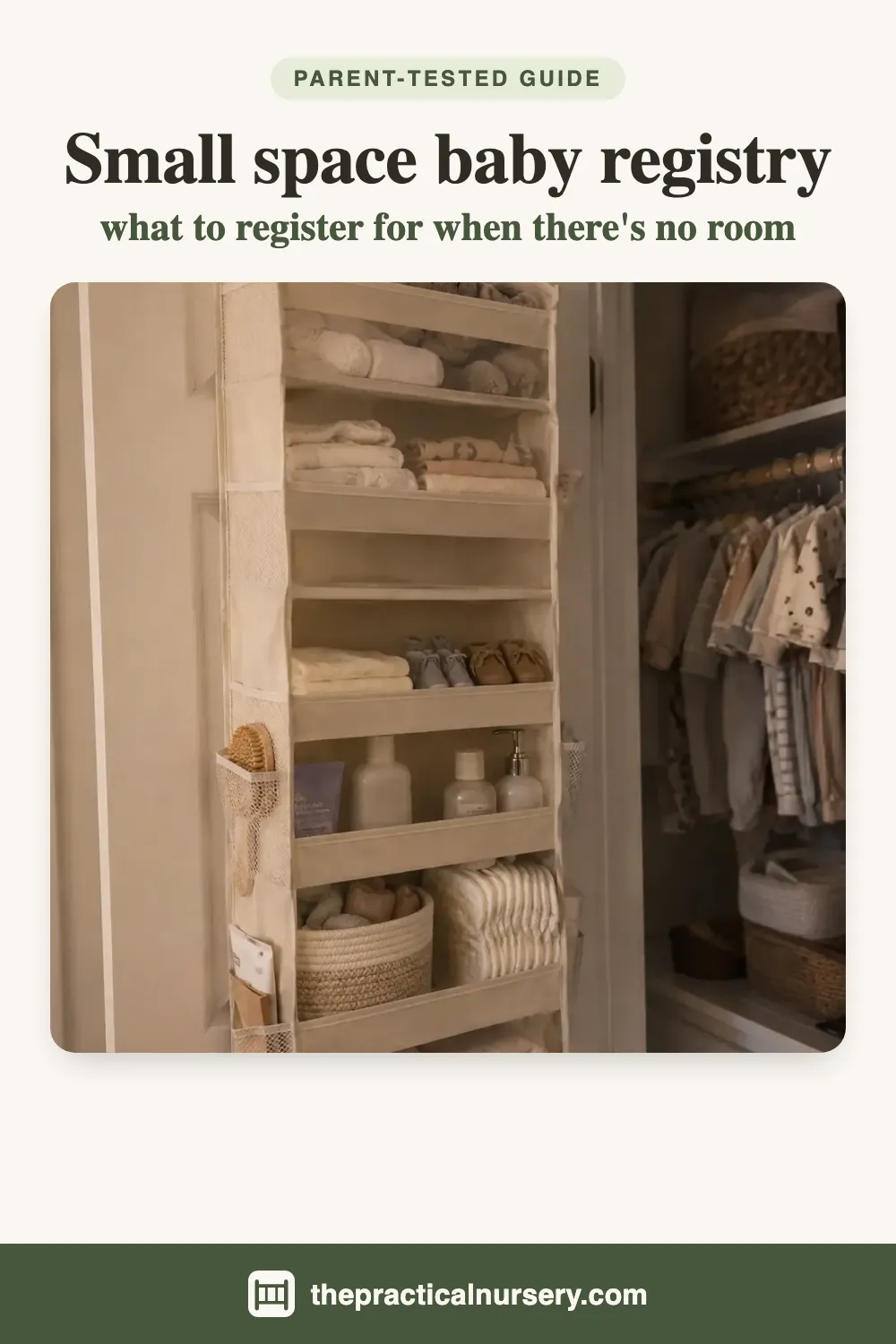
The back of the closet door is the most underused space in most nurseries. An over-the-door organizer hangs on it with no tools and turns it into storage for the things you reach for most.
Size dividers on the closet rod are the other cheap win, because a small closet only works if you can find the right size without pulling everything out. Ours are a seven-piece wooden set covering newborn to 24 months.
On the top shelf, use baskets with a frame, which stay upright when full where plain fabric bins slump. Ours hold out-of-season clothes, towels and toy overflow. All four of the organizers we use are in the best baby closet organizers, and the step-by-step setup is in how to organize a nursery closet.
Fewer appliances on the counter
A small kitchen feels a baby fastest on the counter. Each feeding gadget wants its own spot near a socket.
Check whether you need a sterilizer at all. If your dishwasher has a hot water setting and a heated drying cycle, the CDC says a separate sanitizing step is not necessary, and that saves a whole appliance. Our guide to do you need a bottle sterilizer covers when one earns its counter space.
If you do want a bottle warmer, consider one that does more than warm. Our Momcozy bottle warmer also thaws, heats baby food and steam sterilizes bottles and small parts, so the counter holds one appliance instead of three. We would not buy it as a main sterilizer, because a dedicated one holds more, but as an extra on a warmer you use daily it saves space. Our Momcozy bottle warmer review goes through what it does well and where it is slower.
If you need a full sterilizer and dryer, size matters as much as features. Compact models hold fewer bottles than the box suggests: ours is sold for 8 and fits 6, 7 at most, which is fine for one baby. We compare footprint and capacity in the best bottle sterilizer and dryer.
And keep the bottle count down. Four to six covers most households, and fewer bottles means a smaller drying rack. We explain the numbers in how many baby bottles do you need.
The small space registry at a glance
| Instead of | Register for | Space it saves |
|---|---|---|
| A changing table | A changing pad on a dresser or the bed, plus a diaper caddy | A whole piece of furniture |
| A second changing station | The same caddy, carried to the other room | Another station |
| A full-size high chair | A folding one, like the Primo PopUp | Floor space between meals |
| More shelving | An over-the-door organizer and framed baskets up high | Floor and shelf |
| A sterilizer by default | A dishwasher check first, or a warmer that also steams | A counter appliance |
| A big set of bottles | Four to six, starting with two | Drying rack space |
What we would still not compromise on
A small home is a reason to buy fewer things, not worse ones. A diaper pail is a good example. In a small space you notice smell faster, so a pail that holds smell properly matters more, not less. The Ubbi steel pail is smaller than our Diaper Genie and feels more solidly made, and its steel body does not soak up smell the way plastic does. Our best diaper pail compares the options.
The bottom line
A small space baby registry is mostly about what you leave off. Skip the changing table, register for a caddy, choose a high chair that folds thin, hang storage on the door, and question every appliance before it takes a socket. For the rest of the list, sorted by how sure you can be before the baby arrives, start with our realistic baby registry checklist.
Frequently asked questions
What should I skip on a baby registry if I have a small home?
The changing table first. It is a large piece of furniture with one job and a life of two or three years. A changing pad on a dresser or on the bed, plus a diaper caddy, covers the same ground. After that, skip anything that only does one thing and has to live on the floor or the counter.
What is the best high chair for a small apartment?
One that folds thin and stands up by itself. Ours is the Primo PopUp, which folds to about 4 inches thick in around 10 seconds, weighs 10 lb and arrives assembled. If your problem is floor space while the chair is in use rather than storage, the Graco is tiny standing up.
How do you organize a nursery with no closet space?
Use the back of the door and the space above you. An over-the-door organizer holds diaper packs, wipes and the small things that go missing, with no tools. Stackable baskets with a frame use the height of a shelf without slumping. And a diaper caddy keeps the changing supplies in one portable basket instead of a dedicated station.
Do you need a bottle sterilizer in a small kitchen?
Often not. If your dishwasher has a hot water setting and a heated drying cycle, the CDC says a separate sanitizing step is not necessary. If you do want one, a compact model takes less counter, and a bottle warmer with a steam function can cover occasional sterilizing without a second appliance.