Anti-colic baby bottles: do they actually work?
This post contains affiliate links. If you buy through them, we may earn a small commission at no extra cost to you.Learn more.
Anti-colic baby bottles do work, in the narrow and honest sense that they reduce how much air your baby swallows during a feed. That is a mechanical claim and it is true. Whether that translates into less colic in your baby is a completely different question, it is a medical one, and it is not ours to answer. Of the anti-colic bottles we feed with, the Philips Avent Anti-Colic with the AirFree vent is our first pick at 5 out of 5, the Tommee Tippee Natural Start glass bottle is second at 4.5, and Dr. Brown’s Options+ wide-neck glass takes third at 4.
The honest answer to the question in the title
There are two questions hiding in “do anti-colic bottles work”, and almost every article about them answers the easy one while appearing to answer the hard one.
The easy question is whether the venting does what it says. It does. Air has to enter a bottle as milk leaves it, and without a vent that air arrives through the nipple, which means your baby gets some of it. A vent gives the air another route in. You can watch this happen. Every bottle here does it, they just do it in different places.
The hard question is whether a baby who swallows less air has less colic. That is a medical question about your specific baby. Colic has several possible causes, and gas, fussiness and reflux are symptoms rather than diagnoses. The person to take that to is your pediatrician or the AAP’s guidance, not a review site and not a product page.
So the position we take, and the one we would want a friend to take: buy an anti-colic bottle because the venting is sensible engineering and costs you almost nothing, not because a box promised it would fix your evenings. No bottle cures colic, whoever is making the claim.
The three places a bottle can vent
| Bottle | Vents through | Parts to wash | Material | Our verdict |
|---|---|---|---|---|
| Philips Avent Anti-Colic with AirFree | The nipple, with a one-piece vent that keeps the nipple full of milk | 4 with the vent | BPA-free plastic | Buy: most venting, fewest parts |
| Tommee Tippee Natural Start glass | A vented silicone nipple | 4 | Medical-grade glass | Buy for glass, storage lids and price |
| Dr. Brown's Options+ wide-neck glass | An internal tube carrying air past the milk to the top | 5 with the vent, 4 without | Glass | Buy if swallowed air is the main problem |
More plumbing means more parts on the drying rack, and that trade is most of what separates these three in daily life rather than anything about how they feed. If cleaning time is what you care about, our notes on which parts cause trouble are in how to clean baby bottles properly.
1. Philips Avent Anti-Colic with the AirFree vent
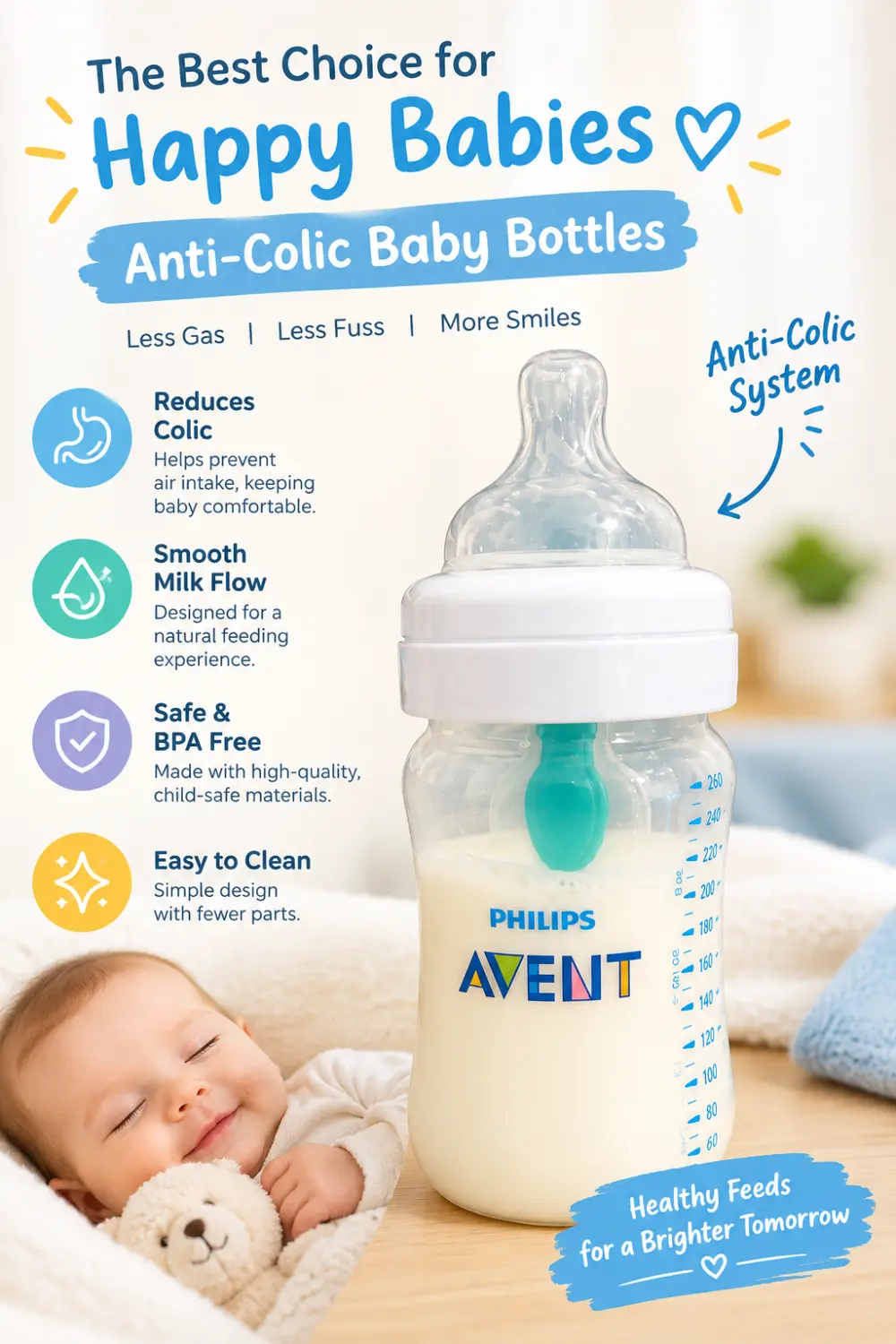
A wide-neck BPA-free plastic bottle with Philips Avent’s anti-colic nipple and a separate one-piece AirFree vent that sits in the neck. Our set is four 9 oz bottles with Flow 2 nipples.
The design idea is worth understanding because it is different from ordinary venting. Most vents manage the air that enters the bottle. The AirFree vent is aimed at the nipple itself: Philips Avent says it keeps the nipple full of milk rather than air, including when the bottle is held horizontal. That horizontal part is the point, because it means you can feed with the bottle level rather than tipped up, which is the position their material connects to reflux and digestion. Those are their claims about the design, not our measurements, and the digestion half of it is exactly the part we would send to a pediatrician rather than adjudicate.
Two things we can speak to plainly. The vent is a single piece, so it adds one part rather than a mechanism, and it needs no special brush. And it is optional: the bottle is designed to work with or without it, so if you decide the venting is no longer the problem you are solving, you take it out and carry on with the same bottles rather than buying a second set.
One caveat before you buy. This set ships with Flow 2 nipples rather than the slowest level, which is fine for the age it is aimed at and is worth knowing if you are buying for a newborn. The slowest newborn bottles we have used are in the best baby bottles for newborns. Nipple levels also do not carry across brands, which we found out the expensive way with Dr. Brown’s.
What we like
- The AirFree vent is one piece, needs no special tool, and adds a part rather than a mechanism
- Works with or without the vent, so the bottles keep earning their place as she grows
- Wide neck fills, takes a scoop flat and cleans with a sponge rather than a brush
- Keeps the nipple full of milk with the bottle held level, which allows a more upright feed
What we don't
- Plastic rather than glass, so it will scuff and cloud eventually where glass would not
- Ships with Flow 2 nipples rather than the slowest level, so check before a newborn feed
- The vent is another small part to find, wash and dry if you choose to use it
This is the one we would hand to someone whose actual problem is swallowed air. It rates 5 out of 5 from us.
2. Tommee Tippee Natural Start glass bottle
The gentlest anti-colic claim of the three, and the most bottle for the money. Tommee Tippee vents through the nipple itself, and describes the silicone as shaped to encourage a natural latch and to reduce air intake. There is no separate vent part, no insert and no tube, which is why it washes like an ordinary bottle.
If you are coming to this article because a box said anti-colic, this is the honest middle of the category: a well-made wide-neck glass bottle with a vented nipple, rather than a dedicated air management system. What it adds instead is everything around the feed. The same glass body takes a sealed storage lid and later a cup ring, so it covers three stages, and it is priced like a normal purchase rather than a premium one.
It sits second because its anti-colic claim is the least specific here, not because it feeds badly. If air is genuinely your problem, the Avent is doing more about it. If you want one glass bottle that does most things well, this is the one. The full write-up is in our Tommee Tippee Natural Start glass bottle review.
What we like
- Glass, so it does not stain, scuff, cloud or hold a milk smell
- Vents through the nipple, so there is no extra part to wash or lose
- Storage lids and cup rings included, covering three stages from one purchase
- Tommee Tippee rates the assembled bottle as leakproof even upside down
What we don't
- The least specific anti-colic system of the three, with no dedicated vent part
- Heavier than plastic, and a chipped bottle has to be thrown away
- Listings count pieces rather than bottles, so a nine-item set is three bottles
3. Dr. Brown’s Anti-Colic Options+ wide-neck glass bottle
The specialist, and the bottle most people picture when they hear anti-colic. Dr. Brown’s runs an internal vent down the inside of the bottle that carries air past the milk to the top, so air goes into the bottle rather than into your baby. Dr. Brown’s describes it as clinically proven to reduce colic and to decrease spit-up, burping and gas. That is their claim about the bottle rather than a diagnosis about your baby, and colic remains a conversation for your pediatrician.
The detail we like most is that the vent comes out. Once swallowed air is no longer a daily problem, you lift the insert out and keep the same bottles, which is a rare thing to be offered.
It finishes third on handling rather than on venting, and that is worth saying clearly because on the anti-colic question specifically it is arguably doing the most of the three. A vented bottle is a bottle with a hole in it by design, so shaking or tipping it puts milk where you did not want it. Add the insert that comes out, gets washed and has to dry at every feed, and you have the most work per feed of anything here.
What we like
- The most thorough venting here, with an internal tube carrying air past the milk
- The maker has clinical backing for its claim about reducing colic symptoms
- The vent lifts out when she outgrows needing it, so the bottles keep working
- Glass, wide neck, and rated for top-rack dishwasher, sterilizers and boiling
What we don't
- Leaks if you shake it or turn it upside down, which is awkward when mixing formula
- The cap is a struggle at both ends of a feed, and worse one-handed
- An extra part to remove, wash and fully dry at every feed, and the one you can lose
- Level 2 ran noticeably faster here than Level 2 on our Avent nipples
The other two anti-colic bottles in our house
Worth naming, because both are anti-colic and neither made this list.
Thyseed vents through a pressure-sensing valve in the base rather than the nipple or the middle, which gives it the shortest wash-up of any bottle we own at three parts. PopYum uses an anti-colic vent that directs air back into the bottle, and is the one we take out of the house because it holds powder and water separately until you press two buttons. Both are ranked against everything else we feed with in best glass bottles for breastfed babies and best baby bottles for formula feeding.
The reason they are a footnote here is that neither is the bottle we would hand someone whose stated problem is air, and that is the only question this article is trying to answer.
What we would skip
Any bottle sold on the promise that it cures colic. Reducing swallowed air is a mechanical claim we are happy to repeat from a maker. Curing colic is not a claim a bottle gets to make.
Paying a premium for anti-colic as a feature in isolation. Almost every bottle on the shelf vents somehow now, so you are rarely choosing between vented and not. You are choosing where the vent lives and how many parts it costs you.
Buying a set of six before your baby has fed from one, which applies to every bottle article we write and applies double here, because anti-colic bottles have the most parts to dislike.
Where we landed
Buy the Philips Avent Anti-Colic with the AirFree vent if swallowed air is the thing you are actually trying to solve and you want the least washing-up for the most venting. Buy the Tommee Tippee Natural Start if you want glass, storage lids and a sensible price, and you are fine with a plain vented nipple. Buy the Dr. Brown’s if you want the most thorough venting available and you will accept the extra part and the leaking as the price of it.
And take the colic question itself to your pediatrician. A bottle can change how much air your baby swallows. Everything past that is medicine, and the honest version of this article ends there.
Frequently asked questions
Do anti-colic bottles actually work?
They do the mechanical thing they are built to do, which is reduce how much air a baby swallows during a feed by venting it into the bottle instead. That part is real and you can see it working. Whether less swallowed air means less colic in your particular baby is a medical question, not a gear question, and colic has several possible causes. That one belongs with your pediatrician. No bottle cures colic, whoever is selling it.
What is the best anti-colic bottle?
Of the ones we feed with, the Philips Avent Anti-Colic with the AirFree vent is our first pick and gets 5 out of 5 from us. It keeps the nipple full of milk rather than air even when the bottle is held level, it is a wide-neck bottle with few parts, and the vent is one piece that cleans without any special tool. The Tommee Tippee Natural Start glass bottle is second at 4.5 and Dr. Brown's Options+ is third at 4, held back by handling rather than by how it vents.
How do anti-colic bottles work?
All of them are solving the same problem in one of three places. Some vent through the nipple, so air goes back into the bottle as milk leaves it. Some vent through a valve in the base. Dr. Brown's runs an internal tube down the middle that carries air past the milk to the top. More plumbing generally means more parts to wash, and that trade is most of what separates these bottles in daily use.
Does the Philips Avent AirFree vent make a difference?
Its stated job is to keep the nipple full of milk rather than air, including when the bottle is held horizontal, which is what allows a more upright feeding position. That is Philips Avent's description of the design rather than our measurement. What we can say is that it is a single piece, it comes out entirely if you decide you do not want it, and the bottle works either way.
Do you need an anti-colic bottle for a newborn?
Not automatically, and this is worth resisting the marketing on. Most bottles sold today have some form of venting, so you are rarely choosing between anti-colic and not. If your baby is genuinely struggling with gas, fussiness or reflux, the person to ask is your pediatrician, because those are symptoms with several possible causes and a bottle is only one of the things that could be involved.
Are anti-colic bottles harder to clean?
Usually yes, because venting means extra parts. The Avent AirFree vent is one piece that needs no special tool, and it lifts out entirely if you stop wanting it. Dr. Brown's uses an insert that has to come out, be washed and be fully dry at every feed, which is the most work of the three here. Count the parts before you buy, since that is what actually decides how long the sink takes.
Which nipple flow do anti-colic bottles come with?
It varies, and it is worth checking before a newborn's first feed rather than assuming. The Avent anti-colic set we have ships with Flow 2 nipples rather than the slowest level, and Dr. Brown's wide-neck glass comes with a Level 1. Nipple levels are also not interchangeable across brands, which we learned the hard way. What flow suits your baby is a question for your pediatrician.