Bottle feeding registry checklist: what to register for, and how many
This post contains affiliate links. If you buy through them, we may earn a small commission at no extra cost to you.Learn more.
Our answer, if you don’t read another word: a bottle feeding registry checklist is shorter than the store versions suggest. Register for two bottles to try, a way to clean and dry them, and plenty of burp cloths. Wait on the warmer, the sterilizer and the full bottle set until you know how feeding is going, because those are the items that depend most on your baby. We feed with eight different bottles, and the lesson we took from buying too many is to buy less, and later.
One note on scope. This is a gear list. How much, how often and what to feed are questions for your pediatrician. For cleaning and sanitizing we follow the CDC’s guidance on infant feeding items, and we link to it wherever it applies.
The checklist
| Item | How many | Register now or wait |
|---|---|---|
| Bottles | Two to try, then four to six | Two now, the rest once your baby takes to them |
| Spare nipples | A spare pack for the bottle you settle on | Once you know which bottle works |
| Bottle brush or sponge | One, plus something small for nipples | Now |
| Drying rack | One with room for small parts | Now |
| Burp cloths | More than feels reasonable | Now |
| Bottle warmer | One | Wait until bottles are a big part of your day |
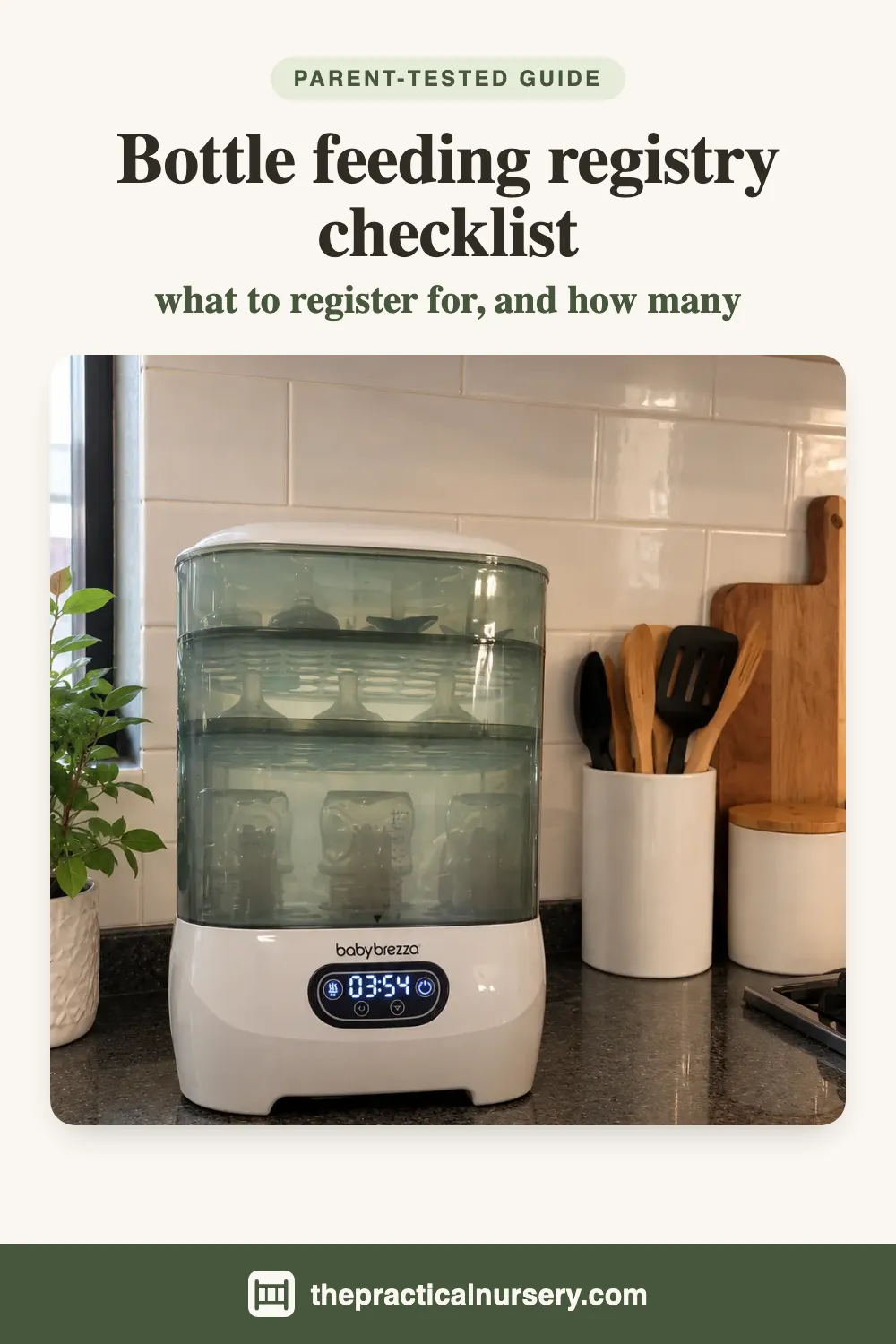
| Sterilizer and dryer | One | Only if you pump, bottle feed every feed or have two babies |
| Portable warmer | One | Wait until you know you feed bottles out of the house |
| Formula bottles or dispenser | As needed | Only if you formula feed |
The rest of this page explains each line.
Bottles: register for two, not twelve
The nipple is the only part of a bottle your baby has an opinion about, and it is the part you cannot return once the pack is open. A registry full of one brand is a bet placed before you have any information. Put one or two of a bottle on the list, feed with them for a few days, then buy the rest.
Four to six bottles in rotation covered a day of feeds for us without anyone running the dishwasher at midnight. Daycare usually raises the number, and pumping into storage bags usually lowers it. Our how many baby bottles do you need guide does the arithmetic for each case.
On size, you probably only need the bigger one. A larger bottle holds a small feed perfectly well, and most lines share nipples and rings across sizes. Ours are 8 and 9 oz bodies, used from about three months after small newborn bottles.
On which bottle, a wide neck is the feature we would look for first, because it fills easily, takes a formula scoop flat and cleans with a sponge. Seven of our eight bottles are wide. We explain the difference in wide-neck vs narrow-neck baby bottles, and compare all eight in the best baby bottles.
If you have not decided between glass and plastic, plan on some of each. Ours split between glass on the counter and plastic in the diaper bag, because the two jobs are different. That case is in glass vs plastic baby bottles.
Cleaning and drying: the unglamorous half
Every bottle you register for has to be washed and dried several times a day. This is the part of bottle feeding that catches people out.
A bottle brush or sponge. A wide neck lets a sponge clean the body, but nipples still need something that gets inside them, and any vent part needs its own attention. Register for a brush with a small nipple cleaner, or a sponge plus a separate small brush.
A drying rack. The CDC asks you to air dry rather than towel dry, which means a washed bottle is not an available bottle for a while. Wide-neck bottles hold water and vent parts hold it where you cannot see. Pick a rack with space for small parts, so they are not nested on top of each other.
Our how to clean baby bottles guide goes through the CDC’s steps with real bottles, including what a dishwasher does and does not cover.
Burp cloths: more than you think
This is the item almost everyone under-registers. Burp cloths double as spit-up rags, changing-pad covers and emergency bibs, and they all end up in the wash at once.
We registered for about 7 or 8 and still ended up with all of them dirty at once. If your baby spits up a lot, as ours does, register for well past that. It is one of the few items on this list where too many is not a real risk.
Sterilizer: only for some families
A sterilizer is the most expensive item people put on a bottle feeding registry without needing it.
It earns its counter space if you pump, bottle feed every feed or have more than one baby. A breast pump adds valves, membranes and flanges to every load, and a machine that sanitizes and dries a full load at once saves real time. That is why we bought ours once our second baby arrived.
You can skip it if your dishwasher has a hot water setting and a heated drying cycle, because the CDC says a separate sanitizing step is not then necessary. You can also skip it if you give the occasional bottle, since a pan of boiling water costs nothing. The CDC does advise sanitizing at least daily for babies under 2 months, born prematurely or with a weakened immune system, so check with your pediatrician, and our do you need a bottle sterilizer guide covers the rest.
If you need one, our ranking is in the best bottle sterilizer and dryer.
Bottle warmer: wait and see
A warmer earns its place once bottles are a big part of your routine, and we use one every day. But plenty of babies take room-temperature milk, and you will not know which kind you have until you meet them.
Until then, a jug of hot water does the job. We compare the two honestly in bottle warmer vs hot water. If a warmer does turn out to be worth it, we compare the ones we use in the best baby bottle warmers.
A portable warmer is a separate decision for families who feed bottles out of the house, and it can wait until you know you need one. Our guide to warming a bottle on the go covers the options.
If you formula feed
Two things change. Neck width matters more, because a formula scoop goes into a wide neck flat and into a narrow one at an angle, leaving powder on the rim. And a bottle that seals properly for shaking saves a lot of mess. Our best baby bottles for formula feeding ranks the three we mix in, with the leakproof Tommee Tippee glass first. A formula dispenser is useful for the diaper bag if you feed out of the house.
What we would leave off
A full set of one bottle before you have tried it.
A sterilizer, unless one of the reasons above applies to you.
Bottle gadgets that solve a problem you do not have yet. Wait for the problem.
The bottom line
A bottle feeding registry checklist works best when it is short. Two bottles to try, a brush, a drying rack and a pile of burp cloths go on now. The warmer, the sterilizer and the rest of the bottles wait until your baby has told you what they need. For the full registry beyond feeding, start with our realistic baby registry checklist.
Frequently asked questions
How many bottles should I put on my baby registry?
Two to start, then four to six once you know your baby takes to them. The nipple is the only part your baby has an opinion about, and you cannot return an opened pack, so registering for a full set before you have tried one is a gamble. Four to six covered a day of feeds for us without anyone running the dishwasher at midnight.
Do I need a bottle sterilizer on my registry?
Only if you will pump, bottle feed every feed or have more than one baby. If your dishwasher has a hot water setting and a heated drying cycle, the CDC says a separate sanitizing step is not necessary. The CDC does advise sanitizing at least daily for babies under 2 months, born prematurely or with a weakened immune system, and boiling water is one of the methods it lists.
Should I register for a bottle warmer?
We would wait. A warmer is useful once bottles are a big part of your routine, and we use one daily, but plenty of babies take room-temperature milk. Find out how feeding goes first, then decide. A jug of hot water does the job in the meantime.
What bottle feeding items are easy to forget on a registry?
A bottle brush or sponge that reaches inside nipples, a drying rack with space for small parts, and more burp cloths than feels reasonable. Drying is the step people do not plan for, and it is why a house with technically enough bottles still runs short.